Insolvency Oracle

Developments in UK insolvency by Michelle Butler


2 Comments

New Rules, Part 15: Decisions, Decisions!

img_0659-close

More than one IP has asked me: ok, I know the New Rules pretty-much remove creditors’ meetings, but what’s all the fuss about? It gets me every time! Not only are the changes far more widespread than this, but also this change is hardly simple. It sounds simple though, doesn’t it: just replace all creditors’ resolutions with some kind of postal vote?

From what I believe was a desire to provide options – to creditors mainly, but also to directors and IPs – has evolved a web of overlapping timescales and feedback mechanisms, not to mention reams more information to creditors, which cannot fail to bamboozle and further dissuade them from engaging.


Decision 1: what type of decision do you have?

The SBEEA15 introduced the idea of two tiers of decisions (by the way, in our new world, there are few resolutions anymore, just decisions… although some decisions are made by resolution, if considered at a meeting, whether physical or virtual). There are decisions that can be made by Deemed Consent and others that must be made by a Qualifying Decision Procedure (although the New Rules drop the “Qualifying” bit). In the latter category are:

  • any “decision about the remuneration of any person” (S246ZE(2)); and
  • the acceptance of IVA and CVA Proposals.

So what decisions might be dealt with by Deemed Consent? The biggie is the appointment of a CVL Liquidator (you might also have thought about the appointment of an IP in court cases, but this involves first the removal of the incumbent OR – aha, now the reason for the change so that the OR becomes Trustee immediately on the order becomes clear, doesn’t it..?). Other Deemed Consent decisions could include several ADM items, e.g. extensions, discharge and even the Proposals themselves. But other than these, Deemed Consent is unlikely to get out much.

I think the Insolvency Service saw Deemed Consent being useful to office holders in seeking creditors’ approval to certain strategies, e.g. to commence litigation. I agree that this is a possibility, however the abolition of the statutory requirement to seek sanction to exercise many old Schedule powers has meant that more often than not IPs feel empowered to take such decisions in the interests of creditors in any event.


Decision 2: should you use Deemed Consent?

The key point to note about Deemed Consent is that, unless more than 10% in value of creditors (entitled to vote) positively object to the decision, then it is approved as proposed. If this proportion of creditors objects, then the IP has another bite of the cherry by proposing the decision by one of the other decision processes (excluding a physical meeting unless the proposed decision is for your CVL appointment).

There is a wrinkle: creditors who meet different criteria can respond by asking for a physical meeting, rather than (or in addition to) objecting to the decision proposed by Deemed Consent. If this happens, then the Insolvency Service has stated that the Deemed Consent process is superseded and the decision must be considered at a physical meeting. Personally, I have failed to spot where this consequence is set out in the rules, so I have asked the Service for clarification.

The thresholds for seeking a physical meeting are either 10% in value of creditors, 10% in number, or 10 creditors (the “10/10/10” criteria). (UPDATE 23/03/17: recently-issued Amendment Rules affect this, although their application is unclear.  I have blogged a question on the Insolvency Service’s blog.) This time, the criteria relate to all creditors, not just those entitled to vote. Thus it seems to me more than just a theoretic possibility that a creditor/s might reach the threshold to seek a physical meeting but fall short of the threshold to object to a Deemed Consent decision… hence the need, I believe, for the rules to be clear on the consequences of a request for a physical meeting.  (UPDATE 02/05/2017: the Insolvency Service has blogged: “The intention here is that the creditors that have an interest in the decision being taken are the ones who determine whether the costs of holding a physical meeting should be incurred. Therefore the convener would consider the value of the potential vote of the creditor(s) making the request, and compare them to the total value of the potential vote.”  Got that? 😉 )

Whilst there are potential complications, I think the Deemed Consent advantages are clear, especially where you need to seek approval from uninterested creditors, e.g. the ADM extension and discharge questions (although if you need secured creditors’ approval, silence from the unsecureds is only half the battle won).

What if you are seeking a CVL appointment, should you go for Deemed Consent? Well, one downside is that you will need to add on another decision procedure if you want to get your fees, including your pre-appointment fee, approved. However, if another IP starts showing an interest, they will first have to object to the Deemed Consent process before the scene is re-set to count votes on nominations. Granted however, it may mean that you’re looking at an unexpected Centrebind.

Another strange characteristic of seeking a CVL appointment by Deemed Consent is that, if unopposed, there is no statutory requirement for any pre-appointment Gazette notice – how odd is that?!


Decision 3: which other Decision Procedure might you use?

How else might you seek a decision? In the order that I think they will be used, the methods are:

  • vote by correspondence (no longer a “meeting” by correspondence and not defined in the rules);
  • virtual meeting (yes, cumbersome and in some respects risky, but the only way effectively to negotiate decisions);
  • electronic voting (hmm… maybe not for some time yet);
  • only if sufficient creditors request it, a physical meeting;
  • and A N Other process that none of us has yet thought up.

Virtual meetings are prepared for pretty-much as physical meetings are now: they require Gazetting and they involve proxy forms, which can be delivered anytime up to the start of the meeting in any case, no longer just for VA meetings. Proofs of debt also need to be delivered and, although there is a deadline of 4pm the business day before the meeting, there is also provision for the chair to accept late proofs, if he is “content”.

Of course, the obvious difference is finding an appropriate virtual meeting resource. From those who I know have been exploring this, I understand that there is no clear winner. Issues include: being able to identify attendees, especially when they join and leave, and being able to block access to people not entitled to attend. The main risk in holding a virtual meeting is that an “excluded person” (i.e. someone who tried to participate but could not through no fault of their own; say, they just happen to live in an area of the UK with unreliable broadband connections) can influence the decision after the meeting (assuming you did not decide to adjourn it). They are given a very short window of opportunity to complain that, had they participated, they would have swung the vote, but this is clearly not an uncertainty you want to be left with after a decision on your appointment or on a VA Proposal. There is also the practical uncertainty in knowing how many people are likely to want to join in to a virtual meeting: multi-party conference calls are exasperating at the best of times and the prospects of being surprised by a virtual room full of fired-up creditors doesn’t bear thinking about.

So should you go for a correspondence vote? Well, if you’re looking for a CVL appointment, it’s worth clocking now that this is not an option: Deemed Consent and virtual meeting are your only options. It is also worth remembering that the deadline for correspondence votes (and other non-meeting processes, including Deemed Consent) is one minute to midnight on your chosen day (the “Decision Date”), so we will have to get used to not knowing the outcome of a proposed decision until the day after… which could prove challenging if you’re trying to coordinate it alongside a members’ meeting. Correspondence votes need to be supported by proofs of debt submitted by the Decision Date and importantly, once a vote has been lodged, it cannot be changed. This makes correspondence vote a risky choice for VA Proposals, I think. I also wonder where correspondence votes will get us on fee approvals: if there is no negotiating possible, then will it result in an increase in court applications?

As with Deemed Consent, on receiving an invitation to a virtual meeting or to vote by another means, a creditor may react by asking for a physical meeting. They have 5 business days after delivery of the notice of the decision procedure in which to have delivered a request (but see Timetables below) and the 10/10/10 thresholds apply.

There is also no ability to ask creditors for a deposit as security for the costs of convening a physical meeting on request… unless it is a requisitioned decision (yes, there is a difference!). The latter may arise for example as a consequence of issuing Para 52 Proposals, although the rules allow you only to ask for the costs of seeking a “decision”, not a physical meeting… however it is not clear whether creditors could ask explicitly for a physical meeting at this stage (that’s another question to the Insolvency Service).  (UPDATE 02/05/2017: the Insolvency Service has blogged that they think it is reasonable to interpret the rules as allowing the creditor to request a physical meeting at the same time as requisitioning a decision, although they have also confirmed that the deposit sought should only be for requesting a decision, not holding a physical meeting.)


Invitations to Form a Committee

In all cases (except, strangely, in Compulsory Liquidations unless the meeting is to appoint a liquidator), whenever a Deemed Consent or decision procedure notice is issued, creditors must be asked at the same time whether they wish to establish a Committee and to propose nominations. This requirement sits unhappily besides the other rules, especially the Deemed Consent process. For starters, how do you ask creditors “whether” they want something? You must propose it as a decision, e.g. I propose the decision that a Committee be established. But if you were to propose this as a Deemed Consent decision and received no objections, this would mean that the decision had been made and you would need to canvass for (more) nominations, thus postponing your original objective until the sorry “no we didn’t mean we wanted a Committee, we simply don’t care” response was made certain. Therefore, several have designed the proposed decision in the negative: I propose the decision that a Committee should not be established (which personally I think also sits better ethically where the IP does not believe a Committee is warranted: is it honest and straightforward for an IP to propose a decision he does not himself desire?). In this case, creditors’ silence works well.

But is it truly necessary to go through this rigmarole every time you propose a decision? Yes, it seems so. And of course we will need to highlight the SIP15 Committee Guidance… however I am puzzled by the SIP15 reference to highlighting it prior to inviting creditors for nominations: does this mean that we need to write to creditors separately before our first proposed decision? For once, this is not a question for the Insolvency Service!


Timetables

In most cases, notice of a decision – by Deemed Consent or other process – must be at least 14 days (plus delivery time). CVL appointment is the obvious exception: in this case, notice must be 3 business days after delivery, which including a weekend makes it very slightly shorter than the current requirement. Because of the short timescale in CVL appointments, requests for a physical meeting can be made at any time up to the Decision Date.  (UPDATE 02/05/2017: oops!  Sorry, the rules set the deadline as between the notice and the Decision Date and Dear IP 76 suggests that the Decision Date is not included in this period.  See https://goo.gl/ygnWjg for more analysis.)


There’s more

The rules contain prescriptive details about the content of notices and how to deal with “excluded persons”. In addition, the interaction of Deemed Consent/decision procedures with other requirements such as the need to send a Statement of Affairs before the CVL appointment Decision Date adds another layer of complexity to the work.

If you want to know more:

  • on the detail of decision processes especially in the context of CVL appointments, then access Jo Harris’ webinar, “New Rules: Decision Procedures and Changes on CVL Appointments” (mailto:info@thecompliancealliance.co.uk for details);
  • on the pros, cons and strategies of decision processes, then join me at the R3 breakfast seminar, The New Rules for Insolvency Work-Winners (16 March in London), or any of the three R3 SPG Technical Reviews (28 March in London, 6 June in Huddersfield, 4 July in Bristol)… and there are more Compliance Alliance webinars to come on these topics;

… or feel free to get in touch with me… but don’t expect many simple answers!


Leave a comment

The 2015 Fees Rules: One Year On

img_0091close

In November last year, I gave a presentation at the R3 SPG Forum: a look back at one year under the new fees regime. Although I don’t have the benefit of my co-presenter, Maxine Reid, I thought I would set out some of my main points here, as well as some new and improved observations on Administrators’ Proposals:

  • Do more recent Proposals indicate a move away from time costs?
  • How are creditors voting now?
  • How do time costs incurred compare to fees estimates?
  • Are progress reports and excess fee requests compliant with the rules and SIP9?
  • Is the picture any clearer now on what the regulators’ expectations are on some of the finer points of the rules and SIP9?

Is there a move away from time costs?

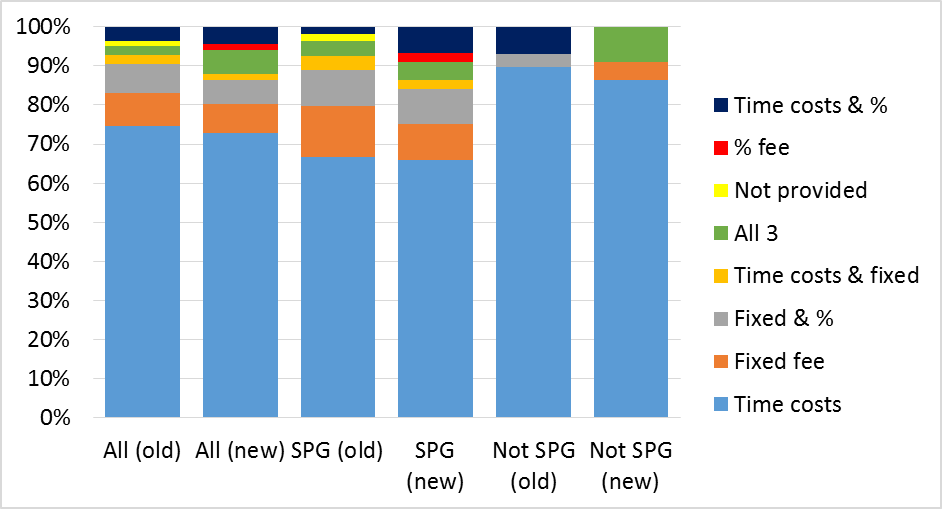
My analysis of Proposals issued in early 2016 (https://goo.gl/bvebTz) showed that time costs was still the preferred choice: 75% of my sample (108 Proposals) had proposed fees based on time costs.

To see whether things had changed more recently, I reviewed another 67 Proposals issued between July and September 2016 (no more than two from each insolvency practice). This is how the fee bases proposed compared:

feebasis2

This suggests that not a lot has changed, which isn’t too surprising I guess as there are only a few months’ difference between the two sets of Proposals. I also suspect that, if I looked at CVLs, I’d see quite a different picture. There does seem to be a bit more experimenting going on though, especially involving percentage fees, which is a topic I’ll come back to later.

How are creditors voting?

The filing of progress reports on my early Administration sample enabled me to fill in the gaps regarding how secured creditors and committees had voted on fees:

feecaps

Although I accept that my sample is small, I think that this is interesting: the average reduction in fees approved is the same whether the decision was made by unsecured or secured creditors. I’d better explain the committee percentage: in these cases, the committees were approving fees only on the basis of time costs incurred, not on the estimated future time costs, which is also interesting: it isn’t what the fees rules envisaged, but I think it is how most committees are accustomed to vote on fees.

Have creditors’ decisions changed more recently?

As I only have the Results of Meeting to go on for the more recent cases, this is not a complete picture, but this is how the two samples compare:

  • Jan-Mar 2016 (67 Results of Meeting):
    • 11 modified; 1 rejected
    • 7 early liquidations; 4 independent Liquidators
    • 1 Administrator replaced
    • 6 fees modified (average reduction 29%)
  • Jul-Sept 2016 (55 Results of Meeting):
    • 5 modified
    • 2 early liquidations; no new IPs
    • 1 fee modified (reduction 48%)

Again, it’s only a small sample, but it seems to me that creditors’ enthusiasm to modify Proposals or cap fees has waned, although c.10% of Proposals were still modified, which is fairly substantial.

How have actual time costs compared to fees estimates?

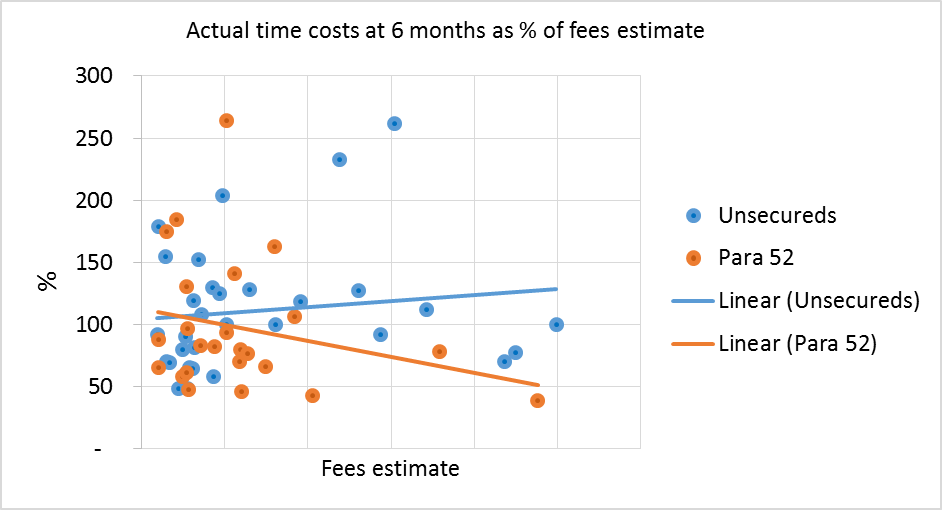
With the filing of 6-monthly progress reports, I was able to compare time costs incurred with the fees estimates:

timecosts

Over the whole case sample, the mean average was 105%, i.e. after only 6 months of the Administration, on average time costs were 105% of the fees estimate included in the Proposals. This graph also shows that, on a couple of cases, the time costs incurred at 6 months were over 250% of the fees estimate, although to be fair a large number were somewhere between 50% and 100%, which is where I’d expect it to be given that Administration work tends to be front-loaded.

You can see that I’ve distinguished above between cases where unsecured creditors voted on the fees and the “para 52” cases where the secured (and possibly preferential) creditors voted. The graph appears to indicate that time costs exceeding the estimate is more marked in cases where unsecured creditors approve fees.

Of course, fees estimates and fees drawn are entirely different worlds, so the fact that time costs have exceeded estimates will be of no practical consequence – at least, not to creditors – where a case has insufficient assets to support the work. In around only half of the cases where time costs exceeded estimates did the progress report disclose that the Administrator was, or would be, seeking approval to excess fees. This suggests that in the other half of all cases the IPs were prepared to do the work necessary without being paid for it, which I think is a message that many insolvency onlookers (and the Insolvency Service) don’t fully appreciate.

How compliant are progress reports and excess fee requests?

Firstly, I think it’s worth summarising what the Oct-15 Rules and the revised SIP9 require when it comes to progress reports. The Rules require:

  • A statement setting out whether:
    • The remuneration anticipated to be charged is likely to exceed the fees estimate (or additional approval)
    • The expenses incurred or anticipated to be incurred are likely to exceed, or having exceeded, the details given to creditors
    • The reasons for that excess

SIP9 requires:

  • Information sufficient to help creditors in understanding “what was done, why it was done, and how much it costs”
  • “The actual costs of the work, including any expenses incurred, as against any estimate provided”
  • “The actual hours and average rate (or rates) of the costs charged for each part should be provided for comparison purposes”
  • “Figures for both the period being reported upon and on a cumulative basis”

It is clear from the above that the old-style time costs breakdown alone will not be sufficient. For one thing, some automatically-produced old-style breakdowns do not provide the average charge-out rate per work category. I also think that simply including a copy of the original fee estimate “for comparison purposes” falls short as well, especially where the fees estimate uses different categories or descriptions from the time costs breakdown.

What is required is some narrative to explain where more work was necessary than originally anticipated. The best examples I saw listed each work category (or at least those categories for which the time costs incurred exceeded the fees estimate) and gave case-specific explanations, such as that it had proven difficult to get the company records from the IT providers or that the initial investigations had revealed some questionable transactions that required further exploration.

I also saw some useful and clear tables comparing the fee estimates and actual time costs per work category. As mentioned above, in some cases, the progress reports were accompanied by a request for additional fees and in these cases the comparison tables also factored in the future anticipated time costs and there was some clear narrative that distinguished between work done and future work.

Reporting on expenses to meet the above requirements proved to be a challenge for some. Admittedly, the Rules are not ideal as they require fees estimates to provide “details of expenses” likely to be incurred and some IPs had interpreted this to require a description only of who would charge the expense and why, but it is only when you read the progress report requirements that you get the sense that the anticipated quantum of expenses was expected. For example, where an Administrators’ Proposals had stated simply that solicitors’ costs on a time costs basis were likely, it is not easy to produce a progress report that compares this with the actual costs or that states whether the actual expense had exceeded the details given previously.

What do the regulators expect?

A year ago, the regulators seemed sympathetic to IPs grappling with the new Rules and SIP9. Do they consider that a year is sufficient for us all to have worked out how to do it?

I get the sense that there may still be some forbearance when it comes to complying with every detail of the SIP, but understandably if there is a fundamental flaw in the way fees approval has been sought, it is not something on which the RPBs can – or indeed should – be light touch. Fees is Fees and the sooner we know our errors, the less disastrous it will be for us to fix them.

The S98 Fees Estimate question seems to have crystallised. There seems to be general consensus now amongst the regulators and their monitoring teams that, whilst there are risks in relying on a fees resolution passed at the S98 meeting on the basis of fees-related documentation issued prior to appointment as a liquidator, the regulators will not treat such a fees resolution as invalid on this basis alone. Fortunately, the 2016 Rules will settle this debate once and for all.

The trouble with percentage fees

From my conversations with a few monitors and from the ICAEW Roadshow last year, I get the feeling that the monitors are generally comfortable with time cost resolutions. There is a logical science behind time costs as well as often voluminous paper-trails, so the monitors feel relatively well-equipped to review them and express a view on their reasonableness. The same cannot always be said about fees based on a percentage – or indeed on a fixed sum – basis.

In her 2013 report, Professor Kempson expressed some doubts on the practicalities of percentage fees, observing that creditors could find it difficult to judge the reasonableness of a proposed percentage fee. When the Insolvency Service’s fees consultation was issued in 2014, R3 also remarked that fixed or percentage fees were not always compatible with unpredictable insolvencies and could result in unfair outcomes. The recent shift towards percentage fees, which appears more pronounced in CVLs, has put these concerns into the spot-light.

In the ICAEW Roadshow, Allison Broad expressed her concerns about fees proposed on the basis of (often quite substantial) percentages of unknown or undisclosed assets. I can see Allison’s point: how can creditors make “an informed judgment about the reasonableness of an office holder’s request” if they have no information?

Evidently, some IPs are proposing percentage fees as a kind of mopping-up strategy, so that they do not have to go to the expense of seeking creditors’ approval to fees later when they do have more information and they feel that creditors can take comfort in knowing that the IPs will not be drawing 100% of these later-materialised assets. Although a desire to avoid unnecessary costs is commendable, the message seems to be that compliance with SIP9 requires you to revert to creditors for fee-approval only when you can explain more clearly what work you intend to do and what financial benefit may be generated for creditors, e.g. what are the assets that you are pursuing or investigating.

Another difficulty with percentage fees is the quantum at which they are sometimes pitched. I have heard some stories of extraordinary percentages proposed, although I do wonder if, taken in context, some of these are justifiable, e.g. where the percentage is to cover the statutory work as well as asset realisations. Regardless of this, the message seems to be that some of us could improve on meeting SIP9’s requirement “to explain why the basis requested is expected to produce a fair and reasonable reflection of the work that the office holder anticipates will be undertaken”… and you should not be lulled into a false sense of security that 15% of everything, which of course is what the OR can now draw with no justification (and indeed with no creditor approval), is always fair and reasonable.

Looking on the bright side

Although getting to grips with the Oct-15 Rules has not been easy, I guess we should count our blessings: at least we have had this past year to adapt to them before the whole world changes again. If there’s one thing we don’t want to get wrong, it is fee-approval, so at least we can face the April Rules changes feeling mildly confident that we have that one area sorted.

If you would like to hear and see more on this topic (including some names of Administration cases that I found had particularly good progress reports and excess fee requests registered at Companies House), I have recorded an updated version of my R3 SPG Forum presentation, which is now available for Compliance Alliance subscribers. For more information, email info@thecompliancealliance.co.uk.


Leave a comment

Part 18: Reporting and Remuneration

imgp2967

Finally, I’ve reached the end of the crazy-busy season and I can get back to the New Rules. This post deals with Part 18 of the Rules: Reporting and Remuneration.

I’m very pleased to see that the Insolvency Service has taken the opportunity to iron out some of the overly prescriptive, clunky and vague rules.   For example:

  • Fixing the prescriptive: stripping back on the loooong list of final report contents
  • Fixing the clunky: new approaches to the ADM-to-CVL conversion process and to reporting for changes in office holder or ADM extensions
  • Fixing the vague: settling the debates on issuing a fees estimate before being appointed as liquidator and on the process of seeking preferential creditors’ approval to fees in Para 52(1)(b) Administrations

Other changes have slipped in too, mainly as a consequence of the more material changes affecting other areas of practice, such as the abolition of final meetings.

For a step-by-step guide to Part 18, including many rules that I have not touched on in this post, I would recommend Jo Harris’ webinar, available now through The Compliance Alliance – contact info@thecompliancealliance.co.uk.


Part 18: Scope

Part 18 is one of the now “common” parts. I think it does help to bring together the procedures that are common to all cases… but it’s not quite this simple. Part 18 covers reporting and remuneration for Administrations, all Liquidations and Bankruptcies. It does not deal with VA reporting. Neither does it deal will all the closing reporting requirements – bits of these appear in the case-specific parts. Ho hum.

One key point to remember is that for the most part the changes apply across the board, so we need to be ready to report and seek rem under the New Rules from the off.

The exceptions are, as previously mentioned, progress reporting on the old pre-2010 appointments and any progress reports that fall due before 6 April 2017. But for everything else – including closure processes on all cases – the New Rules apply.


Contents of Progress Reports

There are some pesky little changes in here. One intriguing change is that, no longer must we detail “assets that remain to be realised”, but instead we need to detail “what remains to be done” (R18.3(1)(h)). I know that we usually do provide a one-liner on this, but isn’t it charming for the Insolvency Service to make it a statutory requirement..?

R18.3(6) accommodates the significant change in the process of an ADM moving to CVL. It’s good to see the Insolvency Service have yet another go at getting this process working smoothly. In my mind, the New Rules improve the process… although I still don’t see why we need to rely on the Registrar of Companies (“RoC”) to tell us when the ADM ends and the CVL starts. Regrettably, though, the trigger for the move has been set down in the Act, so the New Rules simply try to make the best of this awkward situation.

R3.60 sets out the new ADM-to-CVL process. The Administrator submits the Notice of the Move together with their final report to the RoC and copies the pack to creditors etc. Once the Notice is registered, the former Administrator informs the Liquidator of “anything which happens after the date of the final progress report and before the registration of the notice which the administrator would have included in the final report had it happened before the date of the report” (R3.60(5)).

Consequently, within the Liquidator’s first progress report, they must include “a note of any information received by the liquidator from the former administrator” (R18.3(6)).

This process sounds a bit odd when you remember that usually the Administrator is the Liquidator – will the RPBs expect the file to contain a “note to self”..? I think we get the idea though and at least the new process avoids the uncomfortable position of completing and issuing a final Administration report after having vacated office.


Timing of Progress Reports

In principle, nothing has changed on timing. However, again a couple of welcome simplifications in other areas will affect reporting complications with which we have all become familiar under the current Rules.

In future, the 6/12-monthly reporting routine will not be affected by the following events:

  • A change in office holder: under the New Rules, incoming office holders are required to deliver a notice to members/creditors (depending on the case type) “of any matters about which the succeeding (office holder) thinks the members/creditors should be informed” (Rs18.6(3), 18.7(4), 18.8(3)). This removes the need for a formal progress report to draw a line under the change, so the original progress reporting routine remains unaffected. The New Rules are vague on what triggers this requirement, but in my view it is likely to mean that nothing is required if the office holder changes but the practice does not.
  • Extension of an Administration: under the New Rules, a progress report is no longer required in order to seek approval of an extension. The New Rules simply require the Administrator to send, along with the court application or the notice requesting creditors’ consent, “the reasons why the administrator is seeking an extension” (R3.54(2)).

This is all good stuff, thanks Insolvency Service.

These changes do leave me with a question, though: what if you are already dealing with a case with an altered reporting schedule, i.e. an extended ADM or a case involving a change in office holder where the court was not asked to over-ride the current rules’ effect of changing the reporting timeline? After 6 April 2017, will you need to revert to the pre-extension/office holder-change schedule or will you continue to produce 6/12-monthly reports from the date of the last pre-April report? I have heard rumours that the Insolvency Service’s intention is the latter, but personally I think that the wording of the New Rules would require such cases to revert to the old schedule.   That’s another question for the Insolvency Service’s blog, I reckon.

(UPDATE 17/01/2017: the Insolvency Service responded to my query on their blog: “It was not the intention that where a reporting cycle in any relevant process had already been reset, it would need to be changed again as a result of the commencement of the new rules. As you have suggested, we had identified that a transitional provision would make it clear that this should not happen, and we are looking to see whether and how we can insert such a provision into Schedule 2 of the new rules.”)

(UPDATE 23/03/2017: the Insolvency Service has indeed introduced a fix via the recently-issued Amendment Rules.  This fixes the position for changes in office holder such that, if you have an existing case with an amended reporting schedule due to a pre-6/4/17 change in office holder, then after 6/4/17 you continue to report according to your amended schedule.  The position is a little less satisfactory for already-extended ADMs: whilst it seems that the Insolvency Service has attempted to apply the same principle to these cases, I am not convinced that the Amendment Rules wording delivers this effect… although casparjblog has suggested a possible wriggle-through – see the Insolvency Service’s blog at https://goo.gl/IE0pmK.)

(UPDATE 02/05/2017: in Dear IP 76, the Insolvency Service expresses the view that the Amendment Rule is “sufficiently clear” that the reporting schedule for an already-extended ADM should continue, rather than be re-set to the original schedule.)


Contents of “Final Accounts” and “Final Reports”

The abolition of final meetings in Liquidations and Bankruptcies necessitates a change in the final reporting processes. The new processes can be found at:

  • Rs5.9 and 5.10 for MVLs;
  • R6.28 for CVLs;
  • R7.71 for Compulsory Liquidations; and
  • R10.87 for Bankruptcies.

I won’t cover them here, but suffice to say that creditors (and/or members/bankrupt) are provided with a final account (or, in Bankruptcies, a final report) 8 weeks before the office holder obtains their release.

The contents of these final accounts/reports are found in R18.14. Delightfully, the Insolvency Service has decided to lighten up on the miserable prescription that had been introduced by the 2010 Rules (e.g. no more statements of the aggregate numbers of preferential and unsecured creditors or that accounts have been reconciled with those held by the SoS) – thank you again!

In case you’re wondering about Administrations, R3.53 contains details of some of the contents of an ADM final progress report… but because, in Administrations, the final document is called a final progress report, the Part 18 rules on the contents of progress reports also apply to Administration final progress reports (plus an additional requirement slipped in to R18.3(2)).


Remuneration: Circulating Fees Estimates

The biggest change in the remuneration chapters is something very welcome: finally, we can stop debating whether it is possible for an IP to issue a fees estimate (and/or other fees-related information) before they are appointed as Liquidator. R18.16(10) states that “a proposed liquidator” may deliver the information. Excellent!

Of course, the New Rules will transform the whole S98 process beyond recognition – this is a huge topic for another blog post entirely.


Remuneration Niggles

Yes, I know I can be pedantic. If you have visited the Insolvency Service’s blog, you will have seen my query on R18.18(3), which could be read as requiring every Administrator’s fees to be agreed by creditors by a “decision procedure”, which would have had unexpected consequences for Para 52(1)(b) ADMs with only secured creditors in the frame. Thankfully, the Service is on the case and hopefully this will be fixed before April.  (UPDATE 23/03/2017: the recently-issued Amendment Rules have fixed this issue so that Para 52(1)(b) case fees are subject to approval only by secureds/prefs.)

Another niggle of mine is that the wording of the time costs basis has been changed – again. I think it passed by many of us that the 2015 Rules changed the time costs basis from “the time properly given… in attending to matters arising in the administration/winding up/bankruptcy” to “the time properly given… in attending to matters arising in the administration/winding up/bankruptcy as set out in the fees estimate”. Those words in italics have been removed for the New Rules – so if you were diligent enough to change the wording of your standard resolutions last year, unfortunately you’ll have to put them back to the way they were pre-2015.


Preferential Creditors’ Approval

The New Rules resolve another long-running debate: how were we to read the current R2.106(5A)(b)(ii), which sets out that Administrators who have made a Para 52(1)(b) statement and who have made or intend to make a distribution to preferential creditors need to seek the approval to fees of “preferential creditors whose debts amount to more than 50% of the preferential debts of the company, disregarding debts of any creditor who does not respond to an invitation to give or withhold approval”. The question has always been: what happens if no preferential creditor votes, does this mean that you have approval?

R18.18(4) eliminates all doubt. It states that in future Administrators will need to seek preferential creditors’ approval (on relevant cases) “in a decision procedure”. This is a New Rules-defined term, which I will not go into here (again, this is another blog post entirely), but it does mean without a doubt that there will need to be at least one positive vote to reach a decision.

A second long-running question on the current R2.106(5A)(b)(ii) has also been: what if you have paid preferential creditors’ claims in full, do you still need to ask these creditors to approve your fees?

This conundrum is solved by Rs15.11 and 15.31(1)(a), which indicate that in these circumstances only preferential creditors who have not been paid in full are circulated and that, if there’s no claim left, the creditor has no vote. These two rules are specific to creditors voting in decision procedures in Administrations though, so they won’t help you in any other cases (including, I assume, where secured creditors are being asked to approve fees in Administrations).


As mentioned earlier, there are many more rules in Part 18 that are essential-reading, but if you prefer to hear about them, drop an email to info@thecompliancealliance.co.uk and ask about Jo’s webinar.


2 Comments

The New Rules: Part 1… of many

0501-santa-fe

We’ve all heard overviews of the new Rules by now, but time is short – less than 5 months to go – and so it’s about time that we started delving into the nitty gritty.


Starting at the start

It would be wrong to assume that, with the exception of the SBEE changes that everyone has already talked about, the new Rules are simply the old rules in a different order. I thought that starting with the introductory Rules and definitions would be straightforward and frankly dull, but the new Rules are peppered with unexpected intricacies that make such assumptions dangerous.


New Rules, new approach to transitional provisions

No doubt you have heard that the new Rules are a departure from the tradition of leaving old cases to run out under the old rules. This has some advantages: no longer will we need to think twice about the date of an appointment before deciding how to approach a statutory matter, nor will we need to maintain old checklists, diaries and templates to cope with a variety of aged cases. Eliminating this complication should mean that we could run all cases, present and future, on one system… but is that true…?


If you don’t want the confusion, clear away pre-2010 CVLs (and MVLs)

The transitional provisions (Schedule 2 of the new Rules) refer specifically to cases commencing (i.e. orders in the case of bankruptcies (“BKYs”) and compulsory liquidations (“WUCs”)) before 6 April 2010:

  • BKYs & WUCs: this is the easy bit – the new Rules’ provisions on progress reports do not apply
  • CVLs: “a progress meeting required by section 104A of the Act” continues and “R4.223-CVL as it had effect immediately before 6 April 2010 continues to apply”
  • No specific reference to MVLs – did the Insolvency Service assume that all pre-2010 MVLs would be closed?

In pretty-much all other respects, the new Rules apply to these old cases.

What is “a progress meeting”?! Search all you like in the current Act and Rules, you won’t find one. And what is the relevance of S104A to meetings? S104A was the method used to replace the old S105 annual meetings by progress reports.

I think that the Insolvency Service planned for annual meetings to continue on old CVLs, as well as the old six-monthly R&Ps, which had been required under the old R4.223… but I accept that this takes a bit of a stretch of the imagination. Perhaps we will receive some clarity before April.

(UPDATE 23/03/17: the recently-issued Amendment Rules have changed the references to “progress meeting” and S104A so that it now refers to “meetings required by sections 93 and 105 of the Act”.  Therefore, it seems to me that annual meetings on pre-04/2010 MVLs and CVLs should continue to be convened after 04/2017.)


Perhaps also avoid calling a meeting to be held after 6 April 2017

Schedule 2 also includes transitional and savings provisions to enable meetings called before the Rules’ commencement date to be held after that date and for all the usual items resolved upon in meetings, e.g. fixing the basis of fees, to be decided. In a similar way, the old rules will apply also where an invitation to vote on a resolution by correspondence was issued prior to 6 April 2017 but where the deadline for voting falls afterward.

The Schedule includes potential catch-all references, e.g. “governance of the meeting”, stating that “the 1986 Rules relating to the following continue to apply”. Presumably, this will also cover matters such as adjournments.

It is not clear to me whether these transitional provisions will also work where a draft final report has been issued but where, say, R4.126(1D) kicks in after 6 April 2017. That is, what should happen where you have not complied with R4.49D, e.g. because something unexpected has occurred in the 8-week period? Should you follow old R4.126(1D) and issue a revised draft final report and fresh notice of a final meeting under the old rules? It looks like it to me, but I would prefer to avoid straddling the April date with any meeting convened under the old rules.


Other transitionals

Schedule 2 contains many other transitional and savings provisions, including:

  • old rules apply where any progress report became due pre-6 April 2017 but where it has not been issued by that date;
  • conversions from Administration (“ADM”) to CVL started under the old rules generally continue; and
  • all statements of affairs due on pre-6 April 2017 cases continued to be expected under the old rules.


(UPDATE 23/03/2017: the recently-issued Amendment Rules have resolved the issues explored in these next two sections.)

How long is one month?

The mind-bending Schedule 5, “Calculation of Time Periods”, also appears in Part 1 of the Rules.

It starts sensibly enough: “days” are calculated according to the CPR (there is no definition of “weeks” in the Rules).

There are two ways of calculating “months”, depending on whether the date specified is the start date (e.g. the time period within which a progress report should be issued or the progress report review period) or the end date. As I’m struggling to think of any specified end dates involving months, let’s look at a scenario where the start date is specified:

  1. the month in which the period ends is the specified number of months after the month in which it begins, and
  2. the date in the month on which the period ends is:
    • the date corresponding to the date in the month on which it begins, or
    • if there is no such date in the month in which it ends, the last day of that month.

If I’m reading this correctly, then one month from 10 April is 10 May – one month and one day.


Reporting transactions on a period-end date

Let’s say that you received some money on 10 April 2017 on a CVL that began on 10 April 2016. How would this be reported in your progress reports?

  • The review period of your first progress report would be 10 April 2016 to 10 April 2017, so you would report it.
  • The review period of your second progress report would be 10 April 2017 to 10 April 2018… err… so you would report it..?!

This cannot be right, can it?! It would skew all your R&Ps, as the c/f and b/f figures would not tally. In the same way, your time cost breakdowns would be confusing if you incurred any time costs on the threshold day.

What I’m struggling with is why the Insolvency Service has seen fit to redefine the length of a month: what was wrong with the way us mortals measure time?

(UPDATE 17/01/2017: the Insolvency Service responded to my query on their blog: “We have taken legal advice on this matter and will be looking at whether and how we can clarify the definition of a period expressed in months in Schedule 5 so that there is no day which occurs in two different reporting cycles.”  Phew!)

(UPDATE 23/03/2017: the recently-released Amendment Rules have fixed this – no more time-shifting: a month is a month long again.)


So what is the deadline for sending out progress reports?

Let’s take an ADM with a period end date of 10 April 2017. You have “one month after the end of the period” in which to deliver a progress report. Setting aside whether “after” starts the day after – which would add another day to your timescale – let’s assume that this period ends on 10 May 2017.

Ah, but there’s a catch. The report must be “delivered”, not “sent”, by this date. The new Rules define “delivery” as follows:

  • 1st class post is “treated as delivered on the 2nd business day after the day on which it is posted”; and
  • 2nd class post is “treated as delivered on the 4th business day after the day on which it is posted”.

Therefore, you need to factor the delivery times into your statutory timescale. If you left it until 9 May 2017 to put the progress reports in the post, you would be too late. When the new Rules refer to “deliver”, in fact they are referring to the time that the document is deemed to be received by the recipient.


So will every statutory deadline need to factor in the time to deliver the document?

Unfortunately, it is not that simple. For example, the new Rule on issuing progress reports in CVLs – R18.7 – sets the 2-month deadline with reference to the sending of the report, not its delivery. “Send” is not defined in the new Rules.  (UPDATE 23/03/17: the Amendment Rules have changed this “send” to “deliver”, so that all filing deadlines are now consistent.)

However, notwithstanding this inconsistency (I thought that making the rules consistent was one of the main objectives behind the new Rules!), you could do worse than factor time periods to deliver documents into your processes. At least that way you should always meet the deadlines (and you would avoid any debate over semantics -v- the perceived “spirit” of the Rules with your regulator).


Opting out

In her November Technical Update https://goo.gl/XBTAFV, Jo Harris summarised the new Rules under which creditors can send to office holders a notice asking to be excluded from most future standard circulars. This provision – along with the wider website use described below – are two significant changes introduced by the Small Business, Enterprise & Employment Act 2015 that appear in Part 1 of the Rules.

I won’t go into detail on these points, but I will just add to Jo’s observations:

  • Ensuring that you provide information on opting out in your “first communication with a creditor” could take some managing. You will need to make sure you include this when you first communicate with newly-discovered creditors. The new Rules are also silent on how this applies to a successor office holder.
  • As Jo mentions, you will need to designate opted-out creditors differently on your system, but also ensure that they are included in the exempted circulars, such as “notices of intended distribution” (R1.37)… or should that be “notices of proposed dividend” (R1.39)… or perhaps even “notices of intention to declare a dividend” (R14.29)!
  • If you are taking on a consecutive insolvency proceeding, you will need to ask the predecessor for a list of opted-out creditors, as you must exclude them from the defined circulars.

Personally, I don’t expect many creditors to opt out – after all, if they are not engaged enough to be interested in future updates, then are they likely to be sufficiently engaged to sign and return an opting-out notice? However, this new section will add yet another page (no really – the prescribed contents do go on a bit) of information to first circulars, which we will need to take care to get right.


Wider website use

Finally, this is something in the new Rules that put a smile on my face! Again as Jo explained in her Update, under the new Rules office holders will be able to issue to creditors just one notice explaining that future communications will only be uploaded to a website, rather than issue such a notice every time a communication is uploaded as is currently the case.

I have heard some unrest about this provision. Many feel that it will simply help to distant creditors even further from the process. I agree, it will. However, I do not feel that this is sufficient reason to avoid taking advantage of this provision. The Insolvency Service seems to have been charged with the aims of increasing engagement and reducing costs – two aims that are clearly in opposition to one another, as demonstrated also by the new Rules’ abolition of office holder-convened physical meetings – but I wonder how much engagement really is achieved by progress reports that are necessarily unwieldy in order to comply with the plethora of SIPs and statutory requirements. On the other hand, I think that the new provision allowing for website use alone most certainly will reduce costs.


Part 1: just the beginning

As I hope I’ve demonstrated, there are plenty of revisions in Part 1 of the new Rules that will require some thoughtful planning… and that generate more than the odd furrowed brow. I am looking forward to posing a few questions on the Insolvency Service’s forum, which we expect to be launched in the next few weeks.

If you would like to listen to my webinar that explores this Part in more depth and that will be available in the next few days, please drop a line to info@thecompliancealliance.co.uk.

The second webinar in this series, which will review the new Rules on Reporting and Remuneration, will be presented by Jo Harris in a few weeks’ time.


1 Comment

2017: it’s not all about the Rules

0223-portraitmorocco

A watched kettle never boils, so I’ll stop watching for the new Rules to land – having missed their “aim” of w/c 10/10/16, the Insolvency Service is now claiming that it was always their “plan” to have them issued this month – and instead I’ll shift my focus to what other delights the next year may bring.


A Review of the Bonding Regime

What do you think? Is the bonding regime fit for purpose? Does it really work as an effective protection?

The Government has issued a Call for Evidence to explore the weaknesses and reform possibilities of the bonding regime. The opportunity for submissions closes on 16 December 2016 and the Insolvency Service’s document can be found at: https://goo.gl/wiKc0K.

The document notes that the Insolvency Service has “seen evidence where the costs claimed by an insolvency practitioner in proving a bond claim are disproportionate to the loss suffered by the insolvent estate”, whilst the specific penalty bond premiums have increased for smaller firms by 200% in one year. No wonder there are questions over whether bonding is achieving its objective.

The Call for Evidence explores questions (albeit worded differently) such as:

  • Would a system similar to the legal profession’s arrangements for dealing with fraud and dishonesty work for insolvency?
  • Could a solution be a “claims management protocol” incorporating a panel of IPs to deal with bond claims and ways to limit cost?
  • Alternatively, perhaps the bonding regime should be abolished altogether?


Complaints-handling by the RPBs

In September, the Insolvency Service released a summary of its review into the RPBs’ complaints-handling processes.

The Service reported that “the introduction of Common Sanctions Guidance has improved transparency in decision-making but there is scope to ensure more consistency in the application of the guidance”. The Service’s answer is to work with the RPBs to make changes to the guidance.

Three other main recommendations emerged from the review:

 1.  The RPBs should ensure that information is sought from the IP, e.g. “if the complainant has not provided or is unable to provide evidence to support their complaint”, unless there is a justified reason not to do so (whatever that looks like).

The report explains that “the most common reasons for closing a complaint at the assessment stage are the complainant’s failure to respond to further enquiries or their inability to provide evidence to support their complaint”. The Service also reports that “the review identified that some cases had been closed which appeared to merit further investigation”. Thus, the Service is recommending that RPBs look to the IPs for the information and evidence.

The Service seems to be expecting the RPBs to conduct thorough investigations on receipt of nothing more than unsupported suspicions raised by parties who then go to ground as soon as they’re asked to explain or substantiate their allegations. The Service also seems to take no account of the costs to IPs in responding to RPB requests, which of course are not recoverable from the insolvent estates irrespective of whether the complaint is founded. Isn’t it about time that the Service stopped labouring onto IPs more and more expensive burdens whilst simultaneously pursuing the agenda that IPs’ fees need to be curbed?

2.  The RPBs should consider with the Service the feasibility of a regulatory mechanism whereby compensation can be paid by the IP to the complainant where they have suffered inconvenience, loss, or distress.

The Service is recommending this measure “to ensure fair treatment for complainants”, given that some RPBs (but see below) have a compensation mechanism, but others do not. But how often do the RPBs order compensation? This information is conspicuous by its absence from the report.

From the report, it seems that the ACCA is the only RPB with a formal compensation mechanism. In view of the fact that the ACCA is handing over its complaints-handling to the IPA with effect from 1 January 2017, surely the simplest way to make things “fair” to all complainants is to have no compensation mechanism, isn’t it?

I also do not understand the Service’s logic in arguing that compensation should be offered “where minor errors or mistakes have been made”, whilst accepting that “any such mechanism would not be a substitute for any legal remedies available to individual complainants through the Courts”. Next thing we know the Service will be expecting the RPBs to decide whether fees are excessive on fairly straightforward cases, whilst accepting that decisions on really meaty fees should remain with the courts. Oh hang on a minute…

Unfortunately, the IPA is making it easy for the Service to push its agenda: the report mentions that the IPA intends to introduce a formal conciliation process in any event (which is news to me, as I suspect it is to most IPA members).

3.  RPBs experiencing particular issues progressing complaints cases should discuss their plans with the Service.

I think this is directed mainly at the ACCA, which has come in for some heavy criticism, as reported in the Insolvency Service’s monitoring reports over the last couple of years. Now that the ACCA has announced its “collaboration” with the IPA, which will investigate and decide on complaints levelled at ACCA licensed IPs (as well as conduct their monitoring visits), perhaps the Service already will be happy to tick that box.

To read the full report, go to: https://goo.gl/radZpS.


Action on Anti-Money Laundering

This subject really deserves a blog post of its own. The prospects for change are coming from all directions.

“Consent” SARs no more

Actually, this happened in July, but I’ve not seen it covered elsewhere, so I thought I would shoe-horn it in here. Although the Proceeds of Crime Act 2002 refers to “consent”, the NCA has issued guidance clarifying that it will no longer be granting consent, but rather a “defence to a money laundering offence”.

The NCA has taken this step to counteract the “frequent misinterpretation of the effect of ‘consent’ (e.g. assuming that it results in permission to proceed, or is a statement that the money is ‘clean’ or that the NCA condoned the activity going ahead)”.

To request a “defence”, however, you will still need to tick the “consent requested” box on the SAR submission.

For a useful reminder on the purpose and process of consent/defence SARs, including the kinds of responses you might get back from the NCA, go to https://goo.gl/c8tJzk.

Allowing “joint” SARs and other proposals

In April, the Government (via HM Treasury) issued an “Action Plan”, representing “the most significant change to our anti-money laundering and terrorist finance regime in over a decade”, and the Government sought views on the proposed actions.

Amongst other things, the Government was proposing to reform SARs, given the enormous resource demand of c.400,000 SARs submitted each year. The proposals included doing away with the SARs consent/defence process altogether, which alarmed me considerably, but I was relieved to see that the Law Society and others (including R3, although I have to say that they were not as forceful as the LawSoc) urged the Government to reconsider.

The Government’s response on the consultation was issued earlier this month at https://goo.gl/pzezpx and the conclusions are reflected in the Criminal Finances Bill, which is now making its way through Parliament.

I can only see the proposed changes affecting IPs in exceptional cases, but in brief they include:

  • some changes to the SARs regime including empowering the NCA to obtain further information from SARs reporters, but the consent process will continue at least for the moment (“the Government will keep this issue under review”);
  • “establishing a new information sharing gateway for the exchange of data on suspicions… between private sector firms with immunity from civil liability” – I am interested to discover how this will be constructed, although the Government response does include reference to…
  • enabling “joint” SARs to be submitted, which I’m sure will be good news to all IPs who have been conscious of multiple SARs being submitted on cases involving external joint office holders and legal advisers;
  • introducing Unexplained Wealth Orders;
  • strengthening powers to seize and forfeit criminal proceeds in bank accounts or “portable high value items” such as gold.

The Fourth Money Laundering Directive

I understand that Brexit is unlikely to halt the progress of the EU’s Fourth Money Laundering Directive in the UK, which is set to be transposed into national law by 26 June 2017.

In September, HM Treasury issued a consultation on how the Directive should be implemented. The consultation document can be found at https://goo.gl/5AdhQd and it closes on 10 November 2016.

Items with the potential to affect IPs include:

  • a reduction in the threshold for cash or “occasional” transactions from €15,000 to €10,000;
  • changes in the criteria triggering simplified and enhanced due diligence;
  • a potential widening of the scope of those whose AML due diligence may be relied upon (which I find interesting given that the RPBs seem to recommend avoiding reliance);
  • potential prescription surrounding requirements for certain businesses to appoint compliance officers, to conduct employee screening, and to carry out independent audits;
  • a requirement to retain AML due diligence records for 10 years (up from 5 years); and
  • a requirement for certain Supervisors (i.e. the RPBs and others) to “take necessary measures to prevent criminals convicted in relevant areas or their associates from holding a management function in, or being the beneficial owners of” AML-regulated businesses (which, personally, I think is extremely unfair – for example, is it fair to curtail someone’s career because of what their father has done?). Although the consultation refers only to accountants, solicitors and some other businesses as needing this oversight, I would be surprised if IPs escape notice when any legislation is drafted.


More and More Changes in Scotland

Imminent changes

As we know, the new Bankruptcy (Scotland) Act 2016 (and presumably the accompanying Regulations, which are yet to be finalised) come into force on 30 November 2016.

The AiB has headlined the Act and Regulations as “business as usual” but simply a cleaner and more straightforward reorganisation of the existing statutory instruments, the most material effect being that what was the Protected Trust Deeds (Scotland) Regulations 2013 has been written into the Act (all except from the forms, which are in the 2016 Regs).

However, inevitably the AiB has taken the opportunity to slip in a couple of changes. As drafted, the MAP asset threshold will be reduced from £5,000 to £2,000 (Regulation 14).

In its response to the AiB’s informal consultation on the draft Regulations, ICAS took the opportunity to raise a number of issues, including having another dig at the AiB’s compromising positions as both supervisor and supplier of debt management/relief services. As regards these expressions of concern and ICAS’ attempt to highlight the archaic “overly penal” use of an 8% statutory interest rate, I say: “good for them!”.

ICAS also points out apparent deficiencies in the Regulations’ treatment of money advisers, who are required under the draft Regulations to have a licence to use the Common Financial Statement, but the Money Advice Trust provides licences to organisations, not individuals. There also appears to be a flaw in the Regulations in that it does not allow a non-accountant/solicitor IP to be a money adviser if they or their employers provide other financial services.

To read ICAS’ response in full, go to: https://goo.gl/xSaKkv.

Future changes to PTDs and DAS

Earlier this year, the AiB ran consultations as part of their reviews of PTDs and DAS. The AiB published summaries of the consultation responses in July 2016 (see https://goo.gl/MW6gC5) and the AiB has promised its own responses “in the coming weeks”, although these have yet to emerge (not surprising really, given everything else going on!).

The scope of the consultation questions was vast and the reviews have the potential to affect many aspects of the two procedures.


New Restructuring Moratoriums and Plans… but no changes to rescue finance priority

Although the Government has not yet provided its response to the consultation, “A Review of the Corporate Insolvency Framework”, which ended on in July 2016, it has issued a summary of responses at https://goo.gl/Cf0LWK.

The summary does hint, however, that the Government is likely to take forward some of the proposals.

The introduction of a pre/extra-insolvency moratorium

If the Government were to go with the majority (yes I know, that’s a big “if”), the new moratorium:

  • would be initiated by a simple court filing;
  • would have stronger/more safeguards to protect creditors’ interests than as originally proposed;
  • potentially would not suspend directors’ liability for wrongful trading;
  • would be shorter than the originally proposed 3 months, probably 21 days;
  • could be extended without the need to obtain the approval of all secured creditors;
  • would not affect the length of any subsequent Administration (woo hoo!);
  • would be supervised only by a licensed IP (double woo hoo!);
  • would provide for costs incurred during the moratorium to be paid during the moratorium or, failing that, to enjoy a first charge if an insolvency process follows on; and
  • would provide creditors with the power to seek information (with certain safeguards and exemptions).

Essential suppliers to be held to ransom?

In contrast, consultation responses were split on whether more should be done to bind essential suppliers to keep on supplying during a moratorium or indeed during an Administration, CVA or potentially new “alternative restructuring plan”. The only clear majority response was that providing suppliers with recourse to court to object to being designated by the company as “essential” was an inadequate safeguard for suppliers.

The reaction? “Government notes stakeholder concerns and is continuing to consider the matter.”

A new restructuring plan with “cram down”

Cheekily, the consultation actually didn’t ask whether we saw value in a proposed new restructuring plan. It just asked how we saw it working.

The majority were in favour of a court-approved cram down process with the suggested addition that the cram down provisions could also apply to shareholders.

Will the long grass welcome back the proposal for super-priority rescue finance?

The Government had revived its 2009 proposal for super-priority rescue funding. Again this time, the response was pretty overwhelming with 73% disagreeing with the proposals.


Further Education Insolvencies

In July 2016, BIS issued a consultation that explored whether the usual insolvency procedures – as well as a Special Administration Regime – should be introduced to deal with insolvent further education and sixth form colleges in England.

The proposed objectives of the education Special Administration include to “avoid or minimise disruption to the studies of the existing students of the further education body as a whole”. The Government envisages that this emphasis would “provide more time than normal insolvency procedures to mitigate the risk that a college is wound up quickly and in a way which, by focusing only on creditors, would be likely to damage learners.”

Although a Government response has yet to be issued (the consultation closed on 5 August 2016), my scanning of a few published responses indicates that there are some loud objections to the idea from those working in the sector. Many of those who responded to the consultation also expressed exasperation that BIS issued a 4-week consultation over the holiday period, which does seem particularly insensitive in view of the intended audience (which strangely did not include IPs!).


Recast EC Regulation on Insolvency Proceedings

This is another piece of legislation that is set to come into force on 26 June 2017.

I admit that my partner, Jo Harris, is far more knowledgeable on this subject than me and personally I’m waiting for her to record a webinar on it, so that I can learn all about it (no pressure, Jo! 😉 ).


SIP13, SIP15… and many others

The JIC’s consultations on revised drafts of SIP13 and SIP15 closed many months ago. I understand that a revised SIP13 is very near to being issued and the aim is to have a revised SIP15 also issued before the end of the year.

Given that many of the SIPs refer to the Insolvency Rules 1986 – SIP8 on S98 meetings comes immediately to mind – many will need to be reviewed over the next 5 months if they are to remain reliable and relevant (although admittedly it has not stopped SIP13 continuing to refer to S23 meetings and Rule 2.2 reports, despite the fact that they were abolished in 2003!). Well, it’s not as if we have anything else to do, is it?!


Leave a comment

The new Insolvency Rules: is the wait almost over?

0511-borneo-047

The last published .gov.uk update on the new Insolvency Rules was July 2015, when the expectation was that the Rules would be made in “Spring 2016 with a commencement date of 1 October 2016”. As that day fast approaches, where are we..?

Is there a light at the end of the tunnel?

At the ICAEW’s London roadshow last week, Simon Whiting, Senior Policy Advisor of the Insolvency Service, gave us the news:

“we are aiming to lay the Rules before Parliament in the week commencing 10 October 2016”

“commencement will be 6 April 2017”

“… all subject to Ministerial approval”

Technical and compliance directors, managers and consultants have been fearing and dreading this day for several years now. Although my stomach still turns when I think of all the candle-burning days and nights ahead, personally I feel like I’ve done enough waiting: I’m ready!


Spare a thought for colleagues

This is a short plea to all appointment-taking and practice-heading IPs in England & Wales: please try to avoid giving your technical and compliance staff any other projects over the next six to twelve months.

The new Rules will be well over 400 pages long and they will introduce changes from the blinding to the subtle. Okay, many changes will be neither here nor there; if some changes are overlooked, the worst effect will be a red flush at the next monitoring visit. However, some crucial processes – such as how to get appointed and how to obtain fee approval – will change fundamentally and you will want to get these correct from the start.

Also, don’t be misled into thinking that the changes won’t matter until you get your first new appointment after 6 April 2017. The plan is that, with the exception of a few common-sense items, the new Rules will apply across the board, to both existing and future appointments. This does have an advantage – we won’t have to devise and endure dual processes, as we have done since 2010 – however, it will be impossible to introduce the changes gradually: when we wake up on 6 April 2017, we will have to be ready to implement the new Rules for cases at any stage from cradle to grave.


The headline changes

Deborah Manzoori summarised some of the planned changes in an earlier post on the Compliance Alliance’s blog (https://goo.gl/qGLZWv). We’ve known about these ever since the Small Business Enterprise and Employment Act 2015 and the Deregulation Act 2015 came into being. These changes are set in stone and we’ve simply been waiting for the new Rules to tell us “how to”.

They include:

  • Abolition of physical meetings (unless requested by creditors who meet prescribed criteria)
  • Introduction of decisions approved by “deemed consent”
  • “Qualifying decision procedures” – i.e. the methods by which positive responses to proposed decisions can be sought
  • Allowing small debts without proofs
  • Official Receiver immediately being appointed as Trustee in Bankruptcy

If you want to learn more about these changes as set out in the two Acts, which are good foundations to the detailed changes to come, my partner Jo Harris will be recording a webinar in a week’s time. Email info@thecompliancealliance.co.uk for more information.


The “how to”s… and more

If you have a chance to attend one of the ICAEW’s roadshows – or indeed one of the IPA’s – I would recommend it. Hearing first-hand how the Insolvency Service plans to implement the Acts’ changes is quite an experience: I challenge you not to leave the room feeling baffled and just a little depressed!

I’m sure things will become crystal clear when we finally get to see the new Rules… won’t they?

I don’t want to steal the roadshows’ thunder, but here are some items that furrowed my brow:

  • Complicated S98s

I am very keen to see how S98s will work: Centrebinds will still be 14 days max, but creditors will have some time after receiving notices (for a virtual meeting or a proposed deemed consent) to request a physical meeting… for which directors (/IPs) then will need to issue notice. I am sure it can be done, but timescales will be very tight (perhaps it will mean that more company meetings will be adjourned) and companies/IPs will need to manage unexpected hiatus periods.

  • Complicated Statements of Affairs

It will take some careful managing to comply with the requirement for statements of affairs submitted to Companies House to exclude details of “consumers and employees”, whilst ensuring that creditors receive the full schedules. Will this mean a new creditor code in IPS etc.? What about cases where the director submits a hard copy SoA (e.g. Administrations); will insolvency staff need to type up separate schedules for RoC? Will “consumers” always be obvious, e.g. will they be easily distinguishable from other individual creditors? What is the risk if an IP gets it wrong..?

  • Complicated ADM-CVL Conversions

The Insolvency Service has made several attempts in the past to manage the move from Administration to CVL. Their latest method sounds better, but still not ideal. It seems that the conversion will happen when the final Admin report is filed at RoC… and, if in the meantime “anything” has happened, the Administrator will inform the Liquidator. So the final Admin report won’t actually present the final position and IPs will still be on tenterhooks waiting for the RoC to bring down the shutter.

These are only some of the meaty changes. There are many, many more, affecting every part of what we do, even to the extent of changing some of our language: you may think that it is not before time that “defray” is being removed from Notices of No (Further) Dividend, but think of the template-editing to be done as a consequence.


Standing on the starting blocks

As we take our places on the starting blocks – working (/support!) groups are created, timetables are formulated, and we wave goodbye to holidays – we steel ourselves for the next six months: bring it on!

We at the Compliance Alliance are planning a suite of progressive webinars and document pack updates to help clients prepare for the big day. Call us sceptical, but we’re reluctant to set out exactly what we’re planning until we see the new Rules land – we’ve been here before! However, if you want me to explain to you what we think we’ll be doing, please do get in touch with me.


Leave a comment

BHS: lessons for IPs?

0317-kenya

Now that all the pantomiming is over, are there any lessons to glean from the Select Committees’ efforts? I think so. Allegations of “group think” and suggestions of advisers being too heavily incentivised to drive through a particular outcome could lead some to ponder “there but for the grace of God…” Whether or not mud is warranted, some stains may prove stubborn to remove.

The House of Commons Work and Pensions and BIS Committees’ report can be found at: goo.gl/Yi9eMI


“A remarkable level of ‘group think’”

Referring to the several advisers to Sir Philip Green and to Dominic Chappell, the Committee report states that “many of those closely involved claim to have drawn comfort from the presence of others”. Names such as Goldman Sachs and respected law firms and accountants appear to have lent credibility to the proceedings.

During the evidence sessions, some witnesses valiantly attempted to explain to the Committee members the scope of customer due diligence checks and the relatively narrow terms of their engagements. The Committees’ response may be discerned from the report (paragraph 64):

“The only constraint beyond the legally required checks is the risk that a company is willing to take that its reputation may be tarnished by association with a particular client or deal. In the case of BHS, it appears that advisory firms either did not consider the reputational risk or demonstrated a remarkable level of ‘group-think’ in relying solely on each other’s presence.”

IPs and related professionals work in a fairly small pond. Although we like to think we’re a robustly independent bunch, could we be at risk of some complacency when we encounter the same old faces?


“Advisers were rewarded handsomely”

It is perhaps less fair for the Committees to target the advisers on the levels of their fees. The firm that provided a financial due diligence report on BHS to the prospective purchaser, RAL, were set to be paid four times the fee if the transaction were successful than if it were aborted. The Committee also noted that “advisers were doubly dependent on a successful transaction because RAL did not have the resources to pay them otherwise” (the report does not refer to the existence of any guarantees, which was disclosed in the evidence sessions).

The firm tried to put their engagement into context by explaining the additional risks inherent in a successful purchase and by pointing out the ethical and professional standards that safeguard against such arrangements generating perverse strategies (http://goo.gl/ugfiIP).

The Committees were forced to admit that neither of the advisers “can be blamed for the decision by RAL to go ahead with the purchase”. That said, they did feel that the transaction advisers’ report “could have more clearly explained the level of risk associated with the acquisition” and, in the Committees’ typical emotive style, they stated that the advisers were (paragraph 73):

“…increasingly aware of RAL’s manifold weaknesses as purchasers of BHS. They were nonetheless content to take generous fees and lend both their names and their reputations to the deal.”


Countering the Self-Interest Argument

The Committees’ suggestion is that the advisers were too tied into a particular outcome, leading to doubts as to the veracity of their advice. Of course, almost everyone who gives advice – from pensions advisers to dentists – suffer this scepticism. When IPs act both as solutions advisers and implementers, accusations of acting in one’s self-interest are levelled as if they are statements of the blindingly obvious. Such perceptions of being unprofessionally influenced by self-interest are not only articulated by unregulated advisers looking to pigeon-hole IPs into creditors’ pockets, but also are reflected time and again in the Government’s/Insolvency Service’s proposals, for example on how to deal with the pre-pack “problem”, the perennial debates around IPs’ fees and the more recent moratorium proposals.

How do we counter this perception? Personally, I don’t believe the solution lies in setting thresholds on where advisers’ work should end – I was pleased that the early pre-pack suggestions of using a different administrator or a different subsequent liquidator were not taken up – as this risks the evolution of unwritten partnerships with the assumption that the self-interest and self-review arguments automatically fall away.

The perception can only really be tackled by doing a good job, by serving our clients’ interests best and being attentive to our (near-)insolvent clients’ obligations. We also need to remain alert to relationships and when we have stepped over the threshold. We must not see the Insolvency Code of Ethics only in terms of the “Specific Situations”, which I feel is very much an appendix to the real substance of the Code. The Code is by design largely non-prescriptive, but this means that we need to:

  • reflect on prior relationships, e.g. when we have acted as adviser (to the insolvent or to its creditors)
  • evaluate the relationship: is it “significant”, i.e. does it give rise to a threat to our objectivity (or any other fundamental principle)?
  • Can we reduce that threat to an acceptable level?
  • If not, we must have the strength of character to accept the conclusion that we should not take the appointment.
  • And of course, if we do think we can still take the appointment, we need to set out our reasonings and regularly review the position and effectiveness of any safeguards; ticking boxes on an ethics checklist is highly unlikely to be sufficient.

Calls continue to be made for directors to seek help early, when more doors to rescue remain open. IPs are being seen less often solely as insolvency office holders and they have augmented their insolvency skills accordingly.

R3 has just published two helpsheets for individuals and company directors with financial difficulties (at http://goo.gl/WOfCKI and http://goo.gl/eyHlia). These aim to dispel many of the misconceptions about IPs. As the falling insolvency statistics illustrate, IPs can and do help people and businesses get back on track without resorting always to formal insolvency tools.


Leave a comment

The Proposed New Moratorium: the responses are in, but will the Government listen?

Picture 202


I believe we can be proud of R3 and the RPBs. Given only 6 weeks for the Government’s summer consultation, they generated robust and reasoned responses with plenty of variation to evidence that each had been created independently of the others.

Having read every published response I’ve been able to find, I am left with a reasonably strong sense of consensus on many of the big questions. However, I suspect that not all will be welcome news to the Government or the Insolvency Service, so the question is: will they listen?

The original consultation, A Review of the Corporate Insolvency Framework, can be found at: https://goo.gl/Cf0LWK.

In this post, I pick through the 14 responses that I discovered, including those from bodies such as R3, some of the RPBs and turnaround professionals. I don’t envy the Insolvency Service’s job of working through 70 submissions.


A New Moratorium: why?

Almost everyone saw some value in the principle (if not in the detail) of the Government’s proposals to introduce new moratorium provisions, although several questioned the Government’s apparent motives: from the consultation document, it does seem that a desire to get the UK up the ladder of the World Bank’s “Doing Business” rankings is the main driver, which does not seem a sensible policy-making foundation.

Dentons solicitors believe that “the UK has one of the most flexible insolvency regimes, unburdened by high costs and lengthy court procedures and, perhaps most importantly, one of the best recovery rates for creditors worldwide”, so it is difficult to see what advantages the proposed new process will bring. The City of London Law Society went further by not supporting the wider moratorium proposals, failing to see how a potentially costly process that may not adequately protect creditors’ interests would be useful.

The FSB expressed concern at the apparent move towards a US-style Chapter 11 system, feeling that this shift “could result in the UK regime’s strengths being watered down for little demonstrable gain elsewhere”. Several noted that the absence of a specialist insolvency court was a serious obstacle in any attempts to move towards a workable Chapter 11 style regime.

Most struggled to see how the moratorium could be used successfully by SMEs. Even the turnaround professionals were forced to admit that “there will always be some businesses that are too small to avail themselves of such help”.

A few responders felt that more effort should be made to encourage directors to seek help early and the turnaround professional felt that the moratorium would be a useful tool in this regard.


A New Moratorium: how long?

Here is a summary of the responses to the Government’s proposals for an initial 3-month moratorium:

Mora

It should be noted that many answers on this question were dependent upon other changes being made to the proposed moratorium set-up. For example, whilst the City of London Law Society felt that 3 months may prove to be too short for larger or more complex restructurings, it also recognised the risk that the extensive nature of the 3-month moratorium as proposed may “simply encourage directors to put off dealing with a company’s financial difficulties. This could, in turn, lead to creditor anger and frustration should the company’s financial position deteriorate during the moratorium period.”

A similar point was made by R3, which referred to the risk that “providing companies with an entire financial quarter free from creditor pressure could lead to ‘drift’ rather than action.” Instead, R3 stated, a shorter moratorium would make clear that it was the company’s ‘last chance’ to avoid insolvency, thus “requiring concentrated effort and a clear direction of travel”.


Will it simply be jobs for the boys?

The Government proposed that a new moratorium be introduced, which would be “supervised” by anyone with relevant expertise in restructuring who is also either an IP, solicitor or accountant.

However, in general the cry for supervisors to come only from the IP population was made loud and clear. You might think this was inevitable from the likes of R3 and the IPA, but even the accountancy and solicitor bodies were generally strong on this point.

  • Not for solicitors?

The City of London Law Society pointed out that the SRA had only recently dropped regulating solicitors as IPs, so it would seem an odd development to have solicitors return to supervising something tantamount to an insolvency process.

  • Not for accountants?

The ICAEW pointed to the facts that “accountant” covers a wide range of people and that there is already “a large pool of [insolvency] practitioners and a competitive market”, so it would seem an unnecessary risk to widen the pool to include others who are not subject to such heavy regulation as IPs. ICAS made a similar observation, noting its understanding that “at least one third of the [accountancy] sector in the UK has not undertaken any training or possess a formal qualification” and repeating its call on the Government to designate accountancy as a regulated profession.

  • What about turnaround professionals?

Predictably, the EACTP and BM&T, turnaround consultancy, welcomed widening the role to more than just IPs, suggesting that the Certified Turnaround Professional qualification could qualify someone for the role.

Interestingly, these two responses were almost word-for-word the same in many respects, but they differed on one important point: BM&T believes that it is critically important for the supervisor to be clearly seen to be acting in the best interests of all stakeholders, whereas EACTP believes that the supervisor should act in the best interest of the company. I think this betrays one of the tensions in the proposals: is the moratorium intended for solvent companies that may be facing future insolvency or for insolvent ones? The City of London Law Society noted that the consultation document conflicts with the Impact Assessment on this fundamental point.

BM&T seemed alone in expressing the view that, in order to keep costs low, “supervisors should be subject to low levels of regulation”. I appreciate their point that the supervisor is not running the business, merely advising. However, given that a primary duty proposed for supervisors is ensuring that the moratorium – and not a formal insolvency process – remains appropriate, it does seem to me too high a risk activity to be largely unregulated. The ICAEW mentioned that, “if supervisors are not to be regulated persons, then greater court supervision may be required to minimise risks of abuse by directors and unfair prejudice of creditors”, which of course would increase costs and which in turn could have an altogether different impact on the World Bank rankings!

  • The case for IPs

R3 believes that a clear commitment to protecting creditors’ interests is important. The Government’s proposals put creditors firmly in the back seat, offering them only the power to take court action to challenge the moratorium or their status as an essential supplier, a status assigned them by the moratorium company. If the company’s use of a moratorium to give it time to see a way out of its troubles is to earn the trust of creditors, the obvious choice is regulated IPs, and certainly not, as currently seems possible, the company’s in-house lawyer or accountant.

R3 reminded the Insolvency Service of the efforts the profession has made to tackle the problem of ambulance chasers and unregulated advisers. If not carefully structured and controlled, the moratorium could appear an attractive tool for abuse by some.

  • A new professional?

Some responses highlighted the difficulty in ensuring that proposed supervisors meet the expertise criteria: the Government isn’t considering yet another different licence with potentially a whole new (and expensive) regulatory system, is it?

The IPA noted that the Government’s Impact Assessment made no mention of any costs of ensuring regulatory consistency in the event that the role is opened up to other professionals. It also reminded the Government of the new corporate-only insolvency licences, which would seem to lend themselves well to be used by non-IPs who want to develop in this area.


Consequences for Administrators

The Government’s proposals include two striking consequences for Administrations that are preceded by a moratorium:

  • An IP who had acted as the company’s moratorium supervisor would be prevented from taking the appointment as Administrator (or indeed any other insolvency office holder); and
  • The duration of the Administration would be 12 months minus the length of the moratorium.

Conflict of interest?

Few responded directly on this point. As you might expect, the ones that did respond fell into two distinct camps:

  • There may be clear benefits in having the same person throughout, which would reduce costs, and the creditors should have a say in who they want as Administrator (ICAEW, ICAS, R3); and
  • There would be a clear conflict of interest in having the IP supervisor also act as Administrator (EACTP, BM&T).

Personally, I cannot really see how the situation is different from a CVA Supervisor later being appointed as Administrator or Liquidator and I would expect the Insolvency Code of Ethics to be amended to treat the proposed subsequent appointment of a moratorium supervisor similarly.

Shorter Administrations?

Personally, I thought this second proposal was nonsense. Where is the logic behind giving Administrators less time to do their job simply because the company has had a moratorium? I appreciate that the perception may be that an Administration is all about exploring the company’s/business’ options, so if these are all but exhausted in the moratorium, then it should be time saved in the Administration. However, Administrators still need to get the job done and now must pay out any prescribed part dividend, which is by no means a 5-minute task. The ICAEW also made the point that at present the 12 months period “can be problematic, not least because of delays within HMRC and applying for extensions adds to work and cost”.

Although none of the consultation questions invited comments on this proposal, I was very pleased to see that several bodies managed to shoe-horn in their objections to shorter Administrations as a consequence of a moratorium. For heaven’s sake, Administrations are complex and costly enough as it is, please don’t make them any worse!

Having said that, the Law Society posed the sensible recommendation that the relevant date for excluding insolvency set-off and for voidable transaction claims should be measured from the start of the moratorium… although I would also suggest that, in that case, an insolvency office holder should be able to challenge certain dispositions occurring during a moratorium.


Directors’ liabilities

The consultation proposed that, provided the moratorium conditions continued to be met, directors would be protected from liability, e.g. in relation to wrongful trading, but that, should the conditions not be met and the moratorium fail, exposure for liability would resume.

This seemed a curious approach to me and the Law Society explained it well: “during a moratorium, directors will only be at risk once the company has reached the point at which they ‘knew or ought to have concluded that there was no reasonable prospect that the company would avoid going into insolvent liquidation’. Plainly, directors should also terminate a moratorium at, or before, that point, so that it is unnecessary to relieve the directors of liability whilst the conditions for a moratorium are maintained. Indeed, to do so would simply introduce unnecessary complexity into the law”.

The City of London Law Society also observed that suggesting that directors may avoid personal liability “could lead to inappropriate risk taking, particularly if directors believed that they could entirely rely on the views of the supervisor, rather than making their own assessment of the company’s prospects”.


Ranking of costs and expenses in the moratorium

Although a company would be required to have enough capital to discharge all debts incurred during the moratorium, what if the worst should happen?

Several responders agreed with the Government’s proposal that any unpaid debts incurred in a failed moratorium and the supervisor’s costs should enjoy a first charge in any subsequent insolvency (although there was no comment on the priorities between these categories).

However, R3 disagreed, noting that a company could stack up debts to connected parties during the moratorium, which would end up having priority, and so R3 believed that unpaid debts should rank alongside other claims in the subsequent insolvency. Personally, I don’t see that this potential abuse is sufficient reason to push moratorium creditors down the queue, especially in view of the other proposals regarding pressing “essential suppliers” into service during a moratorium.

The City of London Law Society also queried how it is proposed such costs and expenses would be approved for payment from a subsequent insolvency. Perhaps it would be something akin to the current pre-administration costs regime?

Several responders objected to the Government’s proposal that supplies during the moratorium should be paid for under the supplier’s usual terms of credit. BM&T made the connection that, if instead moratorium supplies are paid on a cash up-front basis, there should be no risk that debts would spill over into any subsequent insolvency.


Creditors held to ransom?

The “essential suppliers” proposals generated whole new lines of debate, such as the possible effects on the supplier’s trade credit insurance or debt factoring, which is material for another blog post.

Suffice to say, as worded in the consultation it seems that any supplier (…or only those with a contract? One example in the consultation is of a paper supplier) could be designated by the company as essential (by means of a court filing) with the result that the supplier would be required by statute to continue to supply on the existing terms, whilst its pre-moratorium arrears would be frozen, irrespective of the impact this might have on the supplier’s own solvency.


What’s wrong with the CVA moratorium?

The consultation claimed that the CVA moratorium is rarely used because it is limited to small companies. However, instead of proposing simply to widen the scope of the CVA moratorium (as ICAS has suggested), a new kind of moratorium is the proposal. This would be fine if the plan was simply to adapt the CVA moratorium to allow other restructuring solutions to flow from it, but the proposed new moratorium is different in many unconnected respects.

It is true that there are few CVA moratoria. Both the ICAEW and R3 suggested that the onerous responsibilities (and associated liabilities) of the CVA moratorium nominee deter use of the existing regime. Although we only have a skeleton proposal to judge at the moment, personally I don’t see that the new moratorium would deal with this obstacle any more successfully.

The ICAEW recommended that, to avoid any new moratorium suffering the same fate as the CVA moratorium, the reasons for its apparent lack of use should be analysed.


What’s wrong with CVAs?

As the only debtor in possession formal insolvency tool, you’d think that the Government might be interested in encouraging greater use of CVAs, but it seems to be missing the point.

The consultation stated that “the Government believes that the under utilisation of CVAs is largely caused by the inability to bind secured creditors”, however neither it nor its accompanying Impact Assessment provided any evidence to support this. The Impact Assessment stated that “the consultation will seek to understand fully the reasons behind” the under-utilisation of CVAs and the apparent fact that many fail (2014: 60%), but the consultation didn’t really address this at all. It simply stated that “many CVAs fail because of a failure to maintain agreed payment” – you don’t say!

R3 believes that “the most common reasons why CVAs fail is not because there is a problem with secured creditors but because the management is overly-optimistic in its financial assessment of the company, or the environment in which the company operates changes during the CVA.” The IPA makes a similar observation, suggesting that the CVA process is not at fault, but often the issue is with the underlying viability of the business. ICAS also reported that “anecdotally it is suggested that a significant proportion of CVA proposals will focus on financial/debt restructuring without addressing more fundamental and underlying operational restructuring or management change”.

In its response, R3 asked the Government to work with the profession and the creditor community to “to find ways to improve CVAs so that they can become a much more effective business rescue tool”, especially for SMEs, a request that also seems to have the support of the ICAEW and IPA.


And there’s much more

Some other meaty questions considered by the responders included:

  • Do the Government’s proposals achieve the right balance of debtor-in-possession and creditor protection?
  • If the balance swings too far away from creditors, as many responders fear, what will be the effects on lending?
  • What exactly are the supervisor’s role and duties?
  • How exactly should the moratorium entry criteria be defined and measured?
  • How will notice of the moratorium be publicised or even should it be publicised?
  • How would an extension to the moratorium be achieved and for how long should an extension be?
  • Who would be required to provide information to creditors during the moratorium and what kind of information should be provided?
  • Is there really a need to incentivise rescue funding, particularly by introducing contentious statutory provisions affecting existing secured creditors’ rights?


The consultation responses evidence that, within only a few summer weeks, a great deal of effort has been spent deliberating over the proposals, but the fun has only just begun.


Leave a comment

Reflecting on New Fees Proposals

54Picture 943low res

I reckon that Administrations are the most complex insolvency procedures and the Oct 15 fees Rules made them a whole lot worse.  However, Administrators’ Proposals provide valuable indications of how IPs – and creditors – have reacted to the new fees regime over insolvencies as a whole.

Only for Administrations are the fees proposals filed at Companies House, so they were ripe for review. I have gleaned many lessons on what not to do and I’ve also gathered a view of how IPs in general are structuring fees proposals in this brave new world.

I shared the fruits of my review at the R3 SPG Technical Reviews. If you missed my presentation, I set out here some of the highlights.  The full presentation is also available as a webinar via The Compliance Alliance (see the end of this article for more details).


How many IP practices have I looked at?

Using the Gazette and Companies House, I have gathered 108 sets of Administrators’ Proposals on 2016 cases:

  • Proposals from 69 different IP practices where unsecured creditors were asked to approve fees (i.e. a creditors’ meeting was convened or business was conducted by correspondence)
  • Proposals from 39 different IP practices where fees-approval was limited to secured creditors (and in some cases preferential creditors)
  • In total, 85 different IP practices are represented, from “SPG-sized” (i.e. using R3’s smaller practices criteria) to Big 4.


Time costs basis is still king

Ok, so that’s not a bombshell. I also accept that, if I were to look at CVL fees proposals, I might see a different picture.

However, this is the spread of fee bases for my Administration sample:

Feebasis

I’d be interested in running the exercise again, say in January 2017, to see if the picture has changed at all. I think that it depends, however, on whether creditors are looking any more kindly on non-time costs fees.


How are creditors voting?

Where unsecured creditors voted on fees proposals:

  • 58 fees resolutions were passed by creditors with no modifications
  • 6 fee proposals were modified
  • Creditors’ committees were formed in two other cases
  • One set of Proposals was rejected

The modified fees look like this:

  1. A fixed fee was reduced from £55K to £47.5K.
  2. A fixed fee of £10K plus 50% of realisations of uncharged assets was limited to the fixed £10K alone.
  3. A fixed fee of £33K plus all future time costs was restricted to a fixed sum of £40K.
  4. A time costs fee with an estimate of £30K was limited to £20K.
  5. A time costs fee with an estimate of £1.26m was subject to a complicated cap which effectively meant a reduction of c.6%.
  6. A time costs fee with no estimate was limited to the WIP at the date of the meeting of c.£20K.

I think it is interesting that proportionately more non-time costs fee cases were capped – 50% of all capped fees cases involved fixed/% fees, whereas fixed/% fees cases represent only 27% of the whole.  It was a fixed/% case that suffered the greatest cut: a hefty 79%!  The average reduction was 29% of the fees requested.

Four of the cases listed above also involved new IPs being appointed – in three cases as the subsequent liquidators and, in the other case, the administrator was replaced. In these cases, the original IPs were forced to vacate office early, so it is understandable that the proposed fees were clipped.

However, the IP who had been clobbered with a 79% reduction was not being fairly remunerated in my opinion. I found this case doubly depressing, as the Proposals were of good quality, lots of useful information was given and it was clear that the IP had worked hard.  On the other hand, I saw lots of Proposals that at best were clumsy and vague and at worst contained fundamental breaches of statutory requirements.


Statutory and SIP slip-ups

My presentation included some examples of seriously scary statutory breaches that really should never have happened, but I will spare the authors’ blushes by covering them here. However, we’re all trying hard to comply with Rules and SIPs that often make you go “hmm…”, so I can understand why slip-ups happen.

Sharing only some information with unsecured creditors, because fees are being approved by the secured creditors alone

Do you need to provide full details of the fees that you are seeking in your Administrator’s Proposals, if the Act/Rules only require you to seek secured creditors’ approval? My sample indicates that a couple of IPs at least believe not.

Personally, I think that the Oct 15 Rules are clear: the office holder must, “prior to the determination of which of the [fees] bases… are to be fixed, give to each creditor of the company of whose claim and address the administrator is aware” either the fees estimate (if time costs are being sought) or details of the work the office holder proposes to undertake (if another base is being sought) and in all cases details of current/future expenses.

I do not think it complies with statute to state that this information is only going to be given to the secured creditors (or indeed to a committee, which is a similar scenario). Of course, this does not mean that you must provide all this information in the Administrators’ Proposals – although remember that R2.33 requires Proposals to include the “basis on which it is proposed that the Administrator’s remuneration should be fixed”.  The fees-related information (to support a request for approval of the basis) could be provided under separate cover, but it does need to be sent to all creditors.

Failing to justify fixed/% fees

I think that some IPs have been caught out by the SIP9 requirement that we need to “explain why the basis requested is expected to produce a fair and reasonable reflection of the work that the office holder anticipates will be undertaken”.

Some Proposals seemed to lack any attempt to provide this explanation. This included one set of Proposals on which the fees were proposed on a time cost basis plus a “success fee” of 7.5% of asset realisations on top, which clearly needed substantial justification.

Other Proposals simply included a statement such as “I consider the proposed basis is a fair and reasonable reflection of the work that I propose to undertake” – not good enough, in my opinion.

The R3 SIP9 Guidance Note suggests referring to “prevailing market rates”. Before the new OR fees had been announced, I wondered how this might work in practice, but now I think that many fixed/% fees can be more than justified by comparing them to the OR’s starting point of £6,000 + £2,000 to £5,000 + 15% of all realisations (what, even cash at bank?).

Personally, though, I do think that time costs is generally a fair and reasonable reflection of work undertaken, so I think that comparison of a fixed/% fee to what the time costs might be is justification, isn’t it? I don’t mean that you need to include time costs information, but simply a statement that you would not expect a time costs basis to be any cheaper… although make sure that you can back this up internally, as I understand that some monitors are querying the quantum of some fixed/% fees.


Presentation problems

There is no doubt that over the years many layers have been added to statutory reports such that Administrators’ Proposals and progress reports for all case types have become ridiculously unwieldy – and of course very expensive to create and check. Then, we have the SIPs that layer on yet more requirements to reports.  And don’t get me started on the R3 SIP9 Guidance Note!

With this backdrop, I have to bite my lip whenever I hear/read a regulator or similar express the opinion that items such as fees proposals can be dealt with in short order. I’ve even read that, for simple cases, a fees estimate could be “little more than a few lines of text”! I am ever conscious, however, that it is a temptation of compliance specialists to throw kitchen sinks at statutory and SIP requirements.

Although I accept that Administrators’ Proposals involve often lengthy schedules such as creditors’ lists, my sample had an average length of 41 pages and the longest was 97 pages! It has become silly, hasn’t it?

The mass of information provided in Proposals leads to presentation problems over and above simply helping creditors to trawl through it all.

Documents that just don’t match up

Administrators’ Proposals involving fees proposed on a time costs basis should contain the following numerical items:

  • A receipts and payments account
  • A statement of affairs (“SoA”) or estimated financial position
  • An estimated outcome statement (“EOS”) (optional)
  • A fees estimate
  • A schedule of anticipated expenses (“expenses estimate”)
  • A time costs breakdown (proportionate to the costs incurred)
  • A statement of pre-administration costs

A common problem in my sample was that all these documents did not cross-check against each other. Most frequently, the expenses on the EOS did not match the expenses estimate.  The picture was generally worse in non-time cost cases where sometimes an expenses estimate (or at least “details” of expenses anticipated to be incurred) was missing altogether.  Another issue in non-time cost or mixed bases cases was that my calculation of the expected fee did not match that listed in the EOS.

It is not surprising that mistakes happen with so many schedules to produce and I do realise that we need to manage costs and get these documents out reasonably swiftly, but I do think that a failure to get all these items cross-referring correctly is an easy way to get on the wrong side of a voting creditor (and RPB monitor).

Estimating dividends

I don’t wish to discourage you from providing anticipated dividend figures – especially as we now have the SIP9 requirement that “where it is practical, you should provide an indication of the likely return to creditors” – but it was noticeable that some Proposals that included estimated dividend figures were fraught with difficulties.

How can you estimate the dividend from an Administration if:

  • you only disclose fees on a milestone basis, e.g. for the first six months; or
  • where a non-prescribed part dividend is anticipated, you only estimate the Administrator’s fees, not the fees and expenses of the subsequent CVL?

In these cases, I think you need to make it clear that the bottom line of any EOS does not equate to a dividend, not even to a “surplus available for creditors”, but perhaps the balance after six months (or whatever the milestone happens to be) or the estimated funds to be transferred to the liquidator.

The worst case I saw was an EOS that suggested a 14p in the £ dividend, but when the rest of the Proposals were factored in (especially some expenses that hadn’t made their way to the EOS), it was evident that there would be no dividend and the IP would not recover his time costs in full.

I think it is important to manage creditors’ expectations; do not set yourself up for a fall.

Liquidation estimates

Few Proposals included clear information on the subsequent Liquidators’ fees and expenses: this was present in 10 Proposals out of 63 that indicated a likely non-prescribed part dividend. That is fine, this information is optional under the Rules.

What concerned me, however, was how muddy the water looked in some of the other 53 cases. For example, one Proposal listed adjudicating on claims and paying a (non-prescribed part) dividend in the work to be undertaken, but the surrounding text suggested that the estimate was for the Administration only.

I think it is important to be clear on what the fee estimate covers and also what it does not cover, especially if non-routine investigation work is to be dealt with separately or later.

Although the Rules provide that the basis of the Administrators’ fees carries over automatically to the Liquidation (provided that the IP is the same and that both the Administration and the Liquidation commenced after 1 Oct 15), it seems to me that the quantum of fees that have been approved could be a little trickier to determine.  This does not just concern time costs: when you start working through an actual case, you realise that the Rules are very woolly (and I believe even conflict in some respects) as regards Liquidators’ fees approved on a fixed/% basis in the prior Administration.

The narrative

I am the first to confess that I struggle to get the balance right as regards the Rules and SIP9 requirements for narrative. As my blogs demonstrate, I’m not known for being concise!

My review of over 100 Proposals, however, has led me to the following personal conclusions:

  • A good EOS can tell the story far better than pages of text. I hated seeing an EOS or an SoA with strings of “uncertain” assets.
  • I guess we need to include some narrative to explain the statutory and general administration tasks, but, really, once you’ve read one, you’ve read them all. Yawn!
  • The R3 SIP9 Guidance Note suggests adding the number of creditors, number of statutory reports, returns etc. to your narrative. In view of the costs incurred in tailoring this information to each individual case, I really don’t see that it is effort well spent. Will creditors really thank us?
  • Ok, yes, explaining prospective/past asset realisations is the meat of our reports. Especially if you do not have an EOS or if realisation values truly are uncertain, fleshing out what you have to realise and how you are going to go about unusual realisations would be valuable.
  • What to do about Investigations? I wriggled a bit when I was asked this question at the R3 event. Many IPs are being sensibly cagey when it comes to proposing what Investigations will involve. This is an area where proportionality really is key: if you are expecting to charge a lot, then I think you do need to give creditors some of the story, although you will want to be careful of your timing and the risk of potentially giving the game away.


Other Insights

In my presentation, I also shared other insights from my Proposals dataset, such as whether the amounts of proposed fees tallied with the expected realisations and what was the average and range of charge-out rates, but I think it would be insensitive to share the detail so publicly here.

Nevertheless, here are some general observations from my review:

  • I saw no real difference in the ratio of fees proposed to asset realisations where unsecured creditors controlled approval as compared to that where secured creditors were in control. Although I am no statistician, I think this is interesting in view of the OFT’s conclusion in 2010 that fees were higher when unsecured creditors were in control.
  • Although time costs are still overwhelmingly preferred, other and mixed bases are being proposed in a variety of cases, including some with substantial assets.
  • Only 26% of time cost fee estimates broke down anticipated time into staff member/grade, i.e. to the level of detail suggested in the R3 SIP9 Guidance Note. I am yet to be persuaded that it is in creditors’ interests to go to the expense of providing this level of detail, which I do not believe is required by the Rules or SIP9.


Personally, I’ve learnt a lot from the review – what can go wrong, where some seem to be getting into a muddle, how IPs and creditors have reacted to the new fees regime. Although I spent many (sad) evenings trawling through Proposals, I shall be doing this again sometime to see whether things have changed.

If you would like to listen to the full webinar (£250+VAT for firm-wide access to all our webinars for one year), please drop a line to info@thecompliancealliance.co.uk.


3 Comments

What’s new in the revised IVA Protocol?

IMG_0416

A revised IVA Protocol and Standard Terms – including for the first time standard report templates – were published on 20 June with no fanfare, no comment from regulators or trade bodies. In the absence of an official tracked-changes or commentary, I have created my own.  Perhaps all will be made clear by a Dear IP before the start date of 1 September… or should that be 1 October..?

[UPDATE 06/07/2016: Just today, a Dear IP has been issued!  See https://goo.gl/gSigmg.  The Dear IP sets out the expectation that IPs “should be using the new version by 1 October 2016”.]

The documents can be found at: https://goo.gl/7CZuly.

My tracked-changes version is here: IVA Protocol 2016 comparison with 2014

The key points to note are:

  • Start date: the Protocol purports to be effective from 1 October 2016, although the attached Standard Terms are “for use in proposals issued on or after 1 September 2016”.
  • There are some material changes to allowable extensions to collect in missed or additional payments.
  • The standard report templates are a new feature, although “usage is not mandatory”.

I have elaborated on these and some other changes below.


Making the switch

As I mentioned above, there seems to be some confusion as to the start date. I trust that the IVA Standing Committee will resolve this inconsistency before 1 September: it is difficult to see how the revised Standard Terms can be used for IVAs proposed after 1 September 2016 when the revised Protocol does not apply until 1 October 2016.

Notwithstanding this confusion, because the date for using the revised Terms relates to proposed IVAs, a clear cut-off date is not possible. For example, an IP could issue a proposal incorporating old terms on 30 August (IVA(i)) and a proposal incorporating the new Terms on 1 September (IVA(ii)).  IVA(i) could be approved on 26 September, but IVA(ii) could be approved on 16 September, i.e. an IVA using the new Terms could be older than an IVA using the old terms.

Still, we have been in this position before and I am sure that IPs are able to annotate cases simply so that, at a glance, staff can discern which terms apply. I believe that it will be particularly important to get this right this time, as the revised Protocol reflects some quite different timescales, e.g. as regards payment holidays.

Is a Straightforward Consumer IVA suitable for self-employed people?

The current Protocol states that people “in receipt of a regular income either from employment or from a regular pension” are likely to be suitable for a Straightforward Consumer IVA. The revised Protocol’s definition of “consumer” – as “a person in debt or the debtor” (para 2.6) – suggests a wider application.  This is confirmed by para 3.1, which now states that a suitable person will be “in receipt of a regular sustainable income for example, but not limited to, from employment or from a regular pension”.

Therefore, the revised Protocol seems to acknowledge that self-employed people in receipt of a “regular sustainable income” may be appropriate for a Straightforward Consumer IVA.

Who regulates IPs for debt advice?

In the current Protocol, Annex 2 includes an explanation of the involvement of the OFT and the Financial Ombudsman Service in certain elements of IPs’ work. Clearly, updating this section has been long overdue.  However, the new Protocol removes entirely this explanation from the Annex.

The revised Protocol includes a new statement-of-the-obvious para (2.2) that, if an IP is subject to FCA authorisation, they must comply with the FCA’s Consumer Credit Sourcebook, but the Committee has now side-stepped the dangerous territory of where IPs sit as regards some RPBs’ Designated Professional Body status for governing certain regulated activities; the IP exclusion for advising in reasonable contemplation of an insolvency appointment; and the FCA’s regulatory zone.

In my view, IPs have been piggy-in-the-middle of this territory war for too long: I would dearly love to see some unequivocal guidance.

Vulnerable debtors

Paras 2.8 to 2.10 are new. They highlight the need to be alert to, and deal appropriately with, vulnerable debtors, which is fair enough. However, they also state that, subject to obtaining the debtor’s explicit consent to disclosure, “full transparency is recommended as creditors should take these vulnerabilities into account when considering an IVA proposal”.

“Consumer vulnerability” disclosure is explicitly prompted on the revised proposed IVA summary sheet and on all report templates.

General beefing-up

Personally, I do wonder why many paras have been added. Are there particular mischiefs that need to be dealt with?  If so, then I do not see that slipping more words into the Protocol helps.  Rather, I think the approach should be to highlight the issues to IPs, help us all to understand better what measurable standards are expected, provide examples of behaviour seen to be falling short, and/or take actions under the existing Code of Ethics to deal with anyone working in the extremes.

Anyhow, here are some of the additions. They are generally not controversial, especially when read in context or alongside other standards such as the Code, but what really do they add..?

  • “IVA providers should consider the suitability of an IVA with caution for an individual whose income is mainly made up of benefits.” (para 3.2)
  • “The IP has a responsibility to ensure that any lead generators that they use follow the rules and codes.” (para 5.3)
  • “Every individual who proposes an IVA should be given this advice or information” (i.e. appropriate advice or information in light of the debtor’s particular circumstances, leading to a proposed course of action) (para 6.1) [Update 06/07/2016: Dear IP explains that this is to ensure that both parties in interlocking IVAs are given full advice. Ahh…]
  •  “There are a range of options that may be appropriate in individual circumstances and all advice and information given and action taken should have regards to the best interests of the consumer. Sufficient information must be provided about the available options identified as suitable for the consumer’s needs.” (para 6.2)
  • “In addition to other regulatory requirements the IVA provider should take the following into consideration:
    • a. Fair treatment of consumers is central to the firm’s culture.
    • b. IVAs are offered accordingly.
    • c. IVA and its service functions as the consumer is led to expect (likely to successfully complete). [Is this even English?!]
    • d. Advice is suitable and appropriate for the individual.
    • e. There is clear information before, during and after appointment.
    • f. There are no barriers created to make a complaint.” (para 6.3)
  • “The expenditure should be at a level that is likely to be sustainable and not cause undue hardship to consumers.” (para 7.5)
  • “Where the net worth [in the home] is released by way of a secured loan, consideration should be given to the term and interest rate applied to the loan and the principles of treating the consumer fairly.” (para 9.3) (I don’t think this gets close to dealing with Debt Camel’s concerns about the 2014 Protocol’s migration from remortgages to secured loans – see http://goo.gl/5DCccu and http://goo.gl/x6BK54.)

There is even one of these statements-of-the-obvious-perhaps-for-emphasis for creditors:

  • “Creditors should not put forward modifications which are already included in the proposal” (para 13.5).

I wonder if creditors will observe this instruction…

Snuck in, however, is also a new prescriptive requirement:

  • “Consumers should be provided with a copy of the IVA protocol. This can be either through provision of a physical copy or providing an electronic link.” (para 3.7)

Altered extensions

Perhaps most significant are the changes to the Standard Terms, which affect the processes and timescales of allowable extensions.

As far as I can see, the following have changed significantly:

  • Para 9.2 of the revised Protocol states that the term of the IVA is automatically extended for 12 months, if the consumer’s obligation to pay 85% of their interest in the home is to be discharged via 12 more monthly contributions. Standard Term 5(7) reflects this 12-month extension without variation.
  • Para 10.5 states that the IVA may be extended by up to a maximum of 6 months without a variation to deal with any overtime etc. due but not paid over (this is new).
  • Para 10.8 allows payment “holidays” or reduced payments of 9 months maximum (the current Protocol allows one payment “break” of up to 6 months) with an IVA extension of 12 months max. to pay the missed contributions (the current Protocol allows a 6 month extension).
  • Consumers must provide “full details of the inability to pay… to the Supervisor’s discretion” in order to “qualify” for a payment holiday (para 10.8). Payment holidays will no longer need to be reported to creditors within 3 months of agreement, but only within the next progress report.

Because of Standard Term 5(7), I assume that all these additional months can only run concurrently and, if more than 12 months is required, this must be approved by variation.

After-acquired assets

Currently, after-acquired assets need to be realised to the extent of discharging costs and debts in full plus interest (Term 14(3)). Under the new Terms, after-acquired assets will not need to settle interest on claims.

Unclaimed and returned dividends

The Standard Terms include a whole new section (at 17(7) to 17(10)).

If an interim dividend is unclaimed or returned, “the Supervisor shall take reasonable steps to allocate that payment” – the Terms set out what those steps are (although I am not persuaded that “allocate” is the correct word).

“Where it is not possible to allocate the unclaimed or returned dividend then the Supervisor may discount the proof of debt received and distribute the funds to those creditors whose dividends have been claimed.” Whilst it is useful for the revised Protocol to set out what happens with these, personally I don’t like reference to “discounting proofs”: not only does “discount” conjure up different thoughts to that intended by the term (i.e. the ignoring of a claim for dividend purposes), but also nowhere else in the Standard Terms is a “proof of debt” mentioned.

New Term 17(7) accepts that a Supervisor need not redistribute unclaimed final dividends if it is “cost prohibitive (for example the cost of making payment is in excess of the funds in hand)”… although given that Supervisors are usually paid as a %, I am not certain when this “for example” will arise.

After any attempts to “allocate” (although it does not seem that these attempts need to be made in respect of final dividends) and redistribute, uncashed/ unclaimed/ returned dividends are paid over to the consumer and “the creditors have no further claim to these funds” – which is very different to R3’s IVA Standard Terms.

Dealing with a surplus

If there are residual funds (I assume not including unclaimed or returned dividends) up to £200, the Supervisor “may” choose to return these to the consumer as a surplus (Term 17(10)). If this is unclaimed or returned, the Supervisor can use it to locate the consumer and make payment to them or donate it to a registered charity of the Supervisor’s choice.

Application of the Act and Rules

Revised Term 4(3) borrows from the R3 IVA Standard Terms. It requires the Supervisor to use the bankruptcy provisions of the Act and Rules with necessary modifications “in the event that the Arrangement does not provide guidance to the Supervisor as to what action he/she should take in any given situation”.

Whilst this could be useful, I am not sure how cut-and-dried its application will be in practice. I have rarely seen it used in IVAs incorporating R3’s Standard Terms, but then R3’s Terms are far more all-encompassing anyway.

I think its inclusion does mean, however, that the deletion of the current Standard Term 19(2) – regarding creditors’ power to requisition a meeting – has no practical effect, as the Act and Rules entitle creditor(s)>25% to force a meeting in a bankruptcy.

Standard Report Sheets

The .gov.uk website now provides separately Annex 5 to the Protocol, which comprises excel templates for the following:

  • Proposal summary sheet
  • Chairman’s report on the meeting to consider the Proposal
  • Annual progress report
  • Notice of variation meeting
  • Chairman’s report on the meeting to consider a variation
  • Report on completion
  • Report on failure The disclaimers on each sheet are noteworthy:

Only the Proposal summary sheet gets a mention in the IVA Protocol itself, but all other templates state “usage is not mandatory”, which is handy, given that personally I don’t think they cut the mustard.

The disclaimers on each sheet are noteworthy:

“Completion of this template does not necessarily ensure full compliance with Statute and SIP where circumstances dictate that additional information is warranted.”

“The Regulators accept no liability for deficiencies in the information supplied to creditors – this remains the Responsibility of the Insolvency Practitioner.”

I have not scrutinised the templates to identify what gaps in compliance with statute and SIPs might exist (but I couldn’t help noticing some typos: Protocol “complaint” and “persuant”). However, I do note that there are insufficient prompts as regards dividends paid to comply with SIP7 and so you will need to make sure that your attached R&P provides the breakdown.

Also, the new SIP9 does not feature at all. I appreciate that “proportionate” information on the fees/costs of a Protocol-compliant IVA is likely to be minimal, but the annual progress report template provides a few lines of free text for “information / comments / use of discretion / consumer vulnerability”. Personally, I would have thought that some reference to SIP9 information (i.e. the “key issues of concern”) would have been sensible.

Alternatively, does this indicate that the regulators believe that SIP9 can be complied with in a few lines of text in a case with, say, fees<£10K..?

I also note that the template refers creditors to “R3.org.uk” (or the IP’s website) for a suitable explanatory note (i.e. Creditors’ Guide to Fees), which will not satisfy the monitors, as most expect a link to the relevant Guide.

Finally, the “failure” report does not seem to envisage any transactions, e.g. final dividend payments and fees/costs, being made after termination from monies in trust.


Conclusion

The revised IVA Protocol and Standard Terms introduce plenty of changes, so it would be nice to have some commentary from the IVA Standing Committee at the very least.

Maybe the lack of publicity has something to do with the fact that IVAs are being managed by fewer providers these days (TDX reported that the top five are responsible for 70% of all new IVAs, compared with 55% two years’ ago – https://goo.gl/J3EmFy). If you are hanging on in there, I wish you all the best.