Insolvency Oracle

Developments in UK insolvency by Michelle Butler


Leave a comment

Monitoring the monitors: targeting consistency and transparency

IMGP2570

The Insolvency Service’s 2014 Review had the target of transparency at its core. This time, the Insolvency Service has added consistency.  Do the Annual Reviews reveal a picture of consistency between the RPBs?

My second post on the Insolvency Service’s 2015 Annual Review of IP regulation looks at the following:

  • Are the RPBs sticking to a 3-year visit cycle?
  • How likely is it that a monitoring visit will result in some kind of regulatory action?
  • What action are the RPBs likely to take and is there much difference between the RPBs?
  • What can we learn from 6 years of SIP16 monitoring?
  • How have the RPBs been faring in their own monitoring visits conducted by the Insolvency Service?
  • What have the Service set in their sights for 2016?


RPBs converge on a 3-yearly visit cycle

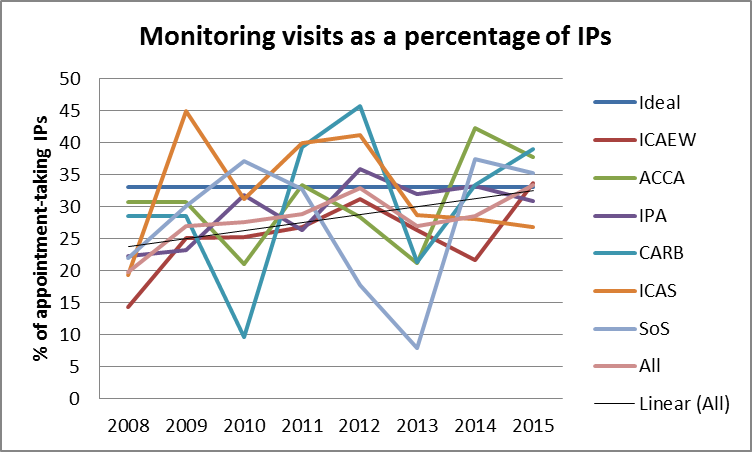
The graph of the percentages of IPs that had a monitoring visit last year gives me the impression that a 3-yearly visit cycle has most definitely become the norm:
Graph7

(Note: because the number of SoS IPs dropped so significantly during the year – from 40 to 28 – all the graphs in this article reflect a 2015 mid-point of SoS-authorised IPs of 34.)

Does this mean that IPs can predict the timing of their next routine visit? I’m not sure.  It seems to me that some standard text is slipping into the Insolvency Service’s reports on their monitoring visits to the RPBs.  The words: “[RPB] operates a 3-year cycle of rolling monitoring visits to its insolvency practitioners. The nature and timing of visits is determined annually on a risk-assessment basis” have appeared in more than one InsS report.

What do these words mean: that every IP is visited once in three years, but some are moved up or down the list depending on their risk profile? Personally, this doesn’t make sense to me: either visits are timed according to a risk assessment or they are carried out on a 3-year cycle, I don’t see how you can achieve both.  If visit timings are sensitive to risk, then some IPs are going to receive more than one visit in a 3-year period and, unless the RPB records >33% of their IP number as having a visit every year (which the graph above shows is generally not the case), the corollary will be that some IPs won’t be visited in a 3-year period.

My perception on the outside is that, generally, the timing of visits is pretty predictable and is now pretty-much 3-yearly. I’ve seen no early parachuting-in on the basis of risk assessments, although I accept that my field of vision is very narrow.


Most RPBs report reductions in negative outcomes from monitoring visits

The following illustrates the percentage of monitoring visits that resulted in a “negative outcome” (my phrase):

Graph8

As you can see, most RPBs are clocking up between c.10% and 20% of monitoring visits leading to some form of negative consequence and, although individual records have fluctuated considerably in the past, the overall trend across all the regulatory bodies has fallen from 30% in 2008 to 20%.

However, two bodies seem to be bucking the trend: CARB and the SoS.

Last year, I didn’t include CARB (the regulatory body for members of the Institute of Chartered Accountants in Ireland), because its membership was relatively small. It still licenses only 41 appointment-taking IPs – only 3% of the population – but, with the exit of SoS authorisations, I thought it was worth adding them to the mix.

I am sure that CARB’s apparent erratic history is a consequence of its small population of licensed IPs and this may well explain why it is still recording a much greater percentage of negative outcomes than the other RPBs. Nevertheless, CARB does seem to have recorded exceptionally high levels for the past few years.

The high SoS percentage is a little surprising: 50% of all 2015 visits resulted in some form of negative outcome – these were all “plans for improvement”. CARB’s were a mixture of targeted visits, undertakings and one penalty/referral for disciplinary consideration.

So what kind of negative outcomes are being recorded by the other RPBs? Are there any preferred strategies for dealing with IPs falling short of expected standards?


What responses are popular for unsatisfactory visits?

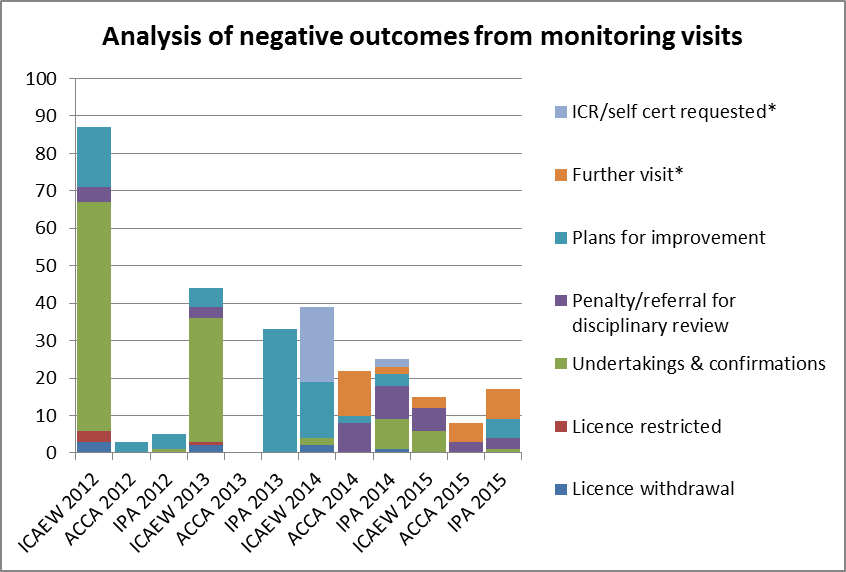
The following illustrates the actions taken by the top three RPBs over the last 4 years:
Graph9

* The figures for ICR/self certifications requested and further visits should be read with caution. These categories do not appear in every annual review, but, for example, it is clear that RPBs have been conducting targeted visits, so this graph probably does not show the whole picture for the 2012 and 2013 outcomes.  In addition, of course the ICAEW requires all IPs to carry out annual ICRs, so it is perhaps not surprising that this category has rarely featured.

I think that all this graph suggests is that there is no trend in outcome types!  I find this comforting: it might be difficult to predict what outcome to expect, but it suggests to me that the RPBs are flexible in their approaches, they will implement whatever tool they think is best fitted for the task.


Looking back on 6 years of SIP16 monitoring
We all remember how over the years so many people seemed to get hot under the collar about pre-packs and we recall some appallingly misleading headlines that suggested that around one third of IPs were failing to comply with regulations. Where have the 6 years of InsS monitoring of SIP16 Statements got us?  I will dodge that question, but I’ll simply illustrate the statistics:

Graph10

Note: several years are “estimates” because the InsS did not always review all the SIP16 Statements they received. Also, the Service ended its monitoring in October 2015.  Therefore, I have taken the stats in these cases and pro rated them up to a full year’s worth.

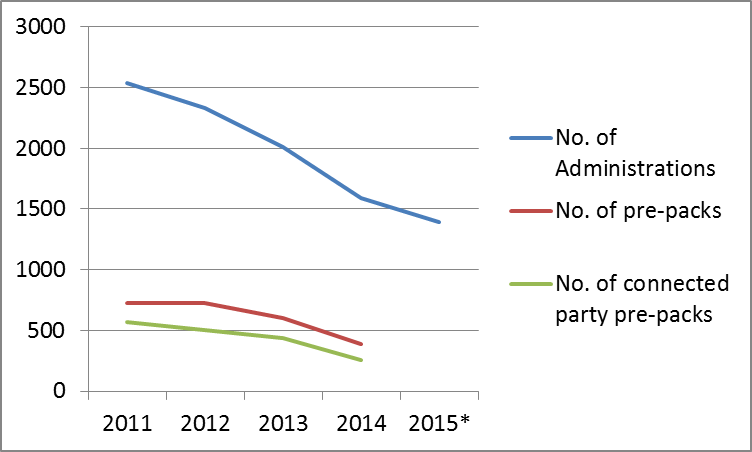
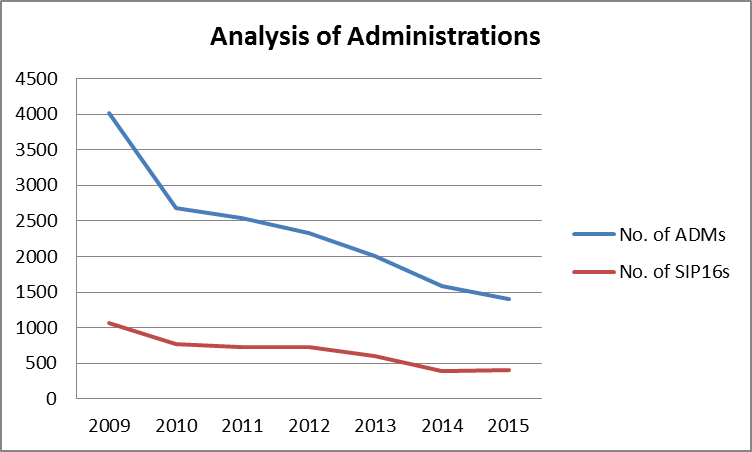
Does the graph above suggest that a consequence of SIP16 monitoring has been to discourage pre-packs? Well, have a look at this one…
Graph11

As you can see, the dropping number of SIP16s is more to do with the drop in Administrations. In fact, the percentage of pre-packs has not changed much: it was a peak of 31% of all Administrations in 2012 and was at its lowest in 2014 at 24%.

I guess it could still be argued that the SIP16 scrutiny has persuaded some to sell businesses/assets in the pre (or immediately post) liquidation period, rather than use Administration.  I’m not sure how to test that particular theory.

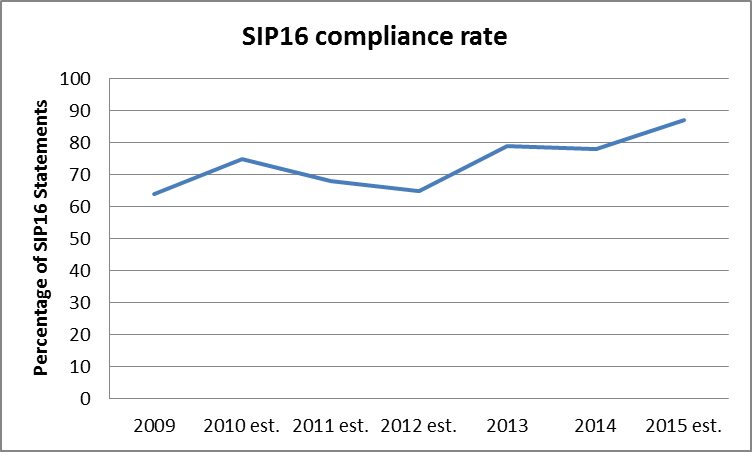
So, back to SIP16 compliance, the graph-but-one above shows that the percentage of Statements that were compliant has increased. It might be easier to see from the following:
Graph12

Unequivocal improvements in SIP16 compliance – there’s a good news story!

A hidden downside of all this focus on improving SIP16 compliance, I think, is the costs involved in drafting a SIP16 Statement and then, as often happens, in getting someone fairly senior in the practice to double-check the Statement to make sure that it ticks every last SIP16 box.  Is this effort a good use of resources and of estate funds?

Now that the Insolvency Service has dropped SIP16 monitoring, does that mean we can all relax a bit? I think this would be unwise.  The Service’s report states that it “will review the outcome of the RPBs’ consideration of SIP16 compliance and will continue to report details in the Annual Review”, so I think we can expect SIP16 to remain a hot regulatory topic for some time to come.


The changing profile of pre-packs

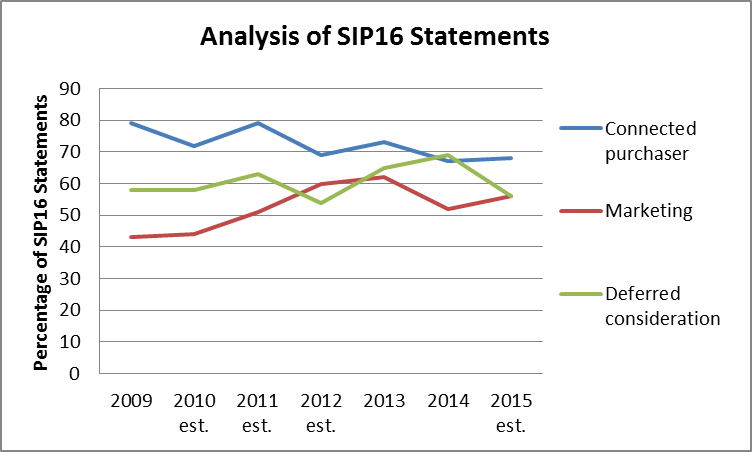
The Service’s reports on SIP16 Statements suggest other pre-pack trends:
Graph13

Personally, I’m surprised at the number of SIP16 Statements that disclose that the business/assets were marketed by the Administrator: last year it was 56%. I’m not sure if that’s because some SIP16 Statements are explaining that the company was behind some marketing activities, but, if that’s not the reason, then 56% seems very low to me.  It would be interesting to see if the revised SIP16, which introduced the “marketing essentials”, makes a difference to this rate.


Have some pity for the RPBs!

The Service claimed to have delivered on their commitments in 2015 (incidentally, one of their 2014 expectations was that the new Rules would be made in the autumn of 2015 and they would come into force in April 2016 – I’m not complaining that the Rules are still being drafted, but I do think it’s a bit rich for the Executive Foreword to report pleasure in having met all the 2014 “commitments”).

The Foreword states that the reduction in authorising bodies is “a welcome step”. With now only 5 RPBs to monitor and the savings made in dropping SIP16 monitoring (which was the reported reason for the levy hike in 2009), personally I struggle to see the Service’s justification for increasing the levy this year.  The report states that it was required in view of the Service’s “enhanced role as oversight regulator”, but I thought that the Service did not expect to have to flex its new regulatory muscles as regards taking formal actions against RPBs or directly against IPs.

However, the tone of the 2015 Review does suggest a polishing of the thumb-screws. The Service refers to the power to introduce a single regulator and states that this power will “significantly shape” the Service’s work to come.

In 2015, the Service carried out full monitoring visits to the ICAEW, ICAS and CARB, and a follow-up visit to the ACCA. This is certainly more visits than previous years, but personally I question whether the visits are effective.  Of course, I am sure that the published visit reports do not tell the full stories – at least, I hope that they don’t – but it does seem to me that the Service is making mountains out of some molehills and their reports do give me the sense that they’re concerned with processes ticking the Principles for Monitoring boxes, rather than being effective and focussing on good principles of regulation.

For example, here are some of the molehill weaknesses identified in the Service’s visits that were resisted at least in part by some of the RPBs – to which I say “bravo!”:

  • Pre-visit information requested from the IPs did not include details of complaints received by the IP. The ICAEW responded that it was not convinced of the merits of asking for this on all visits but agreed to “consider whether it might be appropriate on a visit by visit basis”.
  • Closing meeting notes did not detail the scope of the visit. The ICAEW believed that it is important for the closing meeting notes to clearly set out the areas that the IP needs to address (which they do) and it did not think it was helpful to include generic information… although it seems that, by the time of the follow-up visit to the ICAEW in February 2016, this had been actioned.
  • The Service remains “concerned” that complainants are not provided with details of the independent assessor on their case. “ACCA regrets it must continue to reject this recommendation as ACCA does not believe naming assessors will add any real value to the process… There is also the risk of assessors being harassed by complainants where their decision is not favourable to them.”
  • Late bordereaux were only being chased at the start of the following month. The Service wanted procedures put in place to “ensure that cover schedules are provided within the statutory timescale of the 20th of each month and [to] follow up any outstanding returns on 21st or the next working day of each month”. Actually, CARB agreed to do this, but it’s just a personal bug-bear of mine. The Service’s report to the ICAEW went on about the “vital importance” of bonding – with which I agree, of course – but it does not follow that any bordereaux sent by IPs to their RPB “demonstrate that they have sufficient security for the performance of their functions”. It simply demonstrates that the IP can submit a schedule on time every month. I very much suspect that bordereaux are not checked on receipt by the RPBs – what are they going to do: cross-check bordereaux against Gazette notices? – so simply enforcing a zero tolerance attitude to meeting the statutory timescale is missing the point and seems a waste of valuable resources, doesn’t it?


Future Focus?

The Annual Review describes the following on the Insolvency Service’s to-do list:

  • Complaint-handling: in 2015, the Service explored the RPBs’ complaint-handling processes and application of the Common Sanctions Guidance. The Service has made a number of recommendations to improve the complaints process and is in discussion with the RPBs. They expect to publish a full report on this subject “shortly”.
  • Debt advice: also in 2015, they carried out a high-level review of how the RPBs are monitoring IPs’ provision of debt advice and they are currently considering recommendations for discussion with the RPBs.
  • Future themed reviews: The Service is planning themed reviews (which usually mean topic-focussed questionnaires to all RPBs) over 2016 and 2017 covering: IP monitoring; the fees rules; and pre-packs.
  • Bonding: the Service has been examining “the type and level of cover offered by bonds and considering both the legislative and regulatory arrangements to see if they remain fit for purpose”. They are cagey about the outcomes but do state that they “will work with the industry to effect any regulatory changes that may be necessary” and they refer to “any legislative change” being subject to consultation.
  • Relationship with RPBs: the Service is contemplating whether the Memorandum of Understanding (“MoU”) with the RPBs is still needed, now that there are statutory regulatory objectives in place. The MoU is a strange animal – https://goo.gl/J6wmuN. I think that it reads like a lot of the SIPs: a mixture of principles and prescription (e.g. a 10-day acknowledgement of complaints); and a mixture of important standards and apparent OTT trivia. It would be interesting to see how the Service approaches monitoring visits to the RPBs if the MoU is removed: they will have to become smarter, I think.
  • Ethics? The apparent focus on ethical issues seems to have fallen from the list this year. In 2015, breaches of ethics moved from third to second place in the list of complaints received by subject matter (21% in 2014 and 27% in 2015), but reference to the JIC’s work on revising the Ethics Code has not been repeated in this year’s Review. Presumably the work is ongoing… although there is certainly more than enough other tasks to keep the regulators busy!



Leave a comment

Is the IP regulation system fair?

IMGP0038 (2)

The Insolvency Service’s 2015 review of IP regulation was released in March and, as usual, I’ve dug around the statistics in comparison with previous years.

They indicate that complaint sanctions have increased (despite complaint numbers dropping), but monitoring sanctions have fallen. Why is this?  And why was one RPB alone responsible for 93% of all complaints sanctions?

The Insolvency Service’s report can be found at https://goo.gl/HlATlf.

I honestly had no idea that the R3 member survey issued earlier today was going to ask about the effectiveness of the regulatory system. I would encourage R3 members to respond to the survey (but don’t let this blog post influence you!).

IP number falls to 6-year low

I guess it was inevitable: no IP welcomes the hassle of switching authorising body and word on the street has always been that being authorised by the SoS is a far different experience to being licensed by an RPB. Therefore, I think that the withdrawal from authorising by the SoS (even with a run-off period) courtesy of the Deregulation Act 2015 and the Law Societies was likely to affect the IP numbers.

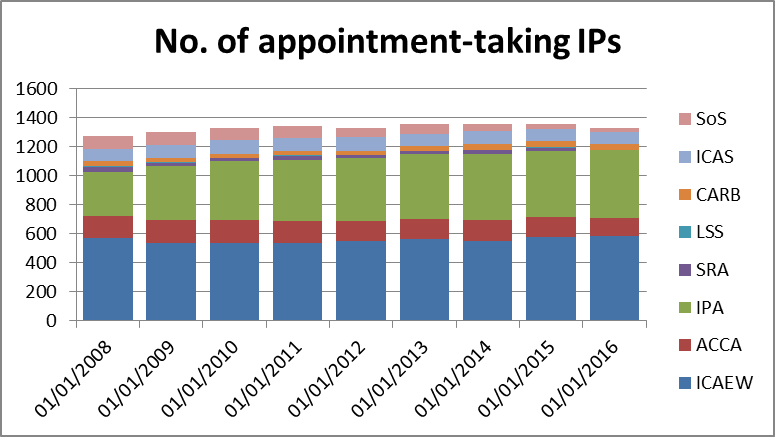
Here is how the landscape has shifted:

Graph1

As you can see, the remaining RPBs have not gained all that the SoS and Law Societies have lost and ACCA’s and CARB’s numbers have dropped since last year. It is also a shame to note that, not only has the IP number fallen for the first time in 4 years, it has also dropped to below the 2010 total.

Personally, I expect the number to drop further during 2016: I am sure that the prospect of having to adapt to the new Insolvency Rules 2016 along with the enduring fatigue of struggling to get in new (fee-paying) work and of taking the continual flak from regulators and government will persuade some to hang up their boots. I also don’t see that the industry is attracting sufficient new joiners who are willing and able to take up the responsibility, regardless of the government’s partial licence initiative that has finally got off the ground.

Maybe this next graph will make us feel a bit better…

Number of regulatory sanctions fall

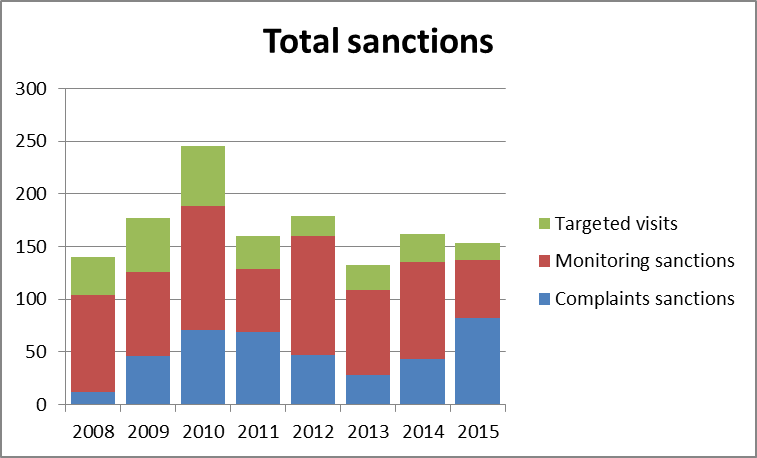
Graph2

Although the numbers are spiky, I guess there is some comfort to be had in seeing that the regulatory bodies issued fewer sanctions against IPs in 2015. [To try to put 2010’s numbers into context, you’ll remember that 1 January 2009 was the start of the Insolvency Service’s monitoring of the revised SIP16, which led to a number of referrals to the RPBs, although I cannot be certain that this was behind the unusual 2010 peak in sanctions.]

But what interests me is that the number of sanctions in 2015 arising from complaints far outstripped those arising from monitoring visits, which seems quite a departure from the picture of previous years. What is behind this?  Is it simply a consequence of our growing complaint-focussed society?

Complaints on the decrease

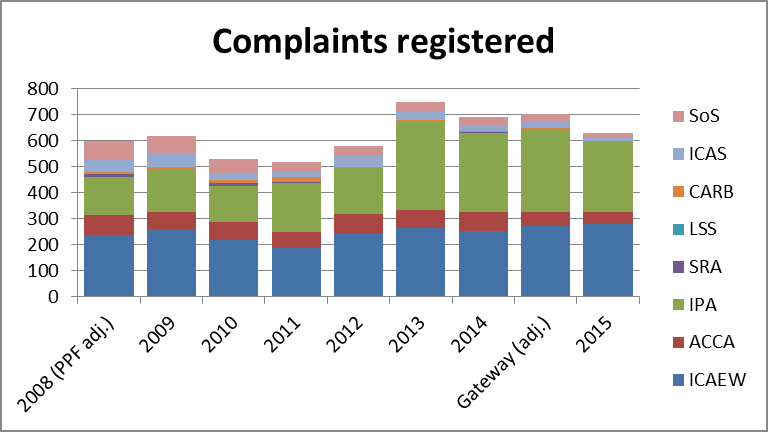
Graph3

Well actually, as you can see here, it seems that fewer complaints were registered last year… by quite a margin.

I confess that some of these years are not like-for-like comparisons: before the Complaints Gateway, the RPBs were responsible for reporting to the Insolvency Service how many complaints they had received and it is very likely that they incorporated some kind of filter – as the Service does – to deal with communications received that were not truly complaints. However, it cannot be said for certain that the RPBs’ pre-Gateway filters worked in the same way as the Service’s does now.  Nevertheless, what this graph does show is that 2015’s complaints referred to the regulatory bodies were less than 2014’s (which was c.half a Gateway year – the “Gateway (adj.)” column represents a pro rata’d full 12 months of Gateway operation based on the partial 2014 Gateway number).

It is also noteworthy that the Insolvency Service is chalking up a similar year-on-year percentage of complaints filtered out: in 2014, this ran at 24.5% of the complaints received, and in 2015, it was 26.5%.

So, if there were fewer complaints lodged, then why have complaints sanctions increased?

How long does it take to process complaints?

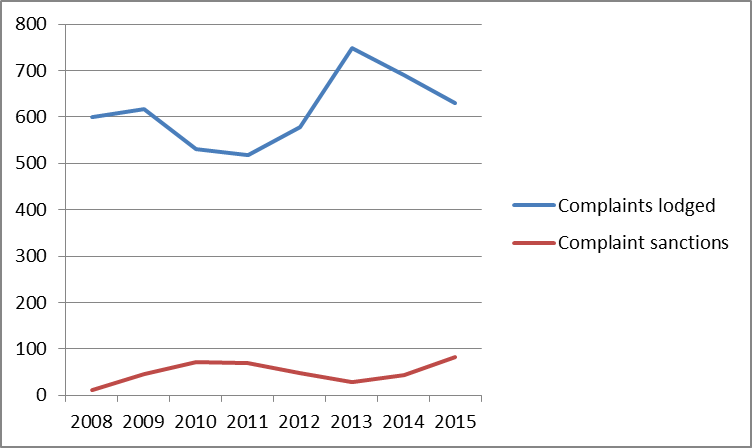
The correlation between complaints lodged and complaint sanctions is an interesting one:

Graph4

Is it too great a stretch of the imagination to suggest that complaint sanctions take somewhere around 2 years to emerge? I suggest this because, as you can see, the 2010/11 sanction peak coincided with a complaints-lodged trough and the 2013 sanctions trough coincided with a complaints lodged peak – the pattern seems to show a 2-year shift, doesn’t it..?

I am conscious, however, that this could simply be a coincidence: why should sanctions form a constant percentage of all complaints?  Perhaps the sanctions simply have formed a bit of a random cluster in otherwise quiet years.

Could there be another reason for the increased complaints sanctions in 2015?

One RPB breaks away from the pack

Graph5

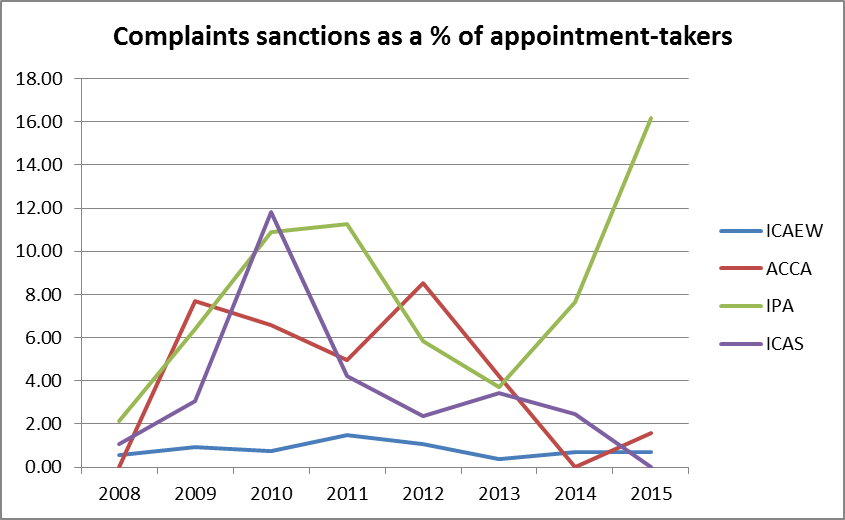
How strange! Why has the IPA issued so many complaints sanctions when compared with the other RPBs?

I have heard more than one IP suggest that the IPA licenses more than its fair share of IPs who fall short of acceptable standards of practice. Personally, I don’t buy this.  Also more sanctions don’t necessarily mean there are more sanctionable offences going on.  It reminds me of the debates that often surround the statistics on crime: does an increase in convictions mean that there are more crimes being committed or does it mean that the police are getting better at dealing with them?

Nevertheless, the suggestion that the IPA’s licensed population is different might help explain the IPA peak in sanctions, mightn’t it? To test this out, perhaps we should compare the number of complaints received by each RPB.

Graph6

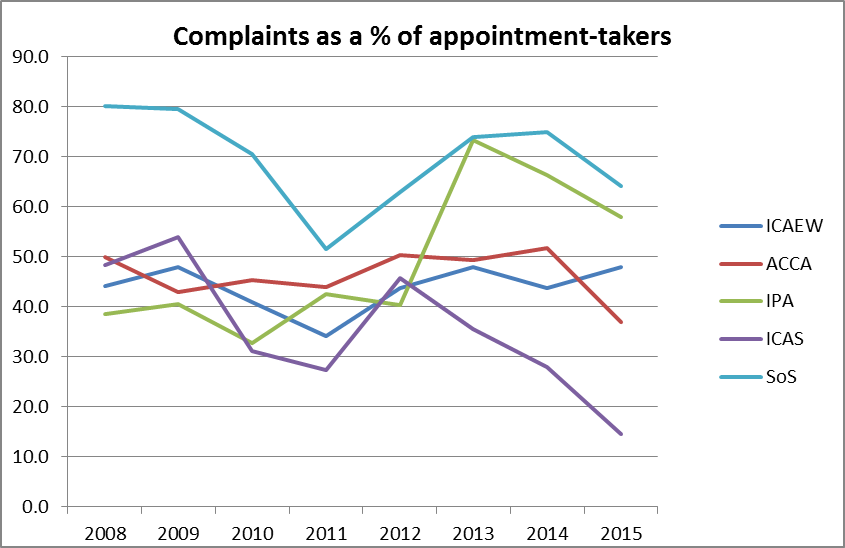
Ok, so yes, IPA-licensed IPs have received more complaints than other RPBs (although SoS-authorised IPs came out on top again this past year).  If the complaints were shared evenly, then 58% of all IPA-licensed IPs would have received a complaint last year, compared to only 43% of those licensed by the other three largest RPBs.  I hasten to add that, personally, I don’t think this indicates differing standards of practice depending on an IP’s licensing body: it could indicate that IPA-licensed (and perhaps also SoS-authorised) IPs work in a more complaints-heavy environment, as I mention further below.

Nevertheless, let’s see how these complaints-received numbers would flow through to sanctions, if there were a direct correlation. For simplicity’s sake, I will assume that a complaint lodged in 2013 concluded in 2015 – although I think this is highly unlikely to be the average, I think it could well be so for the tricky complaints that lead to sanctions.  This would mean that, across all the RPBs (excluding the Insolvency Service, which has no power to sanction SoS-authorised IPs in respect of complaints), 12% of all complaints led to sanctions.  On this basis, the IPA might be expected to issue 36 complaint-led sanctions, so this doesn’t get us much closer to explaining the 76 sanctions issued by the IPA.

I can suggest some factors that might be behind the increase in the number of complaints sanctions granted by the IPA:

  • The IPA licenses the majority of IVA-specialising IPs, which do seem to have attracted more than the average number of sanctions: last year, two IPs alone were issued with seven reprimands for IVA/debtor issues.
  • The IPA’s process is that matters identified on a monitoring visit that are considered worthy of disciplinary action are passed from the Membership & Authorisation Committee to the Investigation Committee as internal complaints. Therefore, I think this may lead to some IPA “complaint” sanctions actually originating from monitoring visits. However, analysis of the sanctions arising from monitoring visits (which I will cover in another blog) indicates that the IPA sits in the middle of the RPB pack, so it doesn’t look like this is a material factor.
  • Connected to the above, the IPA’s policy is that any incidence of unauthorised remuneration spotted on monitoring visits is referred to the Investigation Committee for consideration for disciplinary action. Given that it seems that such incidences include failures that have already been rectified (as explained in the IPA’s September 2015 newsletter) and that unauthorised remuneration can arise from a vast range of seemingly inconspicuous technical faults, I would not be surprised if this practice were to result in more than a few unpublished warnings and undertakings.

But this cannot be the whole story, can it? The IPA issued 93% of all complaints sanctions last year, despite only licensing 35% of all appointment-takers.  The previous year followed a similar pattern: the IPA issued 82% of all complaints sanctions.

To put it another way, over the past two years the IPA issued 111 complaints sanctions, whilst all the other RPBs put together issued only 14 sanctions.

What is going on? It is difficult to tell from the outside, because the vast majority of the sanctions are not published.  Don’t get me wrong, I’m not complaining about that.  If the sanctions were evenly-spread, I could not believe that c.16% of all IPA-licensed IPs conducted themselves so improperly that they merited the punitive publicity that .gov.uk metes out on IPs (what other individual professionals are flogged so publicly?!).

The Regulators’ objective to ensure fairness

This incongruence, however, makes me question the fairness of the RPBs’ processes.  It cannot be fair for IPs to endure different treatment depending on their licensing body.

You might say: what’s the damage, when the majority of sanctions went unpublished? I have witnessed the anguish that IPs go through when a disciplinary committee is considering their case, especially if that process takes years to conclude.  It lingered like a Damocles Sword over many of my conversations with the IPs.  The apparent disparity in treatment also does not help those (myself included) that argue that a multiple regulator system can work well.

One of the new regulatory objectives introduced by the Small Business Enterprise & Employment Act 2015 was to secure “fair treatment for persons affected by [IPs’] acts and omissions”, but what about fair treatment for IPs?  In addition, isn’t it possible that any unfair treatment on IPs will trickle down to those affected by their acts and omissions?

The Insolvency Service has sight of all the RPBs’ activities and conducts monitoring visits on them regularly. Therefore, it seems to me that the Service is best placed to explore what’s going on and to ensure that the RPBs’ processes achieve consistent and fair outcomes.


In my next blog, I will examine the Service’s monitoring of the RPBs as well as take a closer look at the 2015 statistics on the RPBs’ monitoring of IPs.


4 Comments

The draft revised SIP13: has it sold out to SIP16?

IMG_0917

The consultation release explained that the SIP13 revision involved using “(wherever possible) language which is consistent with SIP16”. The resulting draft gives me the impression that the working group started with a blank sheet of paper and asked themselves: how can we adapt SIP16 for on-liquidation sales?

I agree that much of the current SIP13 is redundant, as it simply reproduces principles from the Code of Ethics (albeit that the Code rarely makes such direct applications), it does seem to me that the diversity of scenarios for connected party sales in and around insolvency processes has been lost in this redraft. This SIP’s primary focus clearly has become post-appointment connected party sales that are contemplated prior to appointment.

Why chop out so many connected party sales that are caught by the current SIP13? Will this improve perceptions?  Will we lose valuable transparency if we assume that the only connected party transactions worthy of disclosure are quasi pre-packs?

Requirements on office holders

The only requirements that the draft revised SIP13 puts on IPs in office are:

  1. “If an office holder subsequently relies on a valuation or advice other than by an appropriate independent valuer and/or advisor with adequate professional indemnity insurance this should be disclosed along with the rationale for doing so and the reasons why the office holder was satisfied with any valuation obtained, explained.”
  2. “When considering the manner of disposal of the business or assets the office holder should be able to demonstrate that their duties under the legislation have been met.”
  3. “The office holder should demonstrate that they have acted with due regard to creditors’ interests by providing creditors with a proportionate and sufficiently detailed justification of why a sale to a connected party was undertaken, including the alternatives considered. Such disclosure should be made in the next report to creditors after the transaction has been concluded, which should be issued at the earliest opportunity.”

Item 2 is pointless: a SIP should not have to state that IPs need to be able to demonstrate that they have complied with legislation.

The other two items are generally reasonable, but I think the application of these requirements is confused by the preceding section headed “Preparatory Work”. In fact, item 1 above appears in the “Preparatory Work” section, which adds to the perception that the entire SIP relates only to quasi pre-packs.

“Preparatory Work” – a confusing context

This section states:

“An insolvency practitioner should keep a detailed record of the reasoning behind both the decision to make a sale to a connected party and all alternatives considered.”

“An insolvency practitioner should exercise professional judgement in advising the client whether a formal valuation of any or all of the assets is necessary.”

The SIP’s “principles” explain that “insolvency practitioner” is to be read as relating to acting in advisory engagements prior to commencement of the insolvency process.

The “preparatory work” heading and the reference to the pre-appointment “decision to make a sale” lead me to wonder whether the sections that follow – “after appointment” and “disclosure” – apply only to sales where pre-appointment preparatory work has been undertaken.  Another issue with the heading – and the fact that the first sentence above is a copy of para 10 of SIP16 (with the omission of “pre-pack”) – is that it suggests that SIP13 does not capture sales completed pre-appointment.

But does it make sense to reduce SIP13 to a SIP16 baby brother?

Does the SIP work for liquidation sales?

Often business and/or asset sales to connected parties are conducted in or around a CVL process. Sometimes the sale happens pre-liquidation: sometimes without the advising IP’s involvement, but sometimes with their knowledge and assistance.  In other cases, the IP takes no steps to sell the assets until his/her formal appointment as liquidator; indeed, in some cases the IP will not even have met or spoken with the directors before the S98 meeting as they replace the members’ choice of IP as liquidator.

What are the disclosure requirements for pre-liquidation sales? This draft revised SIP13 omits all such disclosure.  True, at present SIP8 requires some disclosure, but:

  • SIP8 only requires disclosure of transactions in the year before the directors resolved to wind up the company, so there remains a crucial reporting gap;
  • SIP8 only requires disclosure to the S98 meeting, so technically it need not be in the post-S98 report that is circulated to creditors; and
  • SIP8 will be changed enormously by the 2016 Rules and rumour has it that SIP8 might even disappear completely.

How many companies go into CVL having sold/lost all their chattel assets already? I reviewed the filing of 10 one year old CVLs chosen at random:

  • 6 had no chattel assets at the point of liquidation, although the previous accounts of 3 of these attributed some value to chattel assets (and one of the others had no filed accounts);
  • 3 involved post-CVL connected party sales; and
  • 1 involved a post-CVL unconnected party sale.

Of course, there can be all kinds of reasons why a company goes into CVL with no chattel assets, but if the revised SIP13 is issued, how many connected party transactions will go entirely unreported in future? Might it even influence more directors to dispose of assets before an insolvency office holder is appointed so that the sale falls under the radar?

Perceptions

Of course, the insolvency office holder will make appropriate investigations into a pre-liquidation (or any other insolvency process) sale. Therefore, is there really any harm done if the details of the sale are not provided to creditors?

I guess not, but doesn’t the omission de-value the efforts to ensure that office holders disclose post-appointment sales? What are the chances that the distinction between a pre and post sale will be lost on some creditors?  If they see solely a cash at bank lump sum received by the liquidator of a once asset-rich company and few details, what might their sceptical minds conclude?

Not quite SIP16

As I mentioned at the start, this draft revised SIP13 seems to have been produced from a blank sheet of paper and a copy of SIP16. However, fortunately, this SIP seems to have avoided the prescriptive shackles of its fellow.

The consultation release referred to SIP13 having been drafted “in a proportionate way and without being onerous, recognising that it may apply to low value transactions”. Notwithstanding that some liquidation business/asset sales may be as hefty as some pre-packs, I think this is good news: the draft SIP13 does not contain a SIP16-style shopping list of disclosure items (bravo!) and sticks to the principle of providing “a proportionate and sufficiently detailed justification of why a sale to a connected party was undertaken, including the alternatives considered”.

Therefore, whilst I suspect that disclosure of material business sales may be expected to contain a number of SIP16 elements, at least selling an old computer to the director for £50 will not require a chapter-and-verse account. However, it will take diligence on the part of those drafting and reviewing creditors’ reports to ensure that an adequate explanation, depending on the specific circumstances, is given. As with the new SIP9, formulaic approaches to report-writing will not work.

Wider scope?

Assuming that the pre-appointment “preparatory work” context is not meant to rule out disclosure of cold post-appointment sales, the draft revised SIP13 would have a wider reach than the current SIP13 in some respects:

  • Sales with connected parties (or at least as they are defined by statute), not just with directors, are caught; and
  • Personal insolvency processes are caught, so for example it would include a bankrupt’s family member buying out the Trustee’s interest.

Consultation deadline

I agree that a revision of SIP13 is long overdue: for one thing, its reference to a Rule 2.2 report lost all relevance in 2003!

The consultation – available at http://goo.gl/D91QMo – ends on 11 May 2016. I’ll be submitting a response, so if you want to counter my opinions, you’d better getting writing.


By the way, if you’ve been wondering how the picture relates to the story: there’s no connection, it’s just that I’ve recently returned from a spectacular trip to Bolivia and Chile.


2 Comments

Digital D-reporting: the Devil is in the Detail

IMGP3043 closeup

Many of us have been on tenterhooks, waiting to see the detail of the new D-reporting process… which comes into effect in two days!

I lost patience and got in direct contact with the Insolvency Service, who graciously allowed me an audience to convey many of my concerns and to learn more about how it is all intended to work.

We have been promised a Dear IP imminently, but here are the Service’s answers to my questions.

The Basics

I’m sure we’ve all learned the basics by now:

  • D-reporting for new appointments on or after 6 April 2016 will be carried out online via a .gov.uk portal and will need to be completed within 3 months.
  • IPs will have access to an online “dashboard” listing all their post-6 April (CDDA-relevant) appointments with the due dates for D-submissions using a traffic light system of flags.
  • The Service’s plan is that the system will allow IPs to delegate cases to staff to complete the D-report, although these will still be subject to approval by the IP. Staff access is hoped to be functional by mid/late April.
  • Submitted D-reports will remain accessible by the IP, fellow office-holders (only one submission is expected on joint appointments) and any subsequent office-holders.
  • Liquidators of Para 83 CVLs following from post-6 April Administrations will not be required to submit D-reports.
  • D-reporting for appointments prior to 6 April 2016 will continue under the old system.

The Question Bank

The new process has been “sold” to us on the basis that it will be so much simpler to complete as IPs will no longer need to decide whether, in their opinion, the directors’ conduct renders them unfit. Consequently, the Question Bank for the new D-report seeks to convey facts.  The questions are all multiple choice, the majority “simple” Yes/No, although some involve selecting from a range, e.g. regarding the number of creditors.  This is so that the answers can be processed through a rules engine to sift cases not requiring a human review.

In his webinar for the ICAEW last month, Mark Danks of the Insolvency Service did reveal some valuable information about the Question Bank, but I was left with the impression that the Service’s target was to have the process settled in June 2016, so that it is ready for receipt of the first online D-reports.

I expressed my concern to the Service that this is just not good enough. IPs would get criticised if they did not put their minds to the D-reporting task until the deadline was almost upon them and in any event it is not efficient to do so, not least because crunch-time falls in the middle of the summer holidays, so it would be ideal if IPs could get ahead of D-reporting deadlines.  How are IPs and staff supposed to prepare for the changes, if the Question Bank is not fixed and made available now?  There are checklists to amend and there is training to organise.

I was assured that the Service’s work with their IP panel indicates that the Question Bank is on the lines of current CDDA checklists and so they did not envisage (many) changes would be necessary. Now that I have seen the Question Bank, I regret to say that this is patently not the case.

If you want to revisit checklists to mirror the questions – which is how The Compliance Alliance’s revised checklist is being structured and which would be my recommendation so that you make sure that staff do the leg-work to get ready all answers before logging in – beware the following.

How can I access the Question Bank?

Unless the Service makes the Question Bank widely available, you will only be able to see it when you get a post-6 April appointment added to your dashboard. You should then be able to start the D-reporting process and click through the pages of questions.  Of course, this is not user-friendly for anyone trying to manage the work within the practice.

The Service has made available its current Question Bank to its test panel of IPs (and to others, like me, who asked). I am reluctant to provide the link here (it’s a bit too public!), but if you would like a copy of the questions, please drop me a line (insolvencyoracle@pobox.com).

I do fear, however, that the Service’s current Question Bank is not as valuable as we would hope in any event.  The Service expects these questions to change, not only before July but also thereafter, particularly when they start to see how IPs answer and react to the questions on live cases.

As Gareth Allen stated in the R3 magazine article (spring 2016): “this development is an ongoing process and we continue to refine and develop the system in response to continuous user input”. In other words, if you create a checklist to mirror the questions today, it seems to me that the chances are very high that the questions will have changed by the time your staff log in to complete the form!  I tried to stress to the Service person that I spoke to how unhelpful this would be.  I don’t want to be negative about the Service’s drive for continual improvement, but please do warn us all when/what changes are planned so that we can make appropriate changes internally in good time.  My personal preference would be that all of us on the Dear IP list (i.e. not just IPs) are given at least 3 months warning of any changes.

I know that my job is to pick at details, but I am surprised at quite how many issues I have with the current questions – some are poorly worded (e.g. “does the company appear to have ever kept records sufficient to show and explain its transactions..?” Ever? Well, yes, probably immediately on incorporation…); some are impossible for IPs to answer unless they undertake unnecessary investigation; I think that there’s a risk that some might generate false positives (e.g. “is there evidence that not all creditors have been treated equally?” Probably yes, but maybe for good reasons); and some items that I would expect to see (e.g. general misfeasance) are not covered at all.

Is the D-report just a string of multiple choice questions?

The prototype that has been made available is just this. The Service is keen to ensure that the Question Bank remains this way as far as possible so that their evaluation can be an automatic process.  If your answers hit their rules engine’s target, it will trigger a human review of the information and likely will involve an Insolvency Service staff member contacting you to ask further questions in order to decide whether it is a case worthy of taking forward.

At present, the prototype does not allow IPs to inform the Service online of any recovery actions that they intend to take/are taking, although the Service is very keen to receive this information. I understand that the ability for IPs to provide such information will form part of the online form (eventually).

What do we do if misconduct is discovered after the D-report has been submitted?

Personally, I think this is a serious disadvantage of the new process over the old. Firstly, I think that the need to submit D-reports in 3 months instead of 6 greatly increases the chances that you will discover or learn new information that would have affected your report.

However more importantly I think, the removal of the IP’s decision about unfitness removes the IP’s ability to act as any kind of filter: if you learn “new information”, you have to report it, whether or not you think it is material.  Therefore, it doesn’t mean you need only consider newly-identified “misconduct” – it goes much further than this.

What is “new information”?

The new rules define “new information” as “information which an office-holder considers should have been included in a conduct report prepared in relation to the company, or would have been so included had it been available before the report was sent”. If new information comes to the IP’s attention, he must provide this to the Insolvency Service as soon as reasonably practicable.  A failure to do so constitutes an offence.

I pointed out to the Service that, technically, “new information” could involve a wide range of immaterial changes to an IP’s original report. For example, the current questions include “what is the value of the likely dividend?”  If you answer “not known at this stage”, do the rules mean that you need to submit “new information” when this changes?

That may be an extreme example, but many other director-related questions may lead to “new information”. For example: “can all the company’s transactions with directors and any associated parties be identified?”  Just because your original “no” can later be changed to “yes”, does that mean you need to report it to the Service?  One would hope that IPs could exercise discretion in deciding whether technically “new information” is of any interest to the Service, but I do wonder if the rules prohibit this.

I am not certain how this issue can be overcome – the rules are the rules. The Service person gave me the impression that the process for delivering “new information” has not yet been formulated.  However, I hope that the Service sees – and will somehow deal with – the need to avoid burdening IPs (and Service staff) with a requirement to inform them of all “new information”.

What practically can we do to prepare for the new process?

Your to-do list might include these:

  • amend diaries for new appointments to reflect the 3-month timescale.
  • consider changing internal checklists. I guess that you don’t have to, but in my view it would be best to structure internal checklists so that every online question (and preferably no others) is addressed in turn. Certainly, this is how we at The Compliance Alliance are revising our CDDA checklists. Then the IP could review the staff’s completion of the checklist, agree the results and leave the staff member to upload the results into the online form. Ensuring that checklists mirror the online D-report will also help you make revisions whenever the Service makes changes.
  • consider staff resources. D-reporting on pre 6 April 2016 cases will continue as previously. Therefore, you are likely to see roughly double the number of D-reports falling due during July to September 2016, as you will have both 6-month deadlines on old cases and 3-month deadlines on new cases falling simultaneously. I recommend that you consider the effect on your staff resources, particularly as there will be a learning curve associated with the new process… and not to mention that most staff will want summer holidays!
  • ensure that staff are trained. Staff will need to be confident in dealing with the new process, but also important is embedding an awareness of the need to submit “new information” as and when it is discovered.
  • consider also adding a prompt to case review templates to reflect on whether all “new information” has been sent to the Service

I believe that the “new information” provisions present a particular challenge. You will need to ensure that “new information” is identified and reported as soon as reasonably practicable (even if, somehow, it is accepted by the Service and the RPBs that we need not report immaterial “new information”).  Being alert to report new information would seem to be particularly important where you have submitted a D-report before getting access to company records and where your later efforts identified misconduct.  It would also be relevant where you suspected misconduct – and answered “uncertain” or “no” where questions asked about the existence of evidence – and only later did you discover evidence.

Some other consequences of the new statutory provisions

The main statutory provisions are located in:

  • Section 107 of the Small Business Enterprise and Employment Act 2015 (http://goo.gl/NmcRlp);
  • The Insolvent Companies (Reports on Conduct of Directors) (England and Wales) Rules 2016 (http://goo.gl/6OORQn); and
  • The Insolvent Companies (Reports on Conduct of Directors) (Scotland) Rules 2016 (http://goo.gl/wZUj1K)

The Service has widely reported that old-style D-reports will continue to be received until October 2016, but in my view this overlooks the fact that there will be old-style D-reports due later than this.  For one thing, CVLs following from pre 6 April 2016 Administrations are subject to the old regime.  This will also affect old cases where you have submitted an interim D-return with the expectation of submitting a full D1 or final D2 after 6 October 2016.  Therefore, don’t delete all your old templates until you’re sure that you have reported every last old-style D-report.

From my reading of the rules, it seems to me that they provide a transitional period only up to 6 October 2016, but after this date the old D-forms will not be acceptable under the rules.  Presumably, the Service will devise a solution by October!

UPDATE 03/08/2016: I understand that the Insolvency Service would like IPs appointed on Para 83 CVLs after 6 April 2016 either (i) to send a copy of the D1/D2 submitted in the prior Administration with a letter confirming that this form presents the picture also for the CVL; or (ii) to notify the Service of developments since the Admin D1/D2 via the online DCRS system, as they would for “new information” under the new regime – a bit of a fudge, but what can one do if the legislation does not work?!  My thanks for Victoria L for sending me this information.

Liquidators following from post 6 April 2016 Administrations will not be required to submit a D-report.  Whilst this will be good news to any Administrators who keep hold of their Para 83 CVLs, I don’t think it is great for Liquidators who are new to the case.  From my reading of the legislation, it seems to me that these liquidators will be subject to the “new information” requirements and therefore will need to review what the Administrators had reported earlier.

The old rules are revoked in full (apart from the transitional provisions covering old appointments). As far as I can see, this means that there is no longer a 14-day timescale for IPs to submit a report on vacating office.  Presumably, this is because it was felt unlikely that an IP would vacate office before the 3-month deadline.

“Quicker and easier” for whom?

In theory, the move to a simple online form should be quicker and easier for everyone: IPs, their staff and the Insolvency Service alike. However, completing a D-report is more like filling in a self-assessment tax return than completing a passport application: you won’t have all the information at your finger-tips unless you do the prep work.

Most practices have their own tried-and-tested ways of gathering information, following trails, and reaching conclusions on CDDA and SIP2 matters. Structuring a D-report on a string of questions forces our hands.  To reach 4 April and not to have given all IPs access to the detail is, in my view, irresponsible.  Either it shows how little understanding the Service has of IPs’ work or it indicates that the Service has been chasing its tail with a near-impossible deadline.  Personally, I think that it’s a bit of both.


Leave a comment

The ICAEW Roadshows: A Helping Hand Through Hazards

1414 Cairns Zoo

Last autumn, Jo Harris and I enjoyed travelling with the ICAEW on their Roadshows (although it has taken us several months to recover!). If you want to know what you missed (or you feel you need a reminder in view of all that has changed in the past six months), here is my personal summary of highlights from last year’s programme.

RPB Changes

Bob Pinder, ICAEW’s Director of Professional Standards, explained to us the impacts of the two 2015 Acts primarily on the RPB environment.

As we know, the Small Business Enterprise and Employment Act 2015 introduced new powers for the Insolvency Service to sanction RPBs. However, it is worth remembering that the Secretary of State now also has the power to apply to court for a “direct sanctions order” against an IP “if it appears to the Secretary of State that it would be in the public interest for the order to be made” (S141 of the SBEE Act 2015).  Such an order could involve: loss, suspension or restriction of a licence; specific requirements to comply; and/or a contribution to creditors.

Although I am sure that this action will only be contemplated in extreme cases (not least as I’m sure the Service would prefer that the RPBs spend the time and money disciplining IPs), I found this development more than a little disconcerting given the cudgel a certain past Secretary of State swung about when some IPs appeared not to have complied with the employee consultation requirements. As commented on by R3 last November (https://goo.gl/QX6kHM), the 2015 government consultation on this particular issue offered no helpful solution and who knows what (in)action might light the next touch paper in Ministers’ minds.

Compliance Hazards

This was Jo’s and my presentation: an attempt to highlight the principal areas in which we’ve seen IPs trip up. Some of the areas we covered were:

  • Getting remuneration right: how to approach the new fees rules
  • File management: how to deal with the new Oct-15 IP Regulation on maintaining records to demonstrate administration and material decisions
  • Statutory deadlines: how misunderstanding certain rules can make all the difference
  • Anti-money laundering and bribery: how to make checklists more effective
  • SIP highlights: a quick trip through the SIP series identifying some key and some lesser-known slip-up risks
  • Ethics: how to avoid threatening compliance with the principle of professional competence and due care

If you would like to hear the full presentation, Jo has recorded it as a webinar available to all Compliance Alliance webinar subscribers (£250+VAT for firm-wide access to all our webinars for one year)*.

Legal Update

Steven Fennell, Exchange Chambers, explored with ease some key decisions, such as Jetivia SA v Bilta (UK) Limited and Re Corporate Jet Realisations Limited.

Reviewing Steven’s notes now emphasises to me how necessary it is for us to keep up to date with court decisions – so much can happen in six months! Cue plug for R3’s Technical Reviews (starting next month): https://goo.gl/jnnxUA.

Regulatory Hot Topics

Allison Broad, Senior Manager of ICAEW QAD, ran through some regulatory developments and issues seen by the monitoring team. The main points that stood out to me were:

  • ICR reminders: as we know, all appointment-taking ICAEW-licensed IPs need to have an ICR each year. Don’t forget that this includes retiring IPs even if they are merely running off their remaining few cases. IPs who move practices also need to make sure that this requirement is not overlooked, which is easily done if their new colleagues have already carried out an ICR earlier in the year.
  • Ethics reminders: make sure that ethics checks are carried out and signed off before appointment; initial ethics checks signed off months (or even years!) after appointment are not acceptable. Ethics checks should be signed off by the appointment-taking IP personally, not delegated. Make sure that the ethics check is noted appropriately, e.g. if your Form 2.2B (Statement of Proposed Administrator) discloses a prior relationship, is this noted on the ethics review?
  • Anti-Money Laundering reminders: ensure that the files demonstrate the risk-based approach; it is not sufficient simply to state that you consider a subject as “normal” risk, you should be setting out how you reached this conclusion. Also don’t forget to carry out a risk assessment even on court appointments and take appropriate steps consequent to that risk assessment.
  • Bonding reminders: make sure that forms calculate the bond correctly, taking into consideration charged assets and prescribed parts. Also, be consistent in calculating the bond level in VAs: you may have difficulty in justifying why you have bonded assets for less than their realisable values as set out in the VA Proposal’s EOS.
  • SIP8 reminders: Allison described a surprising flurry of SIP8 breaches as regards S98 reports, e.g. lack of detail in trading history and company accounts and inaccurate deficiency accounts. Therefore, perhaps it would be valuable to refresh your staff’s/template’s treatment of SIP8 disclosures in S98 reports.

The Pre Pack Pool

At a time when we were all awaiting the revised SIP16, Stuart Hopewell, a Director of Pre Pack Pool Limited, gave us a welcome insight into the Pool’s vision… and valiantly tackled a number of enthusiastically-delivered questions from the floor.

Back in December, Allison’s webinar http://goo.gl/ZCzzxR reported that the Pool had received two applications over its first month of operation.  I wonder if that number has reached double figures yet…

Valuable CPD

In conclusion, I would just like to say to those of you who have never attended an ICAEW Roadshow before: please do consider it this year. I found it a valuable overview of core developments – both past and prospective – affecting insolvency, together with several heads-up warnings on how some IPs are getting things wrong and carefully-worded insights into the RPB’s perspective on some serious challenges for IPs, balancing well the ICAEW’s roles as both a regulator and a membership body.

* For more information on the Compliance Alliance’s Compliance Hazards webinar, please email info@thecompliancealliance.co.uk


2 Comments

SIP9 – the tricky bits

3124 Kakadu

Warning: this blog post may lead to disappointment.

I know that I am not alone in feeling that SIP9 poses as many questions as it answers. To be fair, much of our dissatisfaction originates from inadequate rules, but the fact that my earlier post, “SIP9 – the easy bits” (http://goo.gl/Xu7DM4), generated contrary feedback indicates to me just how much clarification is needed.

Regrettably, I don’t have the answers, certainly not here and now. I could offer my best guesses, but my opinions don’t count.  We need to know how the RPBs will measure compliance with the SIP and how they want SIP9 applied.  I’m currently waiting for answers to a number of questions I’ve put to some RPB monitors, but I do hope that the regulators – via monitors, committees or the Insolvency Service – issue guidance publicly, so that all IPs and insolvency professionals can benefit.  Allison Broad, ICAEW, has made a fantastic start with her webinar, but SIP9 raises far more questions.

What are the questions?

Here are what I think are some of the tricky bits of SIP9:

  • How does SIP9’s statement that “an IP is not precluded from providing information, including a fee estimate, within pre-appointment communications” fit with the rules’ requirement that the office-holder must give the information to creditors? (I know this is an old chestnut, but a serious one, which I note has not been adjusted in the published draft 2016 Rules.)
  • To what extent are we expected to continue to be “consistent” in using an old reporting style?
  • When and how should proposed S98 fees be disclosed? What about MVL fixed fees?
  • How far do we go in providing narrative? Does the bond premium really need to be explained? Are “a few lines of text” (per an RPB staff member’s online interview) really going to satisfy monitors (and be rules-compliant)?
  • How do you explain why a proposed fixed or % fee is “expected to produce a fair and reasonable reflection of the work” to be undertaken?
  • Are monitors expecting to see time costs breakdowns at all? What about charge-out rate sheets in progress reports?
  • If they are not expecting them right now, is it safe to ditch the ability to produce time costs breakdowns or might we need them for the next inevitable iteration of SIP9?
  • Do the Creditors’ Guides to Fees really work to “inform creditors and other interested parties of their rights under the insolvency legislation”?
  • What are the RPBs expecting as regards providing “an indication of the likely return to creditors where it is practical to do so”?

Where are the answers?

The absence of “official” answers puts pressure on all of us to come up with our own. We’ve heard noises to the effect that some RPB monitors will go gentle on IPs as the SIP beds in.  However, I think that’s a cop-out.  An enormous amount of time and effort is expended in setting up systems and procedures and training staff in what is required.  It’s not good enough to learn only at a monitoring visit how we’re expected to apply the SIP, leading to the need to invest further time and effort in changing things.

I think that the fact that the SIP hasn’t been in force for 3 months yet and already it has been the subject of an R3 webinar, an ICAEW webinar, countless blog posts and insolvency queries demonstrates just how we’re all struggling to get to grips with the issues dealt with so unsatisfactorily by the fees rules and the SIP.

Nevertheless, we have to manage as best we can. If you’re keen to absorb yet more information about SIP9, for the Compliance Alliance I shall be recording a webinar providing my thoughts on the questions above (including some thoughts from RPB staff who have responded to my queries) as well as taking a practical look at how to apply the SIP’s principles and standards.  If you would like to sign up to the webinar (which will be available in a week’s time), please email info@thecompliancealliance.co.uk*.

SIP16: two for the price of one

In the same webinar, I’ll also be reviewing the practical application of the latest revision of SIP16 – a far less troublesome SIP, I think, but perhaps just as risky.

* Our webinars are available to all Compliance Alliance webinar subscribers (£250+VAT for firm-wide access to all our webinars for one year).  If you would like to sign up, please email info@thecompliancealliance.co.uk.


Leave a comment

SIP9 – the easy bits

0902 Monument Valley

There’s no doubt that the October Rules and the revised SIP9 generated many questions. However, in this blog (first published on The Compliance Alliance), I summarise the known impacts of the new SIP9 for those who want to double-check that they have the basics right.

Scope

Have you remembered that the scope of the new SIP9 reaches wider than simply cases affected by the October Rules? It also affects:

  • Pre-October 2015 appointments;
  • Case types not affected by the October Rules, i.e. CVAs, IVAs, Receiverships and MVLs; and
  • Pre-appointment fees (where these are paid from the estate), e.g. SoA/S98 fees and VA drafting fees;
  • But it does not apply to Scottish or NI appointments, which continue to be subject to the “old” SIP9.

Key disclosure

I think that paragraph 9 of SIP9 is key. Whenever you are “providing information about payments, fees and expenses to those with a financial interest in the level of payments from an insolvent estate”, you should address the following:

Prospective disclosure:

  • What work will be done
  • Why it is necessary
  • How much it will cost (both fees and expenses)
  • “Whether it is anticipated that the work will provide a financial benefit to creditors and if so what anticipated benefit (or if the work provides no direct financial benefit, but is required by statute)”

Retrospective disclosure:

  • What work has been done
  • Why it was necessary
  • How much it has cost (both fees and expenses)
  • “Whether the work has provided a financial benefit to creditors and if so what benefit (or if the work provided no direct financial benefit, but is required by statute)”

The information given should be transparent, useful and proportionate to the circumstances of the case (which makes a rigid template approach difficult and dangerous), but also consistent throughout the life of the case. Therefore, whilst you might have made wholesale changes to requests/reports for new cases, you have probably designed a half-way house for older cases.  Although the new SIP9 avoids pretty-much all reference to numerical information, if you have already provided tables for a case on the lines of the old SIP9, it seems that you cannot drop them for future reports.  However, you should review the narrative elements of pre-December 2015 case reports to make sure that they meet the new disclosure requirements.

As mentioned above, these narrative requirements also apply to fees/costs that are new to the SIP9 scope and that are not affected by the October Rules. Therefore, have you checked off your documentation relating to MVL, SoA/S98, and VA drafting/Nominees’/Supervisors’ fees?

Fixed or percentage fees

Have you ensured that, whenever you are seeking approval for fees on a fixed or percentage basis, you have included some kind of prompt/explanation as to “why the basis requested is expected to produce a fair and reasonable reflection of the work that the office holder anticipates will be undertaken” (paragraph 10)?

Also with SIP9 paragraph 25 in mind, have you made sure that this explanation is covered when you are hoping to get approval for the following (which are often sought on a fixed/% basis) where they are to be drawn from the estate:

  • SoA/S98 fees;
  • Nominees’ fees;
  • Supervisors’ fees; and
  • MVL fees?

SoA/S98 fees

As you can see above, the new SIP9 seems to affect SoA/S98 fees quite substantially. I believe it has been rare to see pre-S98 circulars disclose much at all about these fees.  Personally, I find it difficult to see how the principles of SIP9 can be met without disclosing in the pre-S98 circular the quantum of the proposed SoA/S98 fee, if the IP is hoping to get this approved for payment from the estate at the S98 meeting.  However, I do not think that SIP9 is at all clear on this point, so I’ll put this one in the “known unknown” category.

Numerical information

As mentioned above, the new SIP9 has distanced itself from a formulaic numbers-say-it-all approach in favour of case-tailored narrative. However, the SIP does require some numerical information, not all of which I think flows naturally.

Are your systems set up so that, for cases where (October Rules) fees estimates have been provided, the progress reports disclose:

  • “the actual hours and average rate (or rates) of the costs charged for each part… for comparison purposes” (paragraph 13); and
  • “when reporting the amount of remuneration charged [i.e. time costs incurred] or expenses incurred… figures for both the period being reported upon and on a cumulative basis” (paragraph 17)?

Having now looked at some fee estimates, I have to say that I really do not think that the average rate for each work category adds anything at all – although I can see that an overall average rate has some value – so why the JIC felt that this was so vital that it had to be prescribed, I do not know! But I do know that it has added expense to some IPs in getting their time recording systems set up to produce these numbers.

The second requirement adds further complication. The 2010 Rules require progress reports to disclose expenses incurred (whether or not paid) in the period and SIP7 requires expenses paid in the period and cumulative, but now SIP9 requires also expenses incurred on a cumulative basis: that’s four different numbers.  So much for transparency!

Back to the beginning

The new SIP9 has introduced some subtle changes as regards disclosure of parties’ rights.

Information to creditors about how to access information on their rights has been moved to earlier in the process: no longer should this occur in the first communication following appointment, but simply “within the first communication with them” (and in each subsequent report).  Therefore, have you checked that this is covered in the pre-S98 circular?  But have you also kept it as standard in any post-S98 template, just in case you take an appointment without having been the IP advising member for the S98 meeting?

Personally, I’ve been struggling to work out how to meet the requirement above for MVLs: does there exist an “official” sensible explanation of creditors’ rights in an MVL?  The Creditors’ Guide to Liquidators’ Fees doesn’t really do the job, but I am not convinced that the RPBs expect IPs to draft something themselves, do they..?  Perhaps this is another “known unknown”.

Whilst we’re on the subject of Creditors’ Guides… I think that many IPs assumed that, as the new SIP9 applies to old and new cases, the new Guides also apply to both old and new cases.  However, if we remember that the purpose behind directing creditors to the Guide is to inform them of “their rights under insolvency legislation”, then it is evident that the pre-April 2010 Guides are still relevant to pre-April 2010 cases, as new rights were introduced in April 2010.  It is regrettable, however, that all the old Guides set out the requirements of the old SIP9 – and I would suggest that this might render them no longer “suitable information” – but as regards a creditor’s statutory rights, they’re generally reasonable.

Therefore, do your circulars/reports direct creditors to the Guide appropriate to the case type and appointment date? If you display the Guides on your own website, do you have Guides covering the full range of appointment dates?  The R3 website only goes back to 1 November 2011, but the ICAEW website, http://goo.gl/kjZlJC, (for example) has Guides going way back.

Heavy hints

The new SIP9 includes several items that fall short of being prescriptive, but the language indicates to me that monitors will still be looking out for them. These include:

  • Providing “an indication of the likely return to creditors” when seeking approval of the fee basis “where it is practical to do so”;
  • Dividing narrative explanations into the six categories listed in paragraph 12… whilst making sure that not every case follows exactly the same categories (we have to demonstrate that we’ve considered each case’s specific circumstances); and
  • Using “blended rates” for fees estimates.

And don’t forget…

Some old SIP9 requirements have survived the revision process. Items that sometimes get overlooked include:

  • Disclosure of “any business or personal relationships with parties responsible for approving his or her remuneration or who provide services to the office holder in respect of the insolvency appointment where the relationship could give rise to a conflict of interest”;
  • Explanation of why any sub-contractors are being used to do work that could otherwise be done by the IP/staff; and
  • An existing SIP7 requirement: disclosure of any pre-appointment costs paid, detailing the amount paid, name of the payor, their relationship to the estate and the nature of the payment.

Simple?

I get the feeling that the RPBs have been inundated with queries over the practical application of the October Rules and the revised SIP9, many originating from compliance consultants (including The Compliance Alliance). I haven’t raised these queries here; there is no real point, as there are few reliable answers at present.

In many respects, I doubt that we will get straight answers, at least not for some time to come. A recent response from one of my RPB contacts was heavily caveated with the observation that it was only her personal understanding and that the RPB’s stance would be formed by its committees over time.  Therefore, please bear with your compliance consultants.  You might hear us saying that we don’t know how your authorising body or its monitors view a certain matter and you may find that our recommendations change over time, as we try to remain alert to the shifting sands of interpretation around the Rules and SIP.  We will do our best to highlight the issues as we see them, whether they are clear breaches or whether they fall into the currently numerous known unknowns.


1 Comment

SIP1: must you make a formal complaint?

0532 Espanola


Sorry for the long silence. SIP9/fees have ruled my life for the past few months and I’ll share my thoughts on those when the fog has cleared.  In the meantime, I thought I’d catch up on something far less controversial (you’d think!): SIP1’s requirement to “report” IPs to the Complaints Gateway or to the RPB.  Does this mean that reports will be handled as full-blown complaints or is there another way?

Why shouldn’t all reports be handled as formal complaints? 

Well, imagine you are a licensed IP working for other licensed IPs. Maybe you’re in that boat now.  Maybe you’re in a firm’s compliance department.  Maybe you’re a case manager.  Say you become uncomfortable about something you’ve seen, something that you think triggers the SIP1 reporting requirement.  Should you to report it via the Insolvency Service’s Complaints Gateway?

What would happen next? Would the RPB write to the IP providing a copy of the report?  The IPA’s complaints procedure, for example, states that this is done in all complaint cases.

Clearly, this is unhelpful. But does elevating the need to report concerns to a SIP requirement rule out any alternative to lodging a formal complaint?

Does SIP1 allow IPs to discharge their reporting duty by whistle-blowing to the RPB?

SIP1 states:

“An insolvency practitioner who becomes aware of any insolvency practitioner who they consider is not complying or who has not complied with the relevant laws and regulations and whose actions discredit the profession, should report that insolvency practitioner to the complaints gateway operated by the Insolvency Service or to that insolvency practitioner’s recognised professional body.”

This appears to give IPs a choice: either they may lodge a (formal) complaint via the Gateway or they can report to the IP’s RPB.

What is the destiny of a “report” to the RPB?

The MoU between the Insolvency Service and the RPBs (https://goo.gl/ICqHEo) suggests that there is no practical distinction.  It defines a complaint as “a communication about a person authorised as an insolvency practitioner expressing dissatisfaction with that person’s conduct as it relates to his or her professional work as an insolvency practitioner in Great Britain, or with the conduct of others carrying out such work on that person’s behalf.”  The MoU then states: “Each Recognised Professional Body will forward to the Authority any Complaint received by it within five Working Days of receipt” and then the Authority, the Insolvency Service, will process the Complaint in the usual manner.

So this would appear to complete the circle. It appears that however an IP seeks to report a matter, it is going to be handled as a complaint sooner or later.

Is there no way to whistle-blow to a regulatory body?

So it seems that all reports will end up in the Complaints Gateway. This seems wrong, doesn’t it?  After all, the Insolvency Service is a “prescribed person” for the purposes of whistle-blowing about misconduct in companies generally (https://goo.gl/cIkGL4).  It doesn’t make sense to leave those working within the insolvency profession with nowhere to turn.

Surely the Service appreciates that IPs (and others employed by IPs) might want to use a far more discreet method than a formal complaint to bring their concerns to the attention of the regulatory bodies. I certainly hope that the Service would not look to enforce this aspect of the MoU against the RPBs.  We must be able to trust our regulatory bodies to act sensibly when dealing with such sensitive situations.

To be honest, I haven’t asked anyone at the Service for comments. However, I have sought the views of some within the RPBs.

The IPA’s view

Alison Curry gave me this answer:

“If the practitioner is reporting regulatory intelligence, in discharge of their SIP 1 obligations (and their membership rules, as the case may be) then they may do so to the RPB of the practitioner reported upon.  In such an instance, presumably, they could maintain anonymity if they chose, but could not be expected to be appraised of an outcome (i.e. they would not be a complainant in the formal sense). Presumably then the RPB will have a process by which that intelligence is fed into their monitoring processes. We certainly do and expect the IS to be monitoring that others do also.”

Alison also pointed out that, as information may end up in the monitoring stream, it could result in a referral to the Investigation Committee (which deals with complaints). However, this would be a referral from the Membership & Authorisation Committee (which deals with monitoring), so I think the whistle-blower’s identity would be unlikely to feature in the “complaint” referral, as the chances are that the IPA’s monitoring team will have gathered their own evidence in order for the M&A Committee to consider the issue in the first place.

ICAS’ view

David Menzies gave me this answer:

“You will be aware that the normal complaint procedures as agreed by the IS and the RPBs are that complaints should be made through the Complaints Gateway. RPBs also receive regulatory intelligence and it is possible that information relating to an IP’s misconduct could also be received by the RPB in that manner. In reality whether information is submitted through the complaints gateway or via an RPB is not critical, the important aspect being that the information is transmitted in the first place…

“The issue of the reporter’s identity being disclosed is of course something that no guarantees can ever be given on. If matters eventually proceeded to a disciplinary tribunal then certain documents would have to be put before the tribunal and that would most likely include correspondence with the complainer. There is also the possibility that if the IP who was being complained against submitted a subject access request under Data Protection legislation then it may be difficult to justify not disclosing the correspondence containing the complaint. There may well be circumstances where we can withhold a complainant’s identity but I think that this would need to be looked at on a case by case basis.”

The Other RPBs

I won’t quote my ACCA contact here, as it wasn’t an “official” response. Nevertheless, I did learn that ACCA’s monitoring team receives intelligence – from IPs as well as the other RPBs – and this is similarly absorbed into its monitoring processes, rather than put through the formal complaints process where the discloser doesn’t wish to lodge a formal complaint.

I suspect also that this is the case with the ICAEW and, to be fair to them, they were hoping to revert to me with a consensus view once this matter had been discussed at the Regulators’ Forum a couple of months’ ago. I expect that the demands of other SIP revisions have overtaken the publication of any guidance on this matter.

So whistle-blowing to the IP’s RPB can count as SIP1 compliance?

From the comments I have received, it would seem so. It also seems to me that the RPBs would not treat it as a formal complaint and thus pass it to the Insolvency Service for processing via the Gateway.  Confidential intelligence-delivery worked within RPBs before the revised SIP1.  The revision certainly was not intended to close any doors that were previously open.

What about your duty under your RPB’s Membership Rules?

Within all the RPBs’ membership rules/regulations, there is an obligation to report the misconduct of another member. The purpose of the revised SIP1 was to expand this obligation so that, in effect, the same rules apply whether the offending IP is a member of your RPB or not.

However, this means that, technically, if you have lodged a complaint via the Insolvency Service’s Gateway, you may need to report the matter also to your RPB so that you comply with its membership rules. This does seem a bit of unnecessary duplication, however, and I would hope that an IP would not be beaten about the head for complaining only to the Gateway.

What acts should be reported?

As quoted above, SIP1 sets out two criteria:

  • non-compliance with “the relevant laws and regulations” AND
  • actions that discredit the profession.

I am pleased to see that, at least with the IPA, its rules have been amended in the past few months clearly to bring them in line with the revised SIP1. Previously, their rules had stated “misconduct” needed to be reported, which could have constituted simply a breach of a SIP, statutory provision or the Ethics Code.  Now, the IPA has also imported reference to discrediting the profession (although also, interestingly, discredit to either the member, the IPA, or any other member) as a must-have in order to trigger the reporting requirement.

What actions discredit the profession? Actions at the far end of the spectrum will be blindingly obvious, but I reckon there is a huge swathe of greyness where subjectivity reigns.  To be fair though, we have always lived with this issue.  The revised SIP1 wasn’t meant to make our lives more difficult – I don’t think so anyway – but rather to emphasise our personal responsibility to keep our profession clean.  With this objective in mind, I have no complaints about the revised SIP1.


Leave a comment

SIP16: it’s more than just a Pool

IMGP5313

The Pre Pack Pool launched to sounds of applause from the likes of Anna Soubry MP and Teresa Graham, whilst most IPs have been keeping their own counsel at best.  For IPs and their agents, the new SIP16 contains changes of more practical consequence than the Pool.

On the Compliance Alliance blog, I have set out some pointers on how to implement the changes into internal processes and documentation (http://thecompliancealliance.co.uk/blog/sips/sip16/).  I’d also like to make a plug for my Fees Rules article for the ICAEW’s Insolvency & Restructuring Group’s newsletter, which I have reproduced on the CompAll blog (http://thecompliancealliance.co.uk/blog/practical/octfees/).  I plan to present a webinar on the combined subjects of SIP9 and SIP16 in a few weeks’ time.

Here, I thought I’d explore the outlook from over the SIP16 parapet.

How many applications will the Pre Pack Pool see?

Shall we open a book on that question?

Here are the Administration and pre-pack stats:

ADMs


I’ve drawn from the Insolvency Service’s insolvency appointments tables, extrapolating for a full year’s figures, and their annual regulatory and SIP16 monitoring reports.

If the pre-pack proportions are consistent, there would be 340 pre-packs over 2015 of which 228 would be to connected parties.  In one respect, it’s a shame that the Insolvency Service has handed over SIP16-monitoring to the RPBs, as I guess we may lose this insight into the numbers in future.

The Pool has 19 members (I’m not sure why 20 is often-quoted, unless there is an anonymous member!) – the names are at https://www.prepackpool.co.uk/about-the-pool – so each one could be expecting up to one review each month.  Of course, as many have noted, the reality could be far fewer given that applications are not mandatory.  Although the government’s threat of statutory measures to control pre-packs has been breathed hotly, why should this prospect persuade the pre-pack purchasers of today to apply to the Pool?

Also, as the graph illustrates, Administrations have been on the decline for a number of years and I suspect that the additional hurdles raised via the revised SIP16 and the fear in some IPs’ minds of their regulator picking up on an unintentional SIP16 clanger will force the numbers lower still, as instead more deals may be done either before or after Liquidation (which I think is already a far more frequent occurrence).

How will the regulators view absent Pool opinions?

There seems to be some anxiety that the regulatory bodies will be critical of IPs who complete connected party (“CP”) sales that lack a Pool review.  However, the new SIP16 puts little responsibility on the IP to press for a Pool application.  It merely states:

“the insolvency practitioner should ensure that any connected party considering a pre-packaged purchase is aware of their ability to approach the pre-pack pool and the potential for enhanced stakeholder confidence from the connected party approaching the pre-pack pool and preparing a viability statement for the purchasing entity” (paragraph 9).

‘The IP should ensure that [the party] is aware of their ability…’ – that is pretty light touch.

The IP also needs to ask the CP for a copy of any Pool opinion, but of course there is no obligation on the CP to concede to that request.  I understand that the CP can tick a box during the application to tell the Pool to provide a copy of the opinion to the IP, which at least might cut out the potential for some delay.

How should an IP react to a Pool application?

What would you do if you knew that the CP had applied to the Pool, would you wait for the opinion before concluding the sale?  I asked this question of an IP the other day and I confess that I was surprised when he said that he would wait.

Admittedly, 48 hours might not be long to wait in the great scheme of things, although this presupposes that the CP gets their application in pretty sharpish.  In view of the Pool’s wish-list (albeit not prerequisites), some of which carry not insignificant cost, the fact that the CP is probably being bombarded with issues from all directions and feeling ragged given their involvement in a limping company, and of course the inevitable reaction of “so you’re telling me I don’t have to make an application?”, the odds do seem stacked against a swift and comprehensive application to the Pool.

What would you do if the Pool’s answer was negative?  The Pool’s Q&As are factually correct but tight-lipped on the consequence for a potential sale of a negative Pool opinion (remembering of course that a negative opinion means “there is insufficient evidence that the grounds for the pre-packaged sale is reasonable”):

“It is for the IP to decide whether to proceed with such a sale or not.

“IPs are subject to regulation and authorised to act as IPs by recognised professional bodies. The insolvency regulators look at practitioners’ conduct through complaints received and proactive monitoring. Where systemic problems are identified, the regulators have the ability to take appropriate action.

“A complaint would not be well founded solely on the basis that a pre-packaged sale transaction was entered into when an opinion had been issued that the evidence was insufficient to support the grounds for a pre-packaged sale.”

I think that everyone reasonable now appreciates that the IP has got to do what the IP has got to do.  What would an IP do with a negative Pool opinion?  Would it make him think again about the sale, even though he would not know what had been behind the Pool member’s decision?  If it would not – on the basis that the IP knows what needs doing and can fully justify his actions – then why wait for the opinion?

Fortunately, I think negative Pool opinions will be very rare in any event.  After all, why would a CP go to the time and expense of voluntarily applying to the Pool, if he thought that he would struggle to persuade the Pool that the pre-pack was reasonable?  If the Pool does not a record a near-100% “pass” rate, I will be very surprised.

But would a 100% pass rate mean that the Pool has failed?  I do hope it won’t be seen that way!  After all, I suspect that applications will only be made to the Pool if the IP is moving towards concluding a sale; if the IP thinks the sale should happen, then let’s hope that the Pool rarely, if ever, disagrees.  Also, I think there’s an argument that, if applications to the Pool become the norm (although I am not convinced they will be), then the absence of an approach to the Pool might lead onlookers to presume that the CP was uncertain it would pass muster.  Therefore, even if the Pool notches up a 100% pass rate, creditors should feel confident that the wheat is distinguished from the chaff… so job done as regards improving confidence!

Quality agents step forward

For all its publicity, practically the Pool does not present the biggest SIP16 sea change for IPs.  Of far more practical effect to IPs are the additions as regards marketing.  This doesn’t mean that IPs’ past work has necessarily been at odds with the new standards, but inevitably practices and disclosures need to be adjusted to fit the now-codified standards.

Some agents have questioned the emphasis placed on having adequate PII as now required by the SIP, as they feel that qualifications – and especially RICS registration – are far better indicators of high quality and ethical services.  I can see their point, however I think that the quality agent could ease the IP’s SIP16 compliance burden in a new way.

I’d summarise the SIP16 marketing essentials this way:

  • The marketing strategy should be designed to achieve the best available outcome for creditors as a whole in all the circumstances.
  • The business should be marketed as widely as possible proportionate to the nature and size of the business.
  • Consideration should be given to the type of media used to reach the widest group of potential purchasers in the time available. Online communication should be included alongside other media by default.
  • Marketing should be undertaken for an appropriate length of time to ensure that the best available outcome for creditors as a whole in all the circumstances has been achieved.
  • Any previous marketing of the business by the Company is not justification in itself for avoiding further marketing. The adequacy and independence of the marketing should be considered in order to achieve the best available outcome.

Although much of the strategising is likely to be conducted in conversations in view of the urgency of the situation, SIP16 compliance requires good record-keeping.  Could agents help IPs on this?  Could they perhaps set out the “reasons underpinning the marketing and media strategy used” in a form that the IP could transfer readily to the SIP16 Statement?  After all, an agent worth his salt will be familiar with the new SIP16 and will understand well the pre-pack tensions that need to be managed in order to get the best sale away.  IPs look to their agents to propose and execute effective marketing strategies, so wouldn’t it follow that the agents fully justify their recommendations and actions in writing?  Such a helpful service might also attract a premium rate or repeat instructions, mightn’t it?

Before I move away from the marketing topic, I’ve been asking myself: how can we decide if a valuation agent’s PII is “adequate”?

For starters, I suggest that IPs who do more than the occasional pre-pack set up central registers of the PII details of the agents that they use, rather than deal with this on a case-by-case basis.  In this way, you need only ask your agents for PII information once and you can update your central register when the PII renewal dates come along.

Secondly, you might find RICS’ PII guidance useful: http://goo.gl/IAd7TX.  This describes minimum terms for PII required by RICS in a style that will be familiar to all IPs.

Curly additions to SIP16

In the process of updating the CompAll SIP16 Statement template, I discovered that there were several sneaky additions to the new SIP16.  I’ve attached at SIP16 comparison a tracked-changes comparison of the 2013 version and the current SIP16.

Some – but by no means all – of the lesser-publicised changes, which will affect standard documents and processes, are (in italics):

  • IPs should make it clear that their role is not to advise either the directors or any parties connected with the purchaser.
  • IPs should keep a detailed record of both the decision to do a pre-pack and all alternatives considered.
  • If the Administrator has been unable to send his Proposals with the SIP16 Statement, the Proposals should include an explanation for the delay.
  • Confirmation in the SIP16 Statement “that the sale price achieved was the best reasonably obtainable in all the circumstances” has been replaced by confirmation that the outcome achieved was the best available outcome for creditors as a whole in all the circumstances.
  • Disclosure of the extent of the Administrator’s involvement pre-appointment has been extended to involvement of the Administrator’s firm and/or any associates.
  • Disclosure of the alternative courses of action considered has been widened to the alternative options considered, both prior to and within formal insolvency by the IP and the company, and on appointment [of] the Administrator.
  • Disclosure should include explanations of why no consultation took place with major – or representative – creditors; why no requests were made to potential funders; and why no security was taken for deferred security (including the basis for the decision that none was required), if any of these were the case.
  • Disclosure of the names of directors/former directors involved in the management or ownership of the purchaser has been extended to include their associates and to any involvement in financing the purchasing entity.
  • Disclosure of fixed/floating charge allocations of consideration needs to include the method by which the allocation was applied.


Although these SIP16 changes will make compliance staff’s (and consultants’) lives a little more unpleasant as we try hard to avoid SIP16 Statement slip-ups, I would welcome that extra bit of misery if the pay-off were the Holy Grail of “improved confidence”. I am yet to be convinced that this will be the outcome.


Leave a comment

SIP9 – Reading Between the Lines

Peru573 colourfix

How are we coping in this (new) SIP9 vacuum? Well, nature abhors a vacuum and it seems to me that we’re all plugging the gap in our own ways.

One IP told me that he had incurred time costs of c.£4,000 producing his first fees estimate and I heard another IP say that he was not going to seek fees approval on any case until the new SIP9 is in force. Having raised some questions about the RPBs’ recent announcement on SIP9, I was told that I was reading too much into it, but what do they expect given the dearth of guidance?

We have learnt that the new SIP9 will not contain a suggested format. IPs seem almost unanimous in their belief that this is counter-productive (not to mention costly!).  We are led to believe that it’s what the major creditors want, but the comments I have heard and seen from creditors are far from clear: they seem to want simultaneously more information but shorter reports, more prescription (even more legislation?  Give me strength!) but also a bespoke approach!  It will be interesting to read R3’s promised guidance.

I am sympathetic to the IP who is not even going to propose fees resolutions until he sees the new SIP9. Alternatively, we could gamble on what the final SIP9 will look like or we could just concentrate on making fees estimates rules-compliant for now and live with the prospect of having to revisit systems in November.  Both approaches are unattractive and make a mockery of the Insolvency Service’s Impact Assessment that estimated it would take each IP only 1 hour to become rules-ready!

So what are we expected to do now in applying the new rules?

The Consultation Draft SIP9

The draft rules were laid before Parliament on 3 March 2015. The draft SIP9 consultation was issued 5 months later.  It is perhaps not surprising therefore that, 2 ½ months further on, we’re still waiting for a SIP9.

Why does it take so long to finalise SIPs?  Having sat around the JIC table, I think I know why.  But it’s just not acceptable, is it?  This is especially so in view of the fact that the consultation draft SIP9 threatened to introduce new standards that would involve fundamental changes to time-recording systems and reporting formats.

I will save further breath on saying any more about the consultation draft, but if you are curious about what I had to say about it, you can see my consultation response here: SIP9 consult response and my mark-up of the draft SIP here: SIP9 markup.

Whilst I don’t have any idea how the final SIP9 will compare with the consultation draft, I do wonder how we are to read the R3’s recently-released Creditors’ Guides to Fees.

New Creditors’ Guides to Fees

R3’s new Creditors’ Guides to Fees were released on its website on 1 October without fanfare. At first glance, it is easy to assume that nothing has changed (I made that mistake and, as a result, asked R3 to return the old Guides to their page and date the Guides clearly, which R3 very swiftly did – thank you).

However, a closer look at the new Guides reveals that, not only do they incorporate the new rules of course, but they include much of the draft SIP9.  I am sure that the Guides will attract few (if any!) readers, but isn’t it a nonsense that the Guides are intended to explain to creditors what IPs do, but at present they describe standards that are not even enshrined in the statute or SIPs?!

The Guides include a number of new “should”s that appeared in the draft SIP9 but that IPs are probably not following completely at present. For example, the Guides repeat the draft SIP9’s list of “key issues of concern”, about which office holders should explain “in a way which facilitates clarity of understanding”:

  • the work the office holder anticipates will be done, and why that work is necessary;
  • the anticipated cost of that work, including any expenses expected to be incurred in connection with it;
  • whether it is anticipated that the work will provide a financial benefit to creditors, and if so what benefit (or if the work provided no direct financial benefit, but was required by statute);
  • the work actually done and why that work was necessary;
  • the actual costs of the work, including any expenses incurred in connection with it, as against any estimate provided; and
  • whether the work has provided a financial benefit to creditors, and if so what benefit (or if the work provided no direct financial benefit, but was required by statute).

Other “should”s appearing in the Guides include:

  • Where it is practical to do so, the office holder should provide an indication of the likely return to creditors when seeking approval for the basis of his remuneration.
  • When approval for a fixed amount or a percentage basis is sought, the office holder should explain why the basis requested is expected to produce a fair and reasonable reflection of the work that the office holder anticipates will be undertaken.

Fortunately, the Guides do not repeat the draft SIP9 in all aspects.  For example, they do not repeat para 10 of the draft SIP9, which recommended new divisions of work: Statutory Compliance; Asset Realisation; Distribution and Investigation.  They also omit draft SIP9 para 11’s references to the use of blended rates.  I suspect these paras have been omitted precisely because they were not “should”s in the draft SIP9 (although the language used in the draft suggests a stick is waving in the shadows).

Thus, the Guides give the creditors the impression that IPs are working in compliance with the draft SIP9’s standards, but what message have we received from the RPBs?

The RPBs’ Announcement

On 30 September, the IPA emailed its members on “SIP9 Transitional Arrangements” and the ICAEW made the same announcement publicly on 9 October (http://goo.gl/MrExtE).  I assume that the other RPBs/IS conveyed the same message to their members/IPs.

The key message was that, until the new SIP9 is issued (est. on or before 1 November) and/or it becomes effective (est. 1 December), the “principles” of the current SIP9 should be applied “as these remain ostensibly unchanged in the new SIP”.

However, I have some questions on the announcement:

  • “Insolvency Practitioners should apply the principles of the current SIP” – does this mean that IPs will not be taken to task if they do not apply the Key Compliance Standards of the current SIP? Some might argue: if IPs were complying with the letter of SIP9 prior to 1 October, why would they take the time to deviate from the SIP9 detail now? My answer would be: because fixing systems to comply with the new rules is disruptive enough, so much has needed to change. Therefore, if we could remove some of the detail of the old SIP9 – a lot of which doesn’t sit well in our apparent new world of narratives good, numbers bad – life could be so much easier.
  • “The existing SIP9 will be withdrawn” – does this mean that the new SIP9 will apply to new and old cases? If so, this is even more reason to try to avoid right now maintaining (and for some IPs, changing) systems to ensure that the letter of the current SIP9 is met.
  • “IPs should refer to the new Rules and also to Dear IPs 65 and 68… should they need to issue an estimate of their fees in advance of the implementation of the new SIP” – who needs to issue a fees estimate? Does this mean that IPs are doing the right thing, if they refrain from seeking fee approval at all in this hiatus period? Are the RPBs telling IPs for example to hold S98s, get the jobs in, but wait until December before proposing postal resolutions? This would seem to run contrary to the draft “Explanatory Note” that accompanied the consultation draft SIP9, which stated that fees requests should be considered “at the earliest opportunity”… but then of course that was only draft.

Dear IPs

To be fair, I think the Insolvency Service has done a reasonable job with Dear IPs 65 and 68.

Yes, of course, we all knew they would seek to “clarify” the rules’ reference to the “liquidator” providing fees-related information and have stated: “The use of the word ‘liquidator’ is not intended to preclude an insolvency practitioner from providing this information ahead of a s98 meeting at which s/he is subsequently appointed”… but from what I have heard, it seems that this is convincing very few IPs.

Also, whilst I can see what the Service is getting at, I do feel a little nervous about using the ‘unused’ part of an Administrator’s fees estimate to enable the subsequently-appointed Para 83 CVL Liquidator to draw fees. I think it is wonderfully pragmatic of the Insolvency Service and the rules seem to allow it, but I just wonder what the regulators would say if they saw it.  I don’t fancy being the first one to debate the subject with a monitor.

I also wish the Service would take greater care when referring to “fees”, because sometimes I think they mean “time costs” (or “remuneration charged”, as the rules put it, although this phrase is behind some of the confusion, I think). For example, Dear IP 68 states “as work cannot stop on a case, there may be instances where an office-holder exceeds the fees estimate before approval is sought/obtained”.  Err… I don’t think the Service exactly means this, but rather that the office holder may incur time costs in excess of the fees estimate, don’t you think?

But the Dear IPs have stuck pretty-much to the rules – which is to be expected and for which I am thankful – so, if IPs are hoping to read more about how to put the rules into practice, the Dear IPs probably will leave them wanting.

A Pig’s Ear

In summary, we are currently navigating our way through:

  • The Insolvency Rules 2015, which are not without flaws (see my previous posts, http://goo.gl/9mrWl4 and http://goo.gl/inIYEd);
  • Dear IPs 65 and 68;
  • The existing SIP9, which was drafted a world ago when the focus was on explaining what work you had done, not what work you anticipate doing;
  • The RPBs’ announcement, which seems to advise a business-as-usual approach despite the new rules being so different;
  • New Creditors’ Guides to Fees that include some requirements of the draft SIP9, which have not yet made their way into a publicly-available final SIP; and
  • If you feel like gambling, the consultation draft SIP9 and Explanatory Note.

I understand that some delegates to last week’s R3 SPG Forum were hoping for much more guidance on the new rules, but I am struggling to see what could possibly have been said. R3 has promised additional guidance, but understandably they want to wait to check that this is compatible with the final SIP9.

Personally, I have tried to help spread some knowledge by presenting a free-access webinar for the ICAEW on the detail of the new rules (http://goo.gl/93nDb0) and presenting at other ICAEW and R3 events in an attempt to highlight some practical steps.  I have also recorded a webinar for the Compliance Alliance on the practicalities and written much of this down for my clients.  I’m sure that other compliance consultants have been doing much the same, but we all have been working with the suspicion that, once we see the final SIP9, we may have to have a rethink.  I would also not be surprised if monitors’ “recommendations” evolve over time and we see a further revised SIP9 a year or so down the line.

So much for greater transparency!