Insolvency Oracle

Developments in UK insolvency by Michelle Butler


Leave a comment

Stepping up Scrutiny of ERA Claims

There’s no doubt that the RPBs have stepped up scrutiny of RP14/15 forms in recent months.  In this blog post, I explore what the Acts and Dear IP actually require when it comes to “verifying” RP14/15 data and the measures you can take to protect yourself from RPB criticism that you’re not doing enough.

An important resource on this subject is Dear IP chapter 11, found at: https://www.gov.uk/guidance/dear-insolvency-practitioner/11-employment-issues

What does the legislation require?

The Employment Rights Act 1996 and the Pension Schemes Act 1993 use similar language.  They require you to notify the RPS of the amount of debt that “appears” to be owed (S187(1) ERA96 and S125(3) PSA93).

However, the RP14/15 forms use much stronger language.

What do the RP forms require?

The RP14 form requires the office holder to make certain declarations including:

  • “This form and any attachments have been completed, and the information given is correct, to the best of my knowledge”

Wow: “best” is a high bar, isn’t it?  It doesn’t allow room even for inadvertent errors. 

The RP15 form includes a similar declaration:

  • “The information given in this form is correct and complete to the best of my knowledge.
  • “I have examined the claim, including the RP15A spreadsheet and the actuarial certificate if applicable, in accordance with section 125 of The Pension Schemes Act 1993”

The above reference to “examined… in accordance with section 125” seems odd, given that S125 includes the far woollier “appears to be” wording, but hey ho.

The RP14 warning

The RP14 form includes a warning that I guess the RPS is hoping will make IPs stop and think:

  • “NOTE: This information is required under section 190 of the Employment Rights Act 1996.
  • “Any refusal or wilful neglect to provide any information required by the Secretary of State, and any false statement made knowingly or recklessly in response to this requirement, may amount to a criminal offence under that section.”

Personally, I question whether this threat has any teeth. My reading of S190 is that the criminal offence can only be committed by “the employer” who provides false information or by anyone who does not cooperate in producing documents and, while S190 states that a director or similar officer can be culpable for a body corporate’s failure, it still seems to me a bit of a stretch to squeeze an office holder into this section.

But of course I would not want to chance it and in any event we don’t need the threat of a criminal conviction to persuade us to be diligent in our work, do we?  If nothing else, we need to comply with the Insolvency Code of Ethics’ fundamental principle of professional competence and due care.

RPB sanctions

Breach of this fundamental principle tends to be the primary allegation on which RPB disciplinary sanctions are made in this area.  Over the past 6 months, three relevant RPB sanctions have been published:

  • IPA (Aug-23)
    • Failed to ensure that a complete and accurate RP15 was submitted
    • Fined £2,000
  • ICAEW (Oct-23)
    • Failed to inform RPS that the IP had not verified employee claims (and other unrelated failures)
    • Fined £5,000
  • IPA (Nov-23)
    • Failed to take sufficient steps to verify employees’ claims and to carry out independent verification of information provided by directors before submitting RP14As and failed to raise any concerns with the RPS as to the veracity of the employees’ claims
    • Fined £10,000

Why has this become such a hot topic?

Protecting against fraudulent claims

All the way back in October 2008, Dear IP warned us to be on the look-out for fraudulent claims (chapter 11 article 27).  More recently, in December 2020, a more in-depth Dear IP was issued (chapter 11 article 70) flagging up the warning signs for potential fraud.  This article is well worth another read.

Alarmingly, it appears that some companies have been operated perhaps solely for the purpose of extracting fraudulent payments from the RPS.  Even some legitimately trading companies may have ghost employees on their books.  But also fraud can be at the lower level, where individuals’ rates of pay or outstanding holiday entitlements are exaggerated.

Not all the warning signs noted in the Dear IP will be spotted from a company’s records.  But what work are IPs expected to do?

Where does the “verification” requirement come from?

As we have seen, the need to “verify” information does not appear in the legislation or on the RP forms.  Where does this idea come from?

It seems to derive from Dear IP chapter 11 article 27, which states:

  • “RPS assumes that the information on the RP14a has been verified from the employer’s records before it is sent to the RPS.”

Thus, if you receive information from any source other than the employer’s records, the assumption is that this information has been verified against the employer’s records.  In my experience, the RPBs seem to have converted this into a requirement, with the IPA taking the strictest line.  Where I have referred in this article to the RPBs, generally I mean the IPA.

Are you expected to verify all data?

Interestingly, Dear IP chapter 11 article 70 suggests not necessarily:

  • “Insolvency Practitioners are reminded that they should make an assessment on a case-by-case basis to decide what reasonable checks are necessary to verify information or identities before submitting the RP14/14A to the RPS.”

Of course, you would need to have documented this assessment for the file – and it is open to an RPB to challenge such an assessment as falling short of showing professional competence or due care – but this Dear IP does appear to allow an IP to decide that verification of alldata may not be reasonable in every case.

However, in my experience, the RPBs appear to be starting from a default that all data – that is, every piece of data for each employee on the RP14A/15A – need to be verified if at all possible.  After all, isn’t that the only way you are going to be able to declare that the data is “correct to the best of my knowledge”?

A variety of data sources

Ok, so the ultimate data source is the employer’s records.  But sometimes the records just aren’t sufficient, are they?  For example, holiday entitlement data can be sketchy and sometimes non-existent in the records and many employees have a better grip on what overtime or commission they’re owed.

Are there any other acceptable sources of information?

Is it ok to use data on a spreadsheet completed by the director/employee?

It is fairly common practice to provide a pro forma spreadsheet to a director or payroll person, usually pre-appointment, and ask them to complete it with all the employee data. 

This may seem a practical way to compile data from a variety of company records that the director/employee knows inside-out.  However, going by the RPBs’ recent activity, this triggers the Dear IP need for you to “verify” the data against the company’s records.  This pretty-much defeats the object of getting someone else to complete the spreadsheet for you, doesn’t it?

Is it ok to rely on information from pension providers?

Again, this is a fairly common practice, not least as the RP15 form expects the RP15A to be completed by the pension provider.  However, the RPBs are expecting the RP15A data to be verified against the employer’s records.

Is it ok to rely on RP14As/15As drafted by employment specialists?

It appears not.  Even where the specialist has been instructed by the office holder to act as their agent, the RPBs appear to be expecting all data on the forms to be verified against the employer’s records.  The argument is: how else can the IP sign off the form as correct to the best of their knowledge?

In my mind, this seems a step too far.  Surely the RPB doesn’t expect an IP personally to cross-check all the data on an RP14A/15A form against the company’s records where one of their staff have completed the form, do they?  But how is this different from their agent, an external specialist, completing the form?

I asked an Insolvency Service person this question.  They maintained that, in order for the IP to make the declaration, the IP must have some basis on which to form an opinion that the data is correct, so this would require some cross-checking.  However, they did at least agree that it need not be all data.

Is it ok to ask the employee direct or to draw information from the RP1?

I’m sure you can guess my answer: nope, not without verifying the information against the company’s records.

However, Dear IP (chapter 11 article 70) does provide a precedent for this:

  • “Where there is insufficient evidence in the records, IPs should not use the RP1 data to complete the RP14A entry without contacting RPS first to discuss. In the absence of that discussion RPS will assume that there is evidence in the records to substantiate the RP14A”

There’s the instruction: if you have no alternative, then contact the RPS first and discuss with them the last resort of relying on the RP1 data.

What if the company’s records conflict with what an employee says they are owed?

I have heard stories of, not only employees, but also RPS staff badgering IP staff to submit an amended RP14A so that an employee’s claim can be processed.  Of course, while there may be legitimate reasons for amending an RP14A where you are satisfied that the RP14A is wrong, what if you’re simply being told by the employee that the company’s records are wrong or incomplete?

With all the emphasis on preventing fraud and relying on the company’s records, I wonder what would happen if you just said no, you’re not prepared to amend the RP14A. 

S187(2) ERA96 and S125(5) PSA93 empower the RPS to make a payment without the office holder’s “statement”, so you should not be held hostage with the threat that an amended RP14A is the only way the employee is going to get paid.  You will have submitted the original RP14A to the best of your knowledge, having verified the information as far as possible against the company’s records, so why change your mind on the employee’s say-so?

But what if you just don’t have sufficient company records?

Well, as mentioned above, if you are drawing information from an RP1, Dear IP instructs you to discuss this first with the RPS.

In all other scenarios where you use data other than that drawn directly from the employer’s records, I recommend that you notify the RPS of this action when you submit the RP14/15. 

In my mind, if you use data from another reasonable source, it could still be what “appears” to be owed and it could be “correct to the best of your knowledge”, provided that you truly do not have in your possession any other more reliable knowledge, e.g. from company bank statements, that you haven’t checked against.  The RPB sanctions above also illustrate that notifying the RPS of the limitations of your verification work is an acceptable step.

How exactly should you verify data?

As with all things in insolvency administration these days, I think it comes down to having an established procedure and checklist to document the work done and decisions made.  Here is my 6-step process.

1. Document the information you obtained, i.e. each item of data required by the RP14A or RP15A.  It would also be wise to follow Dear IP chapter 11 article 81, which sets out the RPS’ approach to directors’ claims: as the office holder signing off an RP14, you need to satisfy yourself that a director’s claims as an employee are substantiated and so it would seem reasonable to apply the same rationale as the RPS and to document your decision in this regard

2. Document the source(s) of each part of the information, i.e. if it were not all in the company’s records, how did you plug each gap?

3. Check information against the bank statements, e.g. who was paid by the company, what were they paid and when were they – and the pension scheme – last paid?

4. Note whether the company records support each item of data and, if not, what you are relying on

5. Note the bases for calculating the weekly pay and holiday rates for employees with variable rates of pay (see e.g. Dear IP chapter 11 article 72) and how you have calculated holiday entitlements

6. Tell the RPS everything, in particular the extent of your verification work and the source(s) of information where the employer’s records were insufficient

At the Compliance Alliance, we have created a checklist covering these steps and we recommend that the completed checklist be sent to the RPS at the time of submission of an RP14/15 form.

Finally also you need to keep abreast of the legislation.  For example, Dear IP chapter 11 article 82 noted several 2023 SIs that may affect the definition of “wages” or “weekly pay” and other Regulations will affect holiday pay calculations (Employment Rights (Amendment, Revocation and Transitional Provision) Regulations 2023).  Alternatively, instruct employment specialists to assist.  This can take much of the pain out of the process.

That’s a crazy amount of work?!  Are the RPBs aware of how this impacts on time costs?

I asked an Insolvency Service person this question.  They appreciated that substantial time could be required to carry out this verification work.  They maintained that the RPS has a duty to ensure that payments from the NI Fund are accurate and they are therefore looking to IPs to help by providing accurate RP14/15 data.

The common theme in all this is: how else can you declare that the information you have provided on an RP14/15 is correct to the best of your knowledge?

I recently presented a webinar on this topic to clients of the Compliance Alliance.  You and all your colleagues can get access to a recording of this webinar, along with access to all the recorded webinars in our library and c.10 future webinars, for £350 + VAT for one year.  For enquiries, please email info@thecompliancealliance.co.uk.


Leave a comment

Welcome measures to help IPs in these times

In my last blog post, I published a wishlist of measures that would help IPs to do their jobs in these difficult times.  Since then, some extraordinary steps have been taken very quickly to address many of them.  Here, I summarise those actions.

Taking on New Appointments

  • Notices of intention to appoint, and of appointment of, administrators: the Temporary Insolvency Practice Direction (judiciary.uk/publications/temporary-insolvency-practice-direction-approved-and-signed-by-the-lord-chancellor/) came into force on 6 April. Although it states that a statutory declaration by video conference may constitute a formal defect or irregularity, it confirms that this by itself shall not be regarded as causing substantial injustice, provided that the declaration is carried out in the manner specified in the Practice Direction:

“9.2.1. The person making the statutory declaration does so by way of video conference with the person authorised to administer the oath;

9.2.2 The person authorised to administer the oath attests that the statutory declaration was made in the manner referred to in 9.2.1 above; and

9.2.3 The statutory declaration states that it was made in the manner referred to in paragraph 9.2.1 above.”

UPDATE 31/03/2021: a new Temporary Insolvency Practice Direction (https://www.judiciary.uk/publications/extended-temporary-insolvency-practice-direction-approved-and-signed-by-lord-wolfson/) comes into force tomorrow, which keeps the above in place until 30 June 2021.

UPDATE 01/07/2021: a further Temporary Insolvency Practice Direction has been issued (https://www.judiciary.uk/publications/extended-temporary-insolvency-practice-direction-approved-and-signed-by-lord-wolfson-2/) extending the provisions to 30 September 2021.

UPDATE 12/10/2021: another TIPD has been issued (https://www.judiciary.uk/guidance-and-resources/temporary-insolvency-practice-direction/).  This Direction remains in force “unless amended or revoked by a further insolvency practice direction”.

UPDATE 30/05/2020: Please note that the authority for statutory declarations to be administered virtually in Scotland derives from Schedule 4 para 9 of the Coronavirus (Scotland) (No. 2) Act 2020 (http://www.legislation.gov.uk/asp/2020/10/enacted), which came into force on 27 May 2020.  The provisions are temporary only and have an expiry date of 30 September 2020, although this can be extended by regulations. 

UPDATE 27/09/2020: the expiry date has been extended to 31 March 2021 by means of the Coronavirus (Scotland) Acts (Amendment of Expiry Dates) Regulations 2020.

UPDATE 31/03/2021: the expiry date has been extended again to 30 September 2021 by means of the Coronavirus (Scotland) Acts (Amendment of Expiry Dates) Regulations 2021.

UPDATE 04/09/2021: the expiry date has been extended again to 31 March 2022 by means of the Coronavirus (Extension and Expiry) (Scotland) Act 2021.

UPDATE 05/04/2022: the expiry date has been extended again to 30 September 2022 by means of the Coronavirus (Scotland) Acts (Amendment of Expiry Dates) Regulations 2022 and the Coronavirus (Recovery and Reform) Scotland Bill proposes to make the amendment permanent.

UPDATE 05/07/22: the Coronavirus (Recovery and Reform) Scotland Bill was passed on 29 June 2022.  It takes effect from 1 October 2022, making remote statutory declarations for Scottish processes permanent.

  • There have been no regulatory measures to help directly with posting mailouts, but many IPs have been exploring outsourcing options. Although I’m sure there are many providers, I understand that Postworks is used successfully by several IPs.  Widespread use of delivery by email, I think, is still a work in progress: Turnkey and others are geared up to assist, but I think the issues are in compiling a list of email addresses that can be used.  Many IPs had moved to website delivery via a single R1.50 notice before the lockdown and I suspect that this process has become even more popular.
  • HMRC S100 documents: I have seen nothing to move forward from the Dear IP article (insolvencydirect.bis.gov.uk/insolvencyprofessionandlegislation/dearip/dearipmill/chapter8.htm#26) that stated that the HMRC email address is only to be used for “the initial pre-appointment notifications under the deemed consent or virtual meeting procedures”, so it seems to me that Statements of Affairs and adjournment notices etc. must still be posted.
  • Court activities: as far as I can tell and as set out in the Temporary Insolvency Practice Direction, the courts are doing a phenomenal job in keeping their virtual doors open. Bravo!
  • Physical meetings: the RPBs published guidance that: “where procedural meetings are required, virtual meetings will suffice in order to avoid breaching social distancing requirements.  A reasonable approach will be required to handling any creditor requests for physical meetings” (https://ion.icaew.com/insolvency/b/weblog/posts/joint-statement-by-icaew-and-the-ipa-regarding-measures-to-support-ips-during-the-covid-19-pandemic). Personally, I’m not sure how we’re supposed to take this.  Some may consider it reasonable to convene a physical meeting in a space large enough to accommodate social distancing.  Some others could consider it reasonable to dismiss creditors’ requests for a physical meeting altogether!  In my view, the reasonable approach would be to contact the requesting creditors to explore whether their concerns can be addressed in another way, e.g. an informal discussion or, if there are formal decisions to be made, insist that the “physical” meeting be held entirely remotely, thus requiring just a little departure from R15.6(6).
  • It seems that the Government’s intention to suspend the wrongful trading provisions has been met with some negativity by IPs (e.g. r3.org.uk/press-policy-and-research/news/more/29337/covid-19-corporate-insolvency-framework-changes-r3-response/), whereas the House of Commons’ briefing paper quotes other bodies, including the IoD and ILA, as welcoming the news (https://commonslibrary.parliament.uk/research-briefings/cbp-8877/). Although the change has not yet been made, the Government plans that it will be retrospective from 1 March 2020 and it will continue for 3 months thereafter.

Statutory Filings / Deliveries

  • The RPBs’ statement referred to above did not explain their expectations specifically in keeping up with progress reports, but it did acknowledge that the current difficulties could amount to a “reasonable excuse” defence for breaching statutory requirements. The statement highlighted the need to “have followed ethical principles and have justifiable, sound and well documented reasons for making those decisions”, i.e. where “reasonable steps to comply” are not enough to overcome the difficulties caused by the restrictions imposed on us in these extraordinary times.
  • The news on Tuesday that Companies House is now accepting filings by email was extremely welcome (https://content.govdelivery.com/accounts/UKIS/bulletins/28550aa). Understandably, it seems to be taking some time for Companies House to register documents at the moment and, if you physically mailed documents before they opened their doors to emails, you might consider sending them again by email.  I’m sure that Companies House won’t thank me for that though, so only seriously time-critical documents, e.g. ADM-CVL conversions, might merit such a second attempt.  The announcement included several warnings about how a failure to follow the instructions for emailing docs would result in them being rejected and, as Companies House filings by email are excluded from the deemed delivery provisions in R1.45, you would do well to ensure that staff follow the instructions to the letter.
  • I’m a little surprised that the InsS hasn’t sought to extend the deadline for D-reports, especially as they have clearly considered the logistics of collecting books and records. At first glance, Dear IP 95 appeared to concede that IPs didn’t need to take extreme measures to collect books and records, but when I looked closely, it did not such thing.  It replaced the previous instruction that IPs should locate and ensure that books and records are secured and listed as appropriate with a requirement that IPs “should continue to take all possible steps to locate and secure” them (https://content.govdelivery.com/accounts/UKIS/bulletins/284baba).  “All possible steps”?  Well, we weren’t going to be taking impossible ones!  It’s a shame that the InsS hasn’t confirmed that IPs can limit steps to reasonable ones in these times.

Case Administration

  • Although communications from the InsS, RPBs and HMRC regarding general case administration have been welcome, there has been little that has helped avoid cumbersome rules and other regulatory requirements. This is understandable, as the rules are the rules until a statutory instrument says otherwise.  However, at least the announcements have given us some comfort that the bodies appreciate some of our difficulties.
  • Included in these are, from the RPBs (https://ion.icaew.com/insolvency/b/weblog/posts/joint-statement-by-icaew-and-the-ipa-regarding-measures-to-support-ips-during-the-covid-19-pandemic):
    • “IPs may defer, on a short-term basis, non-priority work on existing cases (for instance investigatory work) and focus on new/urgent areas. IPs must take all reasonable steps to progress case administration in the longer term and ensure stakeholder financial interests are not prejudiced.” (Jo and I have been debating how, if on the other hand IPs have found that new engagements have taken a dip, now would be a good time to try to clear the decks for the future busy times.)
    • It may be acceptable to allow markets to recover before selling assets.
    • “Where a Notice of Intended Dividend has already been issued, we acknowledge that the payment of the dividend can be postponed and may be unable to be paid within two months”… but you will need to remember that, in these circumstances, the NoID process will need to begin again later (R14.33(3)).
    • “In order to provide flexibility for IPs to focus on new/urgent matters and to allow time for market recovery, we are relaxing the expectation in existing MVLs that creditors will be paid in full within 12 months provided that the IP continues to consider the company will be solvent in the medium term when markets have recovered.”
    • “When considering MVLs moving to a CVL (s.95), IPs may take longer than the deadline of seven days to notify creditors that the company is unable to pay debts in full within 12 months.”
    • “We acknowledge that it is not likely to be possible to comply with the SIP 3.1 requirement to respond to debtor enquiries ‘promptly’ and to close IVAs ‘promptly’ and accept that IPs will need to prioritise their work through the crisis period.”
    • The RPBs have also acknowledged that IPs will exercise their discretion in relation to CVAs and IVAs and they “accept that the discretion afforded to IPs in order to manage cases affected by the current crisis is necessarily wide”. I’m not sure how to take this: if a VA Proposal allows the Supervisor to exercise discretion, they hardly need the RPBs to tell them that they can do so, but if the Proposal does not allow any such discretion, then they cannot.  There seems to be a veiled message here, much like a lot of the revised Ethics Code, which seems to have been written with the practices of volume/consumer IVA providers in mind.
  • HMRC’s guidance (icaew.com/-/media/corporate/files/technical/insolvency/insolvency-news/coronavirus-insolvency-bulletin.ashx?la=en) includes:
    • A similar peculiar statement that they would expect IPs to exercise any VA discretion “to its maximum, with reference to creditors only if essential”. Well yes, that’s how a discretion should be exercised, isn’t it?  Let’s hope that HMRC is now realising how unhelpful it is to IPs to have modified out many of the discretions that originally had been proposed!
    • HMRC confirms that it will support a 3-month contribution break for coronavirus-impacted “customers”, but I think its in-bold confirmation that “there is no need to contact HMRC to request this deferment” risks misleading some, not least debtors who may expect an automatic payment break. If a VA’s terms do not allow the Supervisor to permit such a payment break, then this statement does not overcome this hurdle and creditors’ approval must be sought.

    • More helpfully, the guidance confirms that HMRC will not view post-VA VAT as due where the Government has already arranged for those VAT payments to be deferred. Unfortunately, the link HMRC has provided is already obsolete and the HMRC guidance does not refer also to the deferral of self-assessment income tax, but presumably the same principles apply?
  • The InsS continues to move into the electronic age, arranging for the following (to reduce the risks of fraudulent attempts, I’m not providing links):
    • ISA payment requests to be submitted with an electronic signature;
    • ISA payment requests and other CAU forms to be received by email; and
    • IVA registration fees to be paid by BACS.
  • HMRC has done likewise with its opening the way for all dividends to be paid via BACS. Unfortunately, if you have any dividends to pay to HMRC by cheque, HMRC has asked that you “hold on to them” (9 April release on insolvency-practitioners.org.uk/press-publications/recent-news UPDATE: additional guidance on paying dividends to HMRC by BACS is on this IPA page, dated 22/04/20).

And there’s more

Finally, some miscellaneous notifications include:

  • Must IPs complete file reviews in these times? Whilst not an official response, an RPB monitor emailed me swiftly after my last blog post.  She observed that, of course, the objective of a file review is to ensure that the case progresses as it ought to and that a firm’s reviewing policies should be designed to achieve this objective.  Thus, if an IP decides to relax their firm’s policy on file reviews in these extraordinary times, they should be considering how they can still try to achieve this objective and document why the firm’s adjusted policy will not compromise effective and compliant case administration wherever possible in the circumstances.  The monitor expressed the view that some kind of file review surely would still be possible in these times, even if access to the full case files is restricted.
  • Can office holders furlough employees? The ICAEW blogged references from .gov.uk guidance (https://ion.icaew.com/insolvency/b/weblog/posts/the-coronavirus-job-retention-scheme—clarity-for-administrators-and-directors), which describes the ability of Administrators to furlough staff as well as some of the finer points about directors’ positions.  Unfortunately, the .gov.uk guidance is not cut-and-dried and furloughing depends on the “reasonable likelihood of rehiring the workers”, so understandably IPs are exercising a great deal of caution before treading a path that could lead to an expensive challenge down the line.
  • Should IPs furlough their own staff? The ICAEW and the IPA have both issued warnings that they would not expect IPs to furlough to the extent that it compromises their ability to meet regulatory requirements (https://ion.icaew.com/insolvency/b/weblog/posts/business-continuity-for-insolvency-practitioners-during-covid-19).  The IPA has also required its members to keep it informed of the numbers and job titles of all furloughed staff as well as those unable to work through serious Covid-19 illness.
  • Are IPs key workers? R3 blogged (r3.org.uk/technical-library/england-wales/technical-guidance/covid-19-contingency-arrangements/more/29316/page/1/is-the-insolvency-profession-classed-as-a-key-sector-24-march-2020/) that likely they are, especially when administering cases that involve managing businesses that themselves are in the key sectors.  R3 also observed that the InsS considers that certain staff working in the RPS, Estate Accounts and ORs’ offices are delivering “essential public services”.  As much of an IP’s work is necessary to enable such InsS staff to deliver these public services, it would seem to follow that the IPs/staff would also be key workers.  Shortly after this post, however, the IPA emailed its members reminding them that it is a decision for each employer per the guidance at www.gov.uk/government/publications/coronavirus-covid-19-maintaining-educational-provision/guidance-for-schools-colleges-and-local-authorities-on-maintaining-educational-provision.
  • Showing us southerners that it can be done, the Scottish Government brought into force the Coronavirus (Scotland) Act 2020 in a matter of a couple of weeks. Amongst other things, it has extended the pre-insolvency moratorium period for individuals from 6 weeks to 6 months.  More details can be found at aib.gov.uk/news/releases/20202020/0404/coronavirus-scotland-act

Stay safe and keep well, everyone.


4 Comments

How can the Insolvency Service and RPBs help in this time?

When the work-place exodus started, I was heartened to read the ICAEW’s acknowledgement that inevitably some statutory deadlines would be missed (although they hoped that remote-working would result in little disruption).  In contrast, the IPA’s two emails to members expressed the expectation that steps would be taken to ensure that statutory compliance continues.

But to be fair, those notices were issued a couple of weeks’ ago when our world looked quite different.  More recently in Dear IP 92, Steve Allinson, Chairman of the Insolvency Service Board, expressed his intention for the Service to do its best to support IPs on their assignments, stressing the need for us all to come together at this time (while keeping our social distance, of course!).

Steps that the InsS has already taken to facilitate the remote-operating of ISAs are very welcome and I hope that these mark just the beginning of changes needed to keep the insolvency wheels moving.

The insolvency technical and compliance community has long practised coming together to resolve difficulties.  Below is a summary of the suggestions of many who are struggling to help insolvency continue to work in these times.  We hold out hope that the InsS and the RPBs will help.

Taking on New Appointments

  • MVL Declarations of Solvency need to be sworn in front of a solicitor/commissioner for oaths. Solicitors are of the view that they must be in the physical presence of the one swearing (although the Law Society guidance is a little woollier).  Could guidance be given to solicitors/IPs on how this could be done virtually?  Better still, could the Act/Rules be temporarily relaxed to allow the author to verify these instead with a Statement of Truth.
  • ADM Notices of Intention to Appoint and Notices of Appointment present the same issue, so similar guidance/relaxation would be invaluable.
  • Posting mailouts is generally problematic – some IPs use commercial mailing providers, but often IPs/staff are simply using their own stash of stamps and making trips to the Post Office/Box, which is not wise – and we cannot be certain that there will be anyone physically present at the recipients’ offices to open the post in any event. The Act/Rules already allow for some mailouts to be dealt with by advertisement notice (e.g. Para 49(6) of Schedule B1 IA86 and R3.38(1) IR16), but not in relation to circulars to creditors (except with court permission).  Could there be a general power for an office holder to publish a notice, say in a Gazette (and such other way if they see fit), informing creditors who to contact/how to access the mailout and that this advertisement would be taken as satisfying the delivery provisions?  Of course, pre-CVL circulars are the responsibility of the director, so any such changes will also need to cover directors’ notifying about the S100 decision process (including any subsequent physical meeting notice) and the Statement of Affairs.
  • If the above is considered a step too far, then it would be useful to be able to write a one-pager to creditors inviting them to access the Statement of Affairs and other pre-S100 decision documents/notices via a website, rather than have to send bulky letters to creditors.
  • Of course, in addition to (or instead of) posting letters, IPs are now endeavouring to email statutory docs to creditors and others as much as possible. 45 states that deemed consent to email delivery occurs when a doc is emailed to the address to which the insolvent “had customarily communicated with” the recipient.  Email delivery is much easier than post in this time, so guidance that what is customary need not be proven would be useful, e.g. to enable directors/debtors simply to provide the IP with an email address for the recipient that the IP can take as valid.
  • HMRC requires notices of S100 decision processes to be sent to their email address, notifihmrccvl@hmrc.gov.uk, but it has not been made clear whether this email address also works for other S100 docs, e.g. the Statement of Affairs – clarification would be useful. An extension of this email address to allow also for post-appointment CVL circulars would also help. 
  • There is some concern that the court filings required in preparation of a CVA will be problematic in light of the courts’ limited activities: the Nominee’s report must be filed in court before the creditors and members can decide on the CVA Proposal.
  • SIP3.2 para 10 requires an IP to meet directors “face to face”. Clarification that this does not have to be a physical meeting would be useful.
  • Where a statutory physical meeting is required (e.g. where a creditor objects to a S100 decision proposed by deemed consent), it should be possible for everyone, including the convener, to attend the meeting virtually. Clarification of this would be valuable.
  • Many IPs are reluctant to consider taking on new appointments that might require them, their staff or agents to attend on-site. However, the business may need to enter an insolvency process and business owners/directors may be nervous to continue to be responsible for the businesses in this period waiting for the coast to clear for an IP to be appointed.  Do they shut up shop now and make everyone redundant?  Or do they furlough employees in the hope that the business might be sold once everyone emerges?  If they choose the latter course, could they be at risk of an allegation of wrongful trading?  Some clarification that business owners/directors would not be penalised for helping employees to continue to be paid via furlough payments in this time would be helpful for IPs advising business owners/directors.
  • On the other hand, some guidance for IPs on how to handle trading-on appointments would also be valuable.

Statutory Filings / Deliveries

  • Of course, some relaxation to statutory deadlines would be invaluable.
  • Some IPs are moving hell and high water to try to get progress reports issued, which can include asking one member of staff to attend premises to print docs, deal with mailouts etc. Personally, I would hope that the RPBs/IS would prefer IPs and their staff to stay at home even if this means that progress report (and other?) deadlines are missed.  In line with the Government’s key messages, some clarification from the RPBs/IS as to the importance (or not) of travelling to work simply to avoid certain breaches of statute/SIPs in these times would seem urgently required.
  • In particular, Para 107 only allows the 8-week timescale to deliver Administrators’ Proposals (and the 10-week timescale for any decision on those Proposals) to be extended by court order. Confirmation that Administrators need not apply to court to extend these timescales would be very welcome. 
  • If shifting deadlines is considered a step too far and the RPBs/IS wish for IPs to meet statutory deadlines wherever humanly possible, perhaps they could confirm that at least they, as regulators, will not look too unkindly on docs that are technically deficient as regards the disclosure requirements of statute & SIPs.
  • As above, it would be good to be able to notify creditors of statutory deliveries, e.g. Administrators’ Proposals, by public advertisement to avoid the problems with posting out packs.
  • At present, all filings to Companies House must be delivered by IPs in hard copy form. In addition to the logistical problems of posting letters mentioned above, IPs are also concerned at the potential for delays by Royal Mail etc. or Companies House such that time-critical dates are missed.  In particular, Form AM22 (notice of move from Administration to CVL) must be received by Companies House before the Administration ends automatically.  Therefore, a mechanism to enable all insolvency forms to be sent to Companies House by email would be valuable.
  • Another issue is extending Administrations by court order. These are always time-pressured at the best of times, but with the courts’ limited activity, there is real risk of Administrations ending automatically before a court order extending them can be granted.  Ideally, a temporary halt of the automatic ending provision (Para 76) and of any subsequent end-date consented to by creditors or the court would be valuable.  If this is a step too far, then perhaps Administrators could be allowed to seek a second extension by creditor consent, rather than having to resort to court.
  • It is now usually impractical for staff/IPs to review company records with a view to submitting CDDA D-reports. Of course they could submit an inconclusive D-report in the 3 month timescale and then, when they are able to review the records, they could submit “new information”.  However, this probably will be unhelpful to the DCRS staff, as in the future they may get a great number of “new information” submissions, which cannot be processed automatically by their rules engine.  Therefore, it is probably in everyone’s interests to extend the 3-month deadline for D-reports.

Case Administration

  • An email address for HMRC forms, e.g. VAT769s, VAT100s, VAT7s, VAT426/427s, would be valuable. Of course, this would involve a number of HMRC departments, but VAT769s and VAT426/427s are particularly needed to be dealt with by email.
  • In light of limited court activity, there is a risk that Trustees in Bankruptcy will not be able to make appropriate applications to avoid bankrupts’ homes revesting under S283A IA86. A pause in the 3-year timescale would help.  Failing this, could S283A(3) be flexed to allow a Trustee to have “applied” for a relevant order by simply posting a skeleton application to the court?
  • Consultations with employees of insolvent entities to comply with TULRCA (and TUPE) have previously been achieved usually by getting all employees together. This should now be avoided, but it does leave office holders with logistical difficulties in complying with TULRCA.  Presumably Job Centre Plus attendance has also ended.  Some guidance on how IPs should approach TULRCA and employee interaction generally would be valuable.
  • It is not clear how furlough payments will work for employees of a business already in an insolvency process. For example, if the office holder retains staff on furlough payments in the hope that they might be able to sell the business (and TUPE transfer all staff) in the future, how will those furlough payments be treated?  Confirmation that these will not be sought back either from the insolvent estate as an expense or from the purchaser would be welcome.
  • Some IPs are office holders of nursing homes and they require regular, usually daily, on-site attendance by them or their staff. Some confirmation that they would be viewed as key-workers might assist.
  • On some cases, office holders had already issued notices of intended dividend before the lock-down, but they will have problems issuing cheques for some time. 34(1) requires the office holder to declare the dividend within 2 months of the last date for proving.  It is possible for the IP to declare the dividend, but not pay cheques out until later, but in the past this has been frowned upon by the RPBs.  Some guidance that this is acceptable in these circumstances would be helpful.
  • In other cases, an office holder would like to extend an already-notified last date for proving in recognition of creditors’ difficulties in submitting proofs and therefore also extend the 2-month timescale for declaring the dividend (as well as the 14 days to adjudicate all claims – R14.32(1)), but there is no way to do this under the rules. The ability to do so would be useful, otherwise the whole process would need to be started again once we all emerge.
  • Dear IP 92 urged IPs to show forbearance “where possible” to individuals who are finding it difficult to meet financial commitments. Although many IVA Proposals will provide capacity for payment breaks/reductions, many will not.   In some cases, the debtors will already have used up their payment break quota.  In other cases, the flexibility simply will not be there in the Proposals.  Of course, variations can be sought but these are cumbersome especially in these times when mailouts are difficult.  It is difficult to see what can be done about IVA terms, but we would welcome some guidance.
  • The same will apply to CVAs based on regular contributions.
  • On many IVAs (involving tax debts) and CVAs, HMRC has modified Proposals to restrict the Supervisor’s ability to propose a variation, e.g. variations may not be allowed in the first year. HMRC has also modified many VAs by including more stringent clauses where the insolvent fails to pay contributions on time.  Perhaps HMRC could notify IPs that, during this time, all such modifications may be considered waived.
  • The AiB has issued a Dear Trustee letter (https://www.aib.gov.uk/sites/default/files/dear_trustee_-_covid-19_-_expanded_ptd_contingency_arrangements.pdf) stating that he believes it would be reasonable for IPs not to extend the period of the Protected Trust Deed in order to ingather contributions that failed to be paid in this period. Personally, I do not believe that the same automatically applies in IVAs (as the Supervisor may be required to take specific action in line with the IVA terms), but the AiB’s letter may create confusion for IVA debtors and IPs in this situation.  Therefore, some guidance may be useful.
  • File reviews are pretty-much impossible for anyone who does not administer electronic case files. Confirmation from the RPBs that IPs are not expected to carry out regular formal file reviews during this period would help.


Leave a comment

InsS Annual Review, part 3: less carrot, more stick?

The Insolvency Service’s September 2018 report pulled no punches in expressing dissatisfaction over some monitoring outcomes: we want fewer promises to do better and more disciplinary penalties, seemed to be the tone.  Has this message already changed the face of monitoring?

The Insolvency Service’s September 2018 Report can be found at www.gov.uk/government/publications/review-of-the-monitoring-and-regulation-of-insolvency-practitioners and its Annual Review of IP Regulation is at www.gov.uk/government/publications/insolvency-practitioner-regulation-process-review-2018.

In this article, I explore the following:

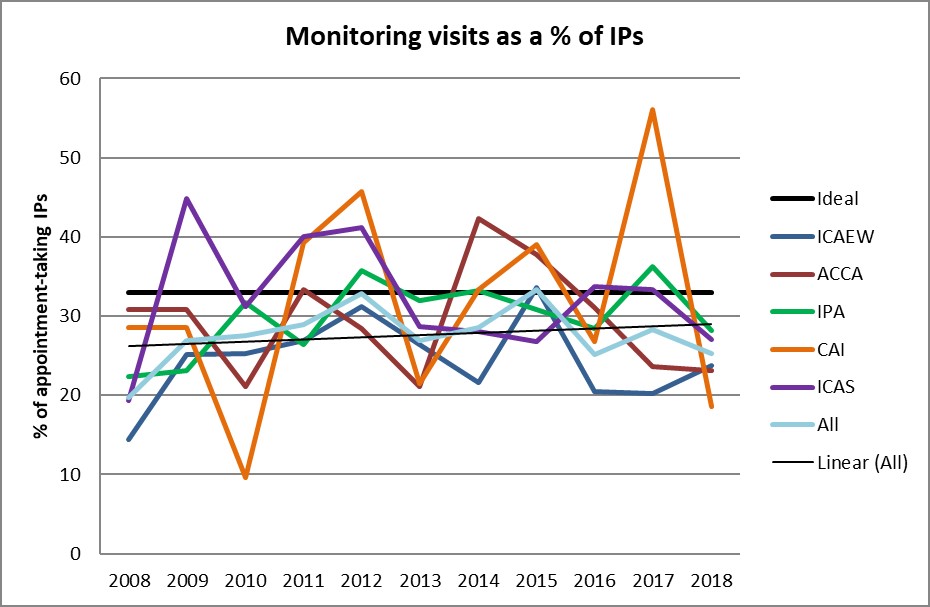
  • On average, a quarter of all IPs were visited last year
  • But is there a 3-yearly monitoring cycle any longer?
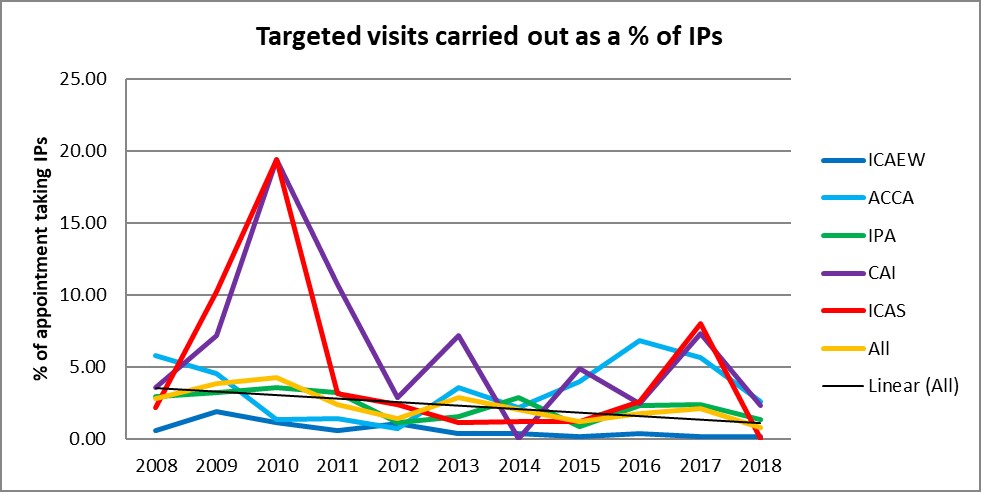
  • 2018 saw the fewest targeted visits on record
  • …but more targeted visits are expected in 2019
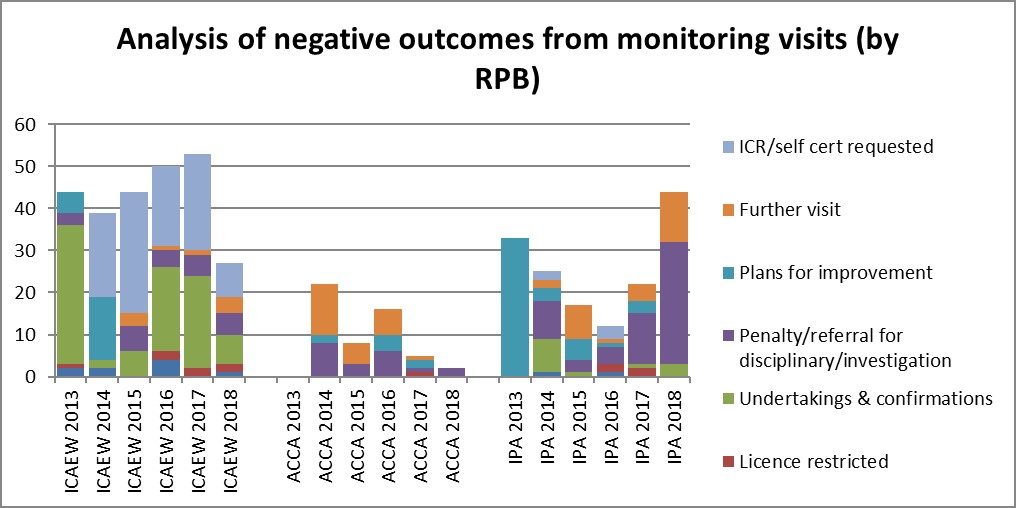
  • No RPB ordered any plans for improvement
  • Instead, monitoring penalties/referrals of disciplinary/investigation doubled
  • Is this a sign that the Insolvency Service’s big stick is hitting its target?
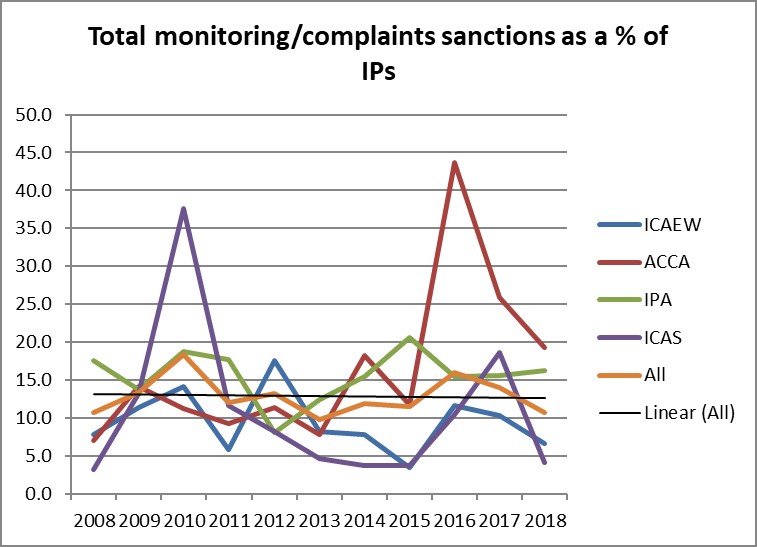
  • IPs had a 1 in 10 chance of receiving a monitoring or complaints sanction last year


How frequently are IPs being visited?

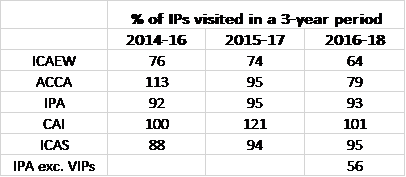
With the exception of the Chartered Accountants Ireland (which is not surprising given their bumper year in 2017), all RPBs visited around a quarter of their IPs last year.  It’s good to see the RPBs operating this consistently, but how does it translate into the apparent 3-yearly standard routine?

Firstly, I find it odd that coverage of ACCA-licensed IPs seems to have dropped significantly.  After receiving a fair amount of criticism from the InsS over its monitoring practices, the ACCA handed the regulating of its licensed IPs over to the IPA in October 2016.  Yet, the number of ACCA IPs visited since that time has dropped from the c.100% to 79%.

Another factor that I had overlooked in previous analyses is the effect of monitoring the volume IVA providers (“VIPs”).  At least since 2014, the Insolvency Service’s principles for monitoring VIPs has required at least annual visits to VIPs.  Drawing on TDX’s figures for the 2018 market shares in IVAs, the IPA licensed all of the IPs in the firms that fall in the InsS’ definition of a VIP.  On the assumption that each of these received an annual visit, excluding these visits would bring the IPA’s coverage over the past 3 years to 56% of the rest of their IPs.  Of course, there are many reasons why this figure could be misleading, including that I do not know how many VIP IPs any of the RPBs had licensed in 2016 or 2017.

The ICAEW’s 64% may also reflect its different approach to visits to IPs in the largest firms: the ICAEW visits the firm annually (to cover the work of some of their IPs), but, because of the large number of IPs in the firm, the gap between visits to each IP within the firm is up to 6 years.  I cannot attempt to adjust the ICAEW’s figure to exclude these less frequently visited IPs, but suffice to say that, if they were exceeded, I suspect we might see something approaching more of a standard c.3-yearly visit for all non-large firm ICAEW-licensed IPs.

These variances in the 3-year monitoring cycle standard, which cannot be calculated (by me at least) with any accuracy, mean that there is very little that can be gleaned from this graph.  Unfortunately, the average is no longer much of an indication to IPs of when they might expect to receive their next monitoring visit.


The IPA’s new approach to monitoring

In addition to its up-to-4-visits-per-year shift for VIPs, at its annual conference earlier this year, the IPA announced that it would also be departing from the 3-yearly norm for other IPs.

The IPA has published few details about its new approach.  All that I have seen is that the frequency of monitoring visits is on a risk-assessment basis (which, I have to say, it was in my days there, albeit that the InsS used to insist on a 3-year max. gap) and that it is a “1-6 year monitoring cycle – tailored visits to types of firm” (the IPA’s 2018/19 annual report).

In light of this vagueness, I asked a member of the IPA secretariat for some more details: was the plan only to extend the period for those in the largest firms, as the ICAEW has done, or at least only for those practices with robust in-house compliance teams with a proven track record?  The answer was no, it could apply to smaller firms.  He gave the example of a small firm IP who only does CVLs: if the IPA were happy that the IP could do CVLs well and her bond schedules showed that she wasn’t diversifying into other case types, she likely would be put on an extended monitoring cycle.  The IPA person saw remote monitoring as the key for the future; he said that there is much that can be gleaned from a review of docs filed at Companies House.  He explained, however, that IPs would not know what cycle length they had been marked up for.

While I do not wish to throw cold water on this development, as I have long supported risk-based monitoring, this does seem a peculiar move especially in these times when questions are being asked about the current regulatory regime: if a present concern is that the regulators are not adequately discouraging bad behaviour and that they are not expediting the removal of the  “bad apples”, then it is curious that the monitoring grip is being loosened now.

Also, now that I visit clients on an annual basis, I realise just how much damage can be done in a short period of time.  It only takes a few misunderstandings of the legislation, a rogue staff member or a hard-to-manage peak in activity (or an unplanned trough in staff resources) to result in some real howlers.  How much damage could be done in 6 years, especially if an IP were less than honest?  Desk-top monitoring can achieve only so much.

What this means for my analysis of the annual reports, however, is that the 3-year benchmark for monitoring visits – or one third of IPs being monitored per year – is no longer relevant ☹ But it will still be interesting to see how the averages vary in the coming years.


Targeted visits drop to an all-time low

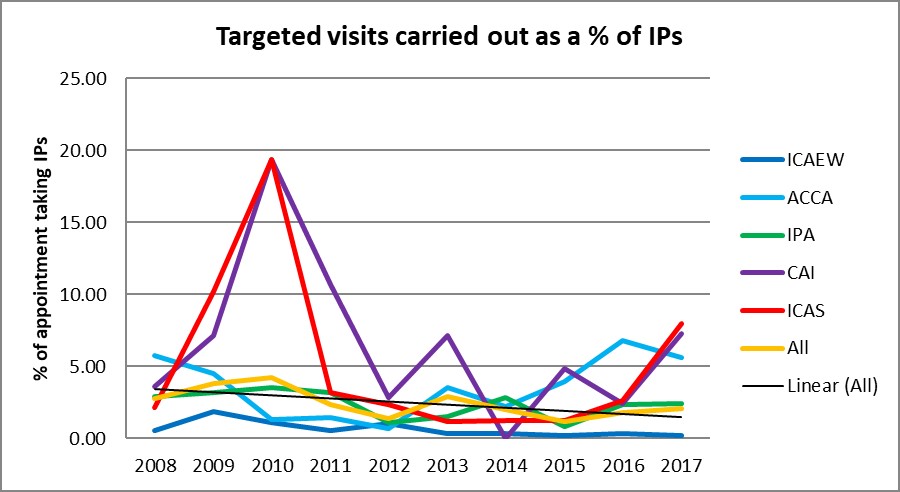
Only 10 targeted visits were carried out last year – the lowest number since the InsS started reporting them – and it seems that all RPBs are avoiding them in equal measure.

But 2019 may show a different picture, as several targeted visits have been ordered from 2018 monitoring visits…


Are the Insolvency Service’s criticisms bearing fruit?

I was particularly alarmed by the overall tone of the Insolvency Service’s “review of the monitoring and regulation of insolvency practitioners” published in September 2018.  In several places in the report, the InsS expressed dissatisfaction over some of the outcomes of monitoring visits.

I got the feeling that the Service disliked the focus on continuous improvement that, I think, has been a strength of the monitoring regime.  Instead, the Service expected to see more investigations and disciplinary actions arising from monitoring visit findings.  The report singled out apparently poor advice to debtors and apparently unfair or unreasonable fees or disbursements as requiring a disciplinary file to be opened with the aim of remedies being ordered.  It does seem that the focus of the InsS criticisms is squarely on activity in the VIPs, but the report did worry me that the criticisms could change the face of monitoring for everyone.  

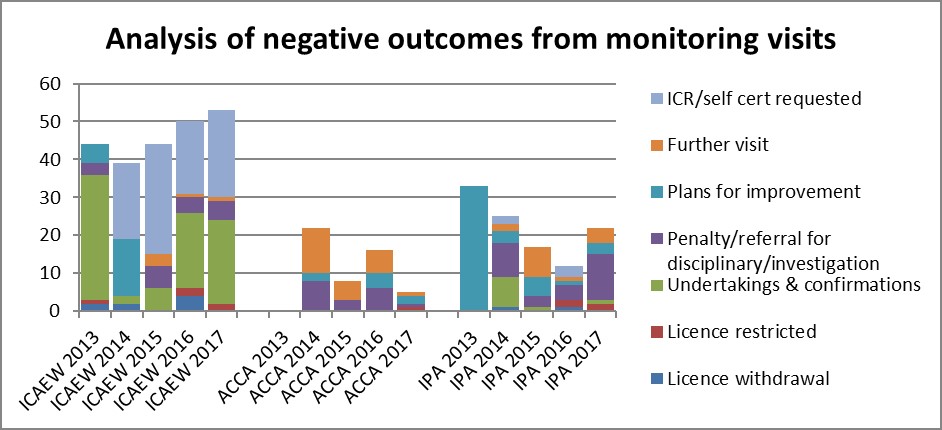
2018 is the first year (in the period analysed) in which no monitoring visit resulted in a plan for improvement.  On the other hand, the number of penalties/referrals for disciplinary/investigation action doubled.

Could the InsS’ report be responsible for this shift?  Ok, the report was published quite late in 2018, in September, but I am certain that the RPBs had a rough idea of what the report would contain long before then.  Or perhaps the Single Regulator debate has tempted some within the RPBs/committees to be seen to be taking a tougher line?  Or you might think that these kinds of actions are long overdue?

I think that the RPBs have tried hard over the last decade or so to overcome the negativity of the JIMU-style approach to monitoring.  In more recent years, monitoring has become constructive and there has been some commendably open and honest communication between RPB and IP.  This has helped to raise standards, to focus on how firms can improve for the future, rather than spending everyone’s time and effort analysing and accounting for the past.  It concerns me that the InsS seems to want to remove this collaborative approach and make monitoring more like a complaints process.  In my view, such a shift may result in many IPs automatically taking a more defensive stance in monitoring visits and challenging many more findings.  Such a shift will not improve standards and will take up much more time from all parties.

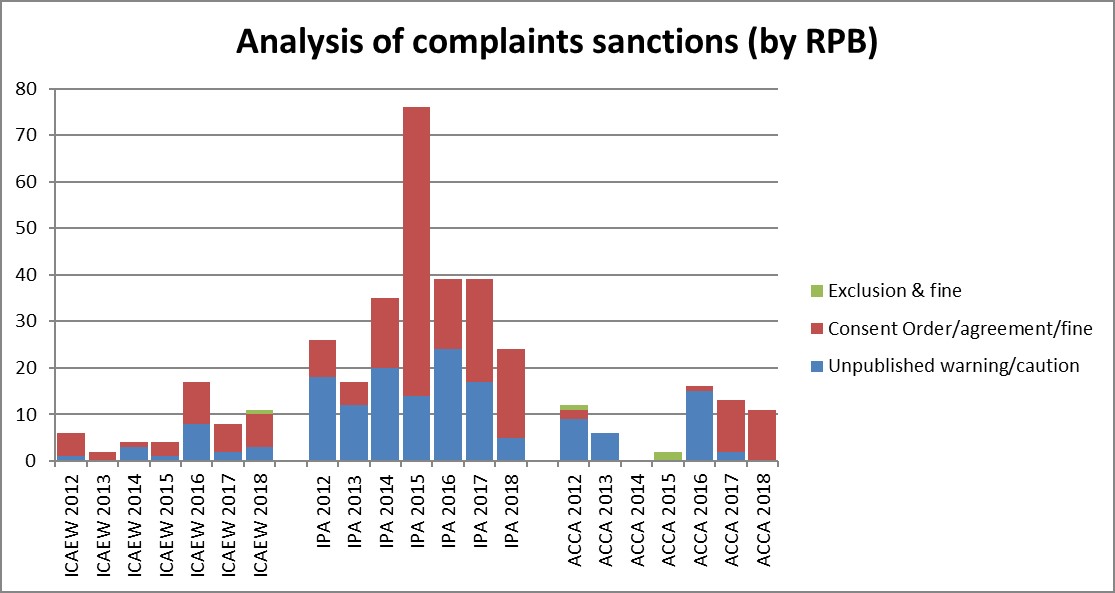
Getting back to the graph, of course a referral for an investigation might not result in a sanction at all, so this does not necessarily mean that the IPA has issued more sanctions as a consequence of monitoring visits.  Also, the IPA’s apparent enthusiasm for this tool may simply reflect the IPA’s (past) committee structure whereby the committee that considered monitoring reports did not have the power to issue a disciplinary penalty, but could only pass it on to the Investigation Committee.  As this was dealt with as an internal “complaint”, I suspect that any such penalty arising from this referral would have featured, not in the IPA’s monitoring visit outcomes, but in complaint outcomes.

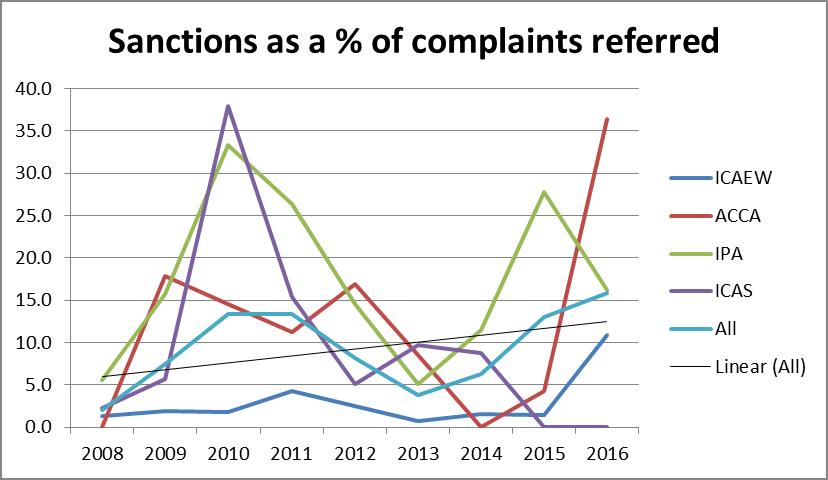
So how do the RPBs compare as regards complaints sanctions?


Complaints sanctions fall by a quarter

Although the IPA issued relatively fewer sanctions last year, I suspect that the monitoring visit referrals will take some time to work their way through to sanction stage, so it is unlikely that this demonstrates that the monitoring visit referrals led to a “no case to answer”.

What this and the previous graph show quite dramatically, though, is that last year the ICAEW seemed to issue far fewer sanctions per IP than the IPA.  As mentioned in my last blog, the IPA does license a large majority of the VIP IPs and there were more complaints last year about IVAs than about all the other case types put together.  One third of the published sanctions also were found against VIP IPs.


Likelihood of being sanctioned is unchanged from a decade ago

In 2018, you had a 1 in c.10 chance of receiving an RPB sanction, which was the same probability as in 2008…

I find it interesting to see the IPA’s and the ACCA’s results converge, which, if it were not for the suspected VIP impact, I would expect given that the IPA deals with both RPBs’ regulatory processes.

There’s not a lot that can be surmised from the number of sanctions issued by the other two RPBs: they’re a bit spiky, but it does seem that, on the whole, the ICAEW and ICAS has issued much fewer sanctions.  It seems from this that, at least for last year, you were c.half as likely to receive a sanction if you were ICAEW- or ICAS-licensed as you were if you were IPA- or ACCA-licensed.


Is a Single Regulator the answer to bringing consistency?

True, these graphs do seem to indicate that different regulatory approaches are implemented by different RPBs.  However, I do think that some of that variation is due to the different make-up of their regulated populations.  There is no doubt that the IVA specialists do require a different approach.  To a lesser degree, I think that a different approach is also merited when an RPB monitors practices with robust internal compliance teams; it is so much more difficult to have your work critiqued and challenged on a daily basis when you work in a 1-2 IP practice.

Differences in approach can also be a good thing.  Seeing other RPBs do things differently can force an RPB to challenge what they themselves are doing and to innovate.  My main concern with the idea of a single regulator is the loss of this advantage of the multi-regulator structure.

Perhaps a Single Regulator could bring in more consistency, but it would never result in perfectly consistent outcomes.  I’m sure I’m not the only one who remembers an exercise a certain JIEB tutor ran: all us students were given the same exam answer to mark against the same marking guide.  The results varied wildly.  This demonstrated to me that, as long as humans are involved in the process, different outcomes will always emerge.


4 Comments

InsS Annual Review, part 2: IP number is down but complaints are up

The number of IPs just keeps on falling, but complaints have increased.  What is going on?

In this blog, I explore whether the Insolvency Service’s 2018 report on IP regulation provides the answer.  Also, is it just a blip?  And could this analysis help with the Service’s recently-issued call for evidence on IP regulation?

The Insolvency Service’s report can be found at: https://www.gov.uk/government/publications/insolvency-practitioner-regulation-process-review-2018

In brief, the report indicates that, in 2018:

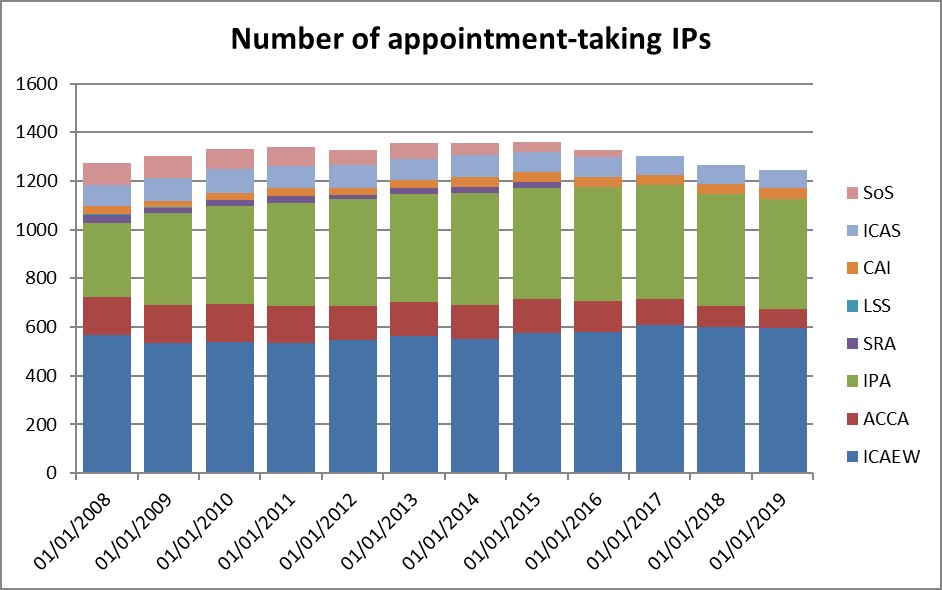
  • Despite insolvency case numbers increasing, IPs continued to leave the profession
  • Actions that most often appeared in RPB sanctions were: poor case progression/closure; faults in administering IVAs; and breaches of statutory filing/reporting requirements
  • Only two complaints (of the 381 referred to the RPBs) had been received from creditors! As usual, debtors were the most frequent complainers, but complaints lodged by directors and IPs showed quite an increase
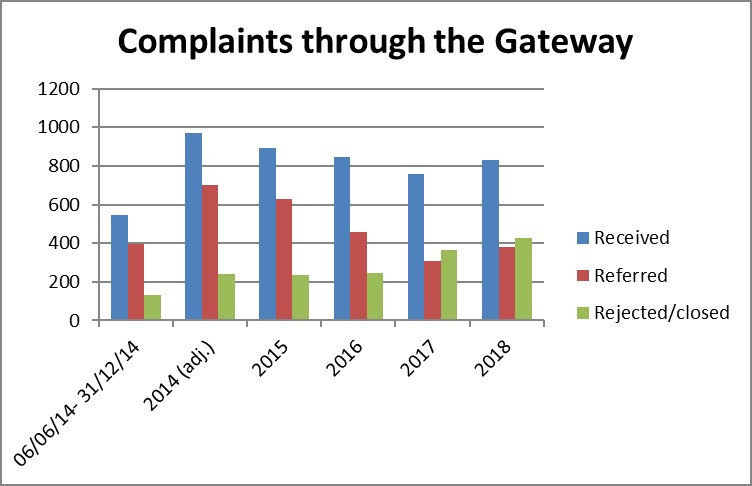
  • Over 50% of the complaints lodged at the Gateway did not make it through to the RPBs
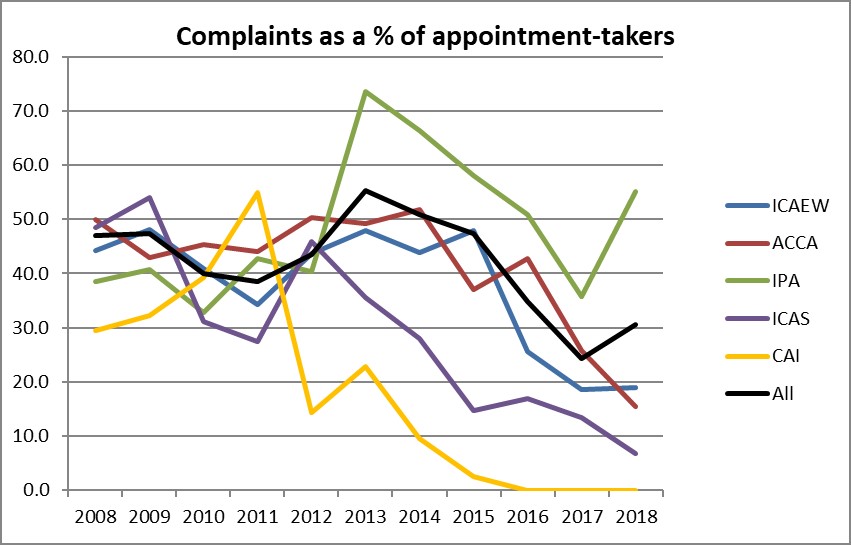
  • On average, one in three IPs received a complaint, but this figure jumped to more than one in every two for IPA-licensed IPs
  • Could this be because the IPA licenses all the IPs in the top six volume IVA provider firms (who registered over 75% of all new IVAs last year)..?
  • Over 50% of all complaints referred to the RPBs related to IVAs


Case numbers go up but IP numbers keep on going down

There has been a significant increase in insolvency case numbers over the past 3 years.  There were 20% more corporate insolvencies and over 40% more personal insolvencies started in 2018 than the numbers started in 2015.  Isn’t now a good time to be in insolvency..?

These statistics reflect my personal experience: over the past year, I have known of IPs who have left the profession and they’ve not all been of retiring age.  What is happening?

There’s no doubt in my mind that competition has become fiercer.  I have seen more occasions of IPs being toppled from offices and the ORs seem all the more reluctant to allow cases to leave their hands.  I have also seen some new ambulance-chasers on the field.

I think that small firms are struggling in this market.  It seems to me that larger firms seem hungrier to fight for smaller cases than they used to be.  In addition, 2018 was not a regulation-light year: it seemed that simply getting GDPR-ready was someone’s full-time job for several months, which was not at all easy for smaller firms to stomach.  Recruitment and retention are also difficult for smaller firms: new talent is attracted to big names, big cities, meaty cases and varied portfolios.

Fewer IPs and more cases mean that each IP has on average a larger caseload (or it could be that the IPs are closing them quicker, but from my personal experience, I don’t think this is happening).  If insolvency cases continue to increase, which I think is generally expected, then I think case progression is going to become a bigger concern.  Of course, IPs can always look to surround themselves with a larger team to deal with their larger caseloads, but we all know that this tends not to happen: in times of plenty, old cases tend to be shelved while people concentrate on the new excitements.


Is case progression already an issue?

The Insolvency Service’s report gives brief descriptions of every RPB sanction issued (including a couple that weren’t even published on .gov.uk – not sure how that happened!).  On categorising these summaries, I have come up with the following failures that appear most frequently in the disciplinary sanctions reported:

  • 7 case progression / closure issues (including one failure to realise assets and two failures to pay a dividend – not sure if these were delays or entirely overlooked)
  • 6 IVA-related faults (not including case progression / closure)
  • 6 statutory filing/reporting breaches
  • 3 SIP16 breaches
  • 3 faults in relation to directors’ RPO claims
  • 3 fee-related errors
  • 3 confidentiality breaches (perhaps related?)
  • 2 PTD-related faults
  • 2 SIP2 failures to investigate or to secure books and records

This shows that failing to progress cases promptly or appropriately can get you into hot water.  So too can failing to meet the rules on filing and reporting: four of the six instances listed arose because progress reports were not filed on time (or at all).


What are people complaining about?

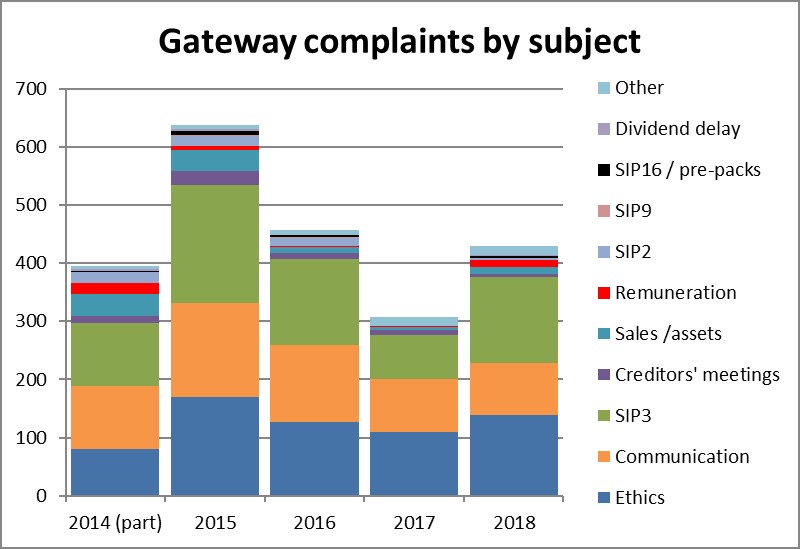
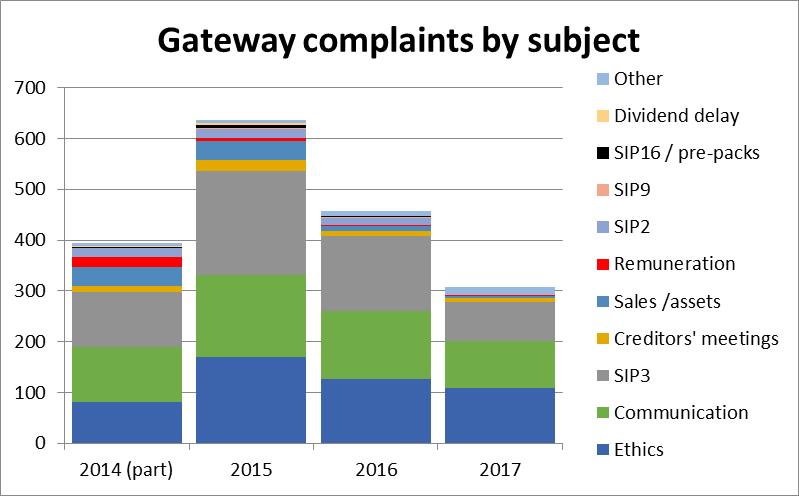
The Top 3 topics continue to be ethics, poor communication and SIP3 issues, with the latter now counting for 34% of all complaints recorded by subject, up from 25% last year:

(Note: a complaint may appear in more than one category.  There were a total of 381 complaints referred in 2018 – see further below.)

Ok, that’s not a surprise.  We all know that the Insolvency Service’s report in September 2018 pulled no punches when it came to the RPB-monitoring of volume IVA providers.  It is also unsurprising that people are not directly complaining about late or missing progress reports, but as the sanctions demonstrate, if a statutory filing/reporting breach is identified in the course of the RPB’s investigations into a complaint, don’t be surprised if this is added to your charge sheet.

What we should perhaps be a little concerned about is that complaints on areas that attract a lot of negative press and criticism – SIP16/pre-packs and remuneration – have increased.  True, they still pale into insignificance when compared with the total number of complaints (they account for only 16 of the 429 complaints recorded by subject), but this is quite a jump from the one complaint in 2017.


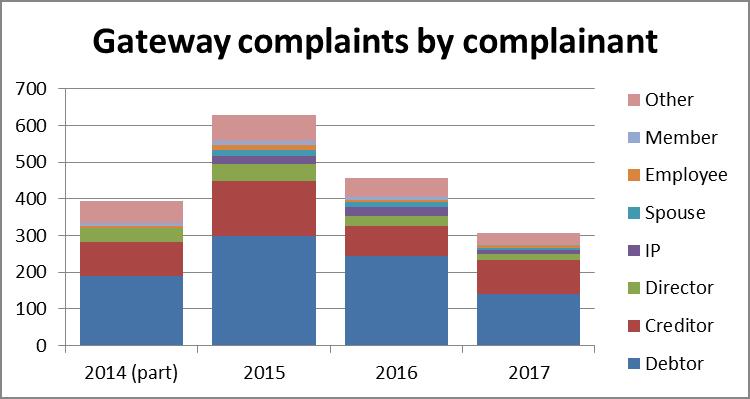
Who is complaining?

I think this shows an interesting shift:

With IVAs featuring so heavily in complaints, it is not surprising that debtors are the most frequent complainant.  More bankruptcies were complained about in 2018 too (up from 31 to 75), which no doubt contributed to the increase in complaining debtors.

What I found interesting was that very few creditors complained last year – only two!  Even if we add in complaints from employees, this only comes to seven.  However, the number of complaints lodged by IPs more than trebled to 38.  Ok, this is still a relatively small number, but I think it hints at an interesting development in self-regulation: RPB monitors may only visit you once every 3 years or so, but your peers are watching you all the time!


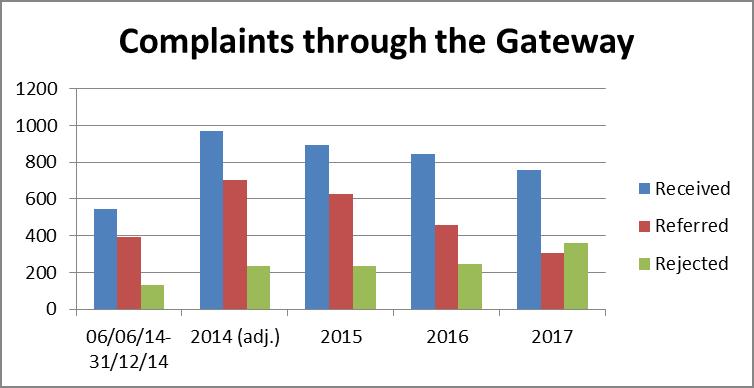
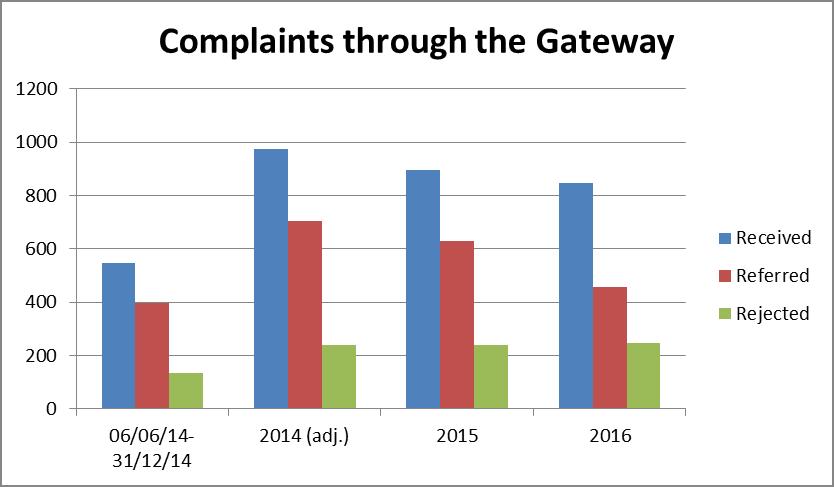
How many complaints get through the Gateway?

(Note: the Gateway started in June 2014, so I have pro rated the partial 2014 figure to estimate for a full year.)

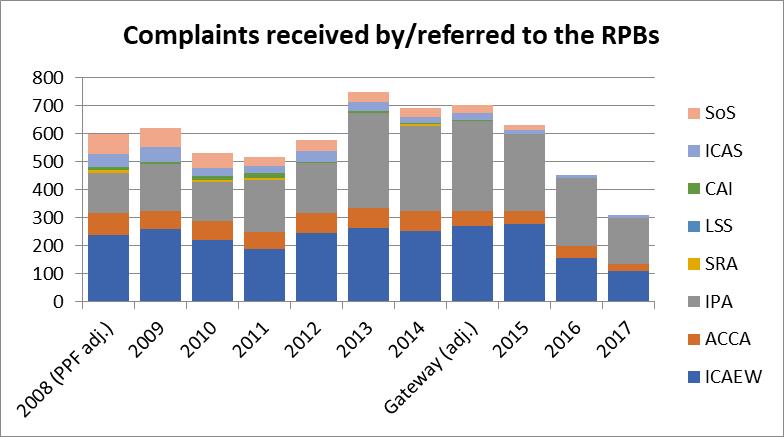
Complaint numbers are back up to the 2016 level: in 2016, 847 complaints were lodged and in 2018 the number was 830.  However, many more complaints fail to make it through the Gateway.  In fact, every year, the number rejected/referred has increased, even though the trend in complaint numbers shows an overall decrease.  In 2017, 48% of complaints were rejected or closed and this percentage increased to 52% last year.


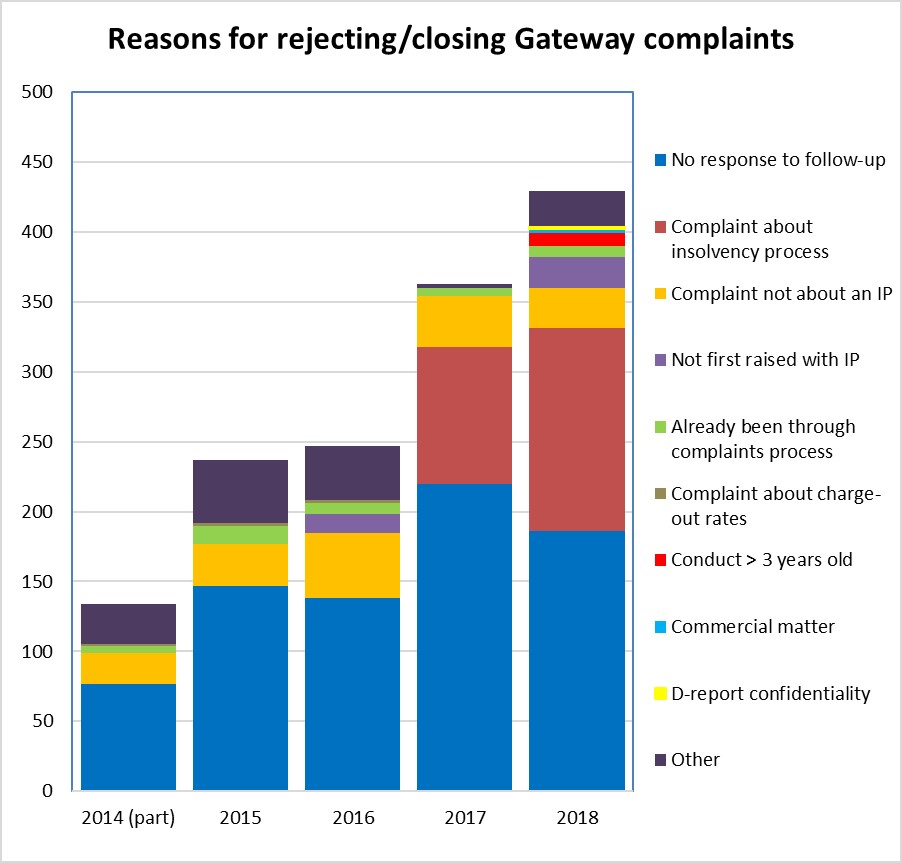
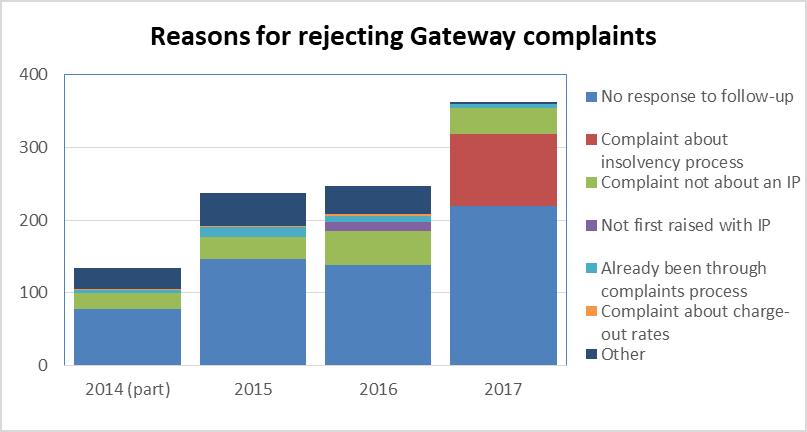
Why are complaints not making it through the Gateway?

In their 2018 report, the Insolvency Service added a number of new reasons for rejection/closure, which personally has helped me to understand the operation of the Gateway better.  For example, I hadn’t appreciated that complaints about conduct that happened over 3 years ago are rejected.

This graph also demonstrates that a large number of complaints (145) – and a great deal more than in 2017 – are rejected because the complaint is about the insolvency process.  Again, given that most complaints are lodged by debtors and directors, this perhaps indicates that in many cases IPs may be upsetting the right people.  But it might also suggest that some IPs could do a better job of explaining the consequences of insolvency.


What are an IP’s chances of receiving a complaint?

Yes I know that some IPs work in a field that is more likely to attract criticism, but on average how many IPs received a complaint last year and does this average change much depending on one’s licensing body?

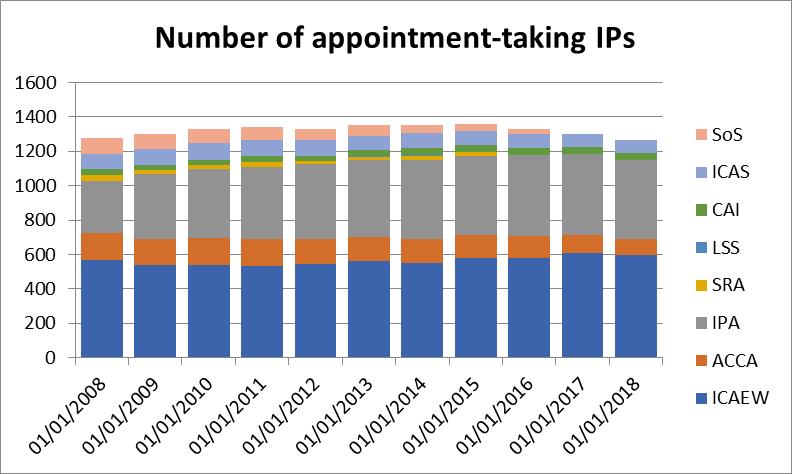
This shows that, generally speaking, one out of every three IPs receives a complaint.  Of course, this assumes that complaints are only about appointment-takers and that complaints are evenly spread about.

However, it also shows a large range in averages across the RPBs, with less than one in five IPs for all except the IPA, which shows an average of over one complaint for every two IPs.

The IPA has publicised that “the majority of IPs who work on IVAs are regulated by the IPA” (IPA press release 29/11/2018)… although, as the IPA does not license the majority of all IPs, a large proportion of which will have at least one IVA, presumably they’re meaning those who do IVAs in volume.  Does this, along with the graph above, mean that volume IVA providers disproportionately feature in complaints?


How many Volume IVA IPs does the IPA license?

The Insolvency Service now publishes data on new IVAs per firm: https://www.gov.uk/government/statistics/individual-voluntary-arrangement-outcomes-and-providers-2018, which helped me out with this question.

An analysis of this list shows that the IPA licenses all the IPs registered at the Top 6 firms.  These firms alone account for over 75% of all IVAs registered in 2018.  Even if we look at the whole list of Top 14 firms (two of which no longer exist!), the IPA licenses 25 of the 33 IPs registered at these firms (with the ICAEW licensing 3 and ICAS the remaining 5, all 5 of which are located at the one firm).

So clearly then, the IPA’s complaints figures are bound to be affected by the number of IVA complaints lodged.  But this assumes that IVAs count for a large proportion of complaints.  Is this true?


How many IVAs are being complained about?

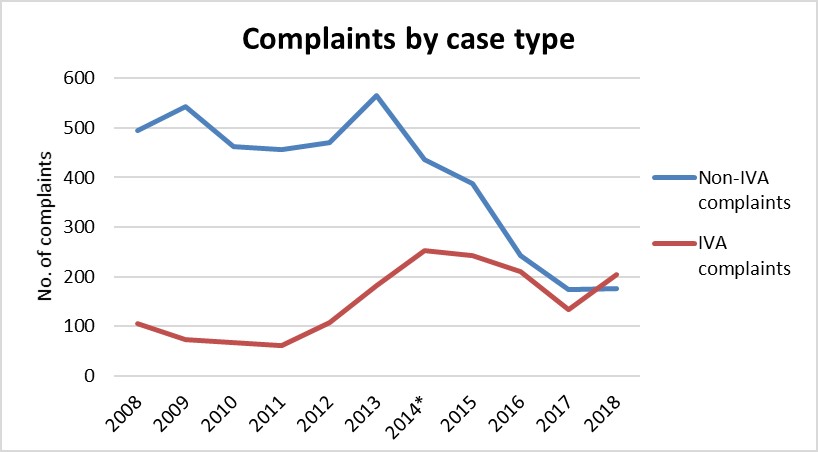
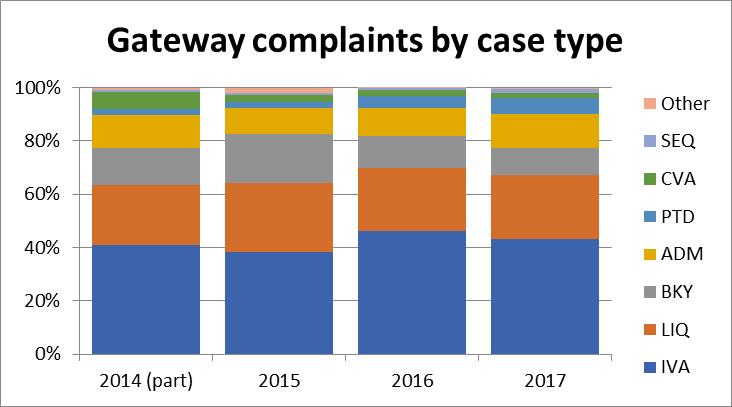
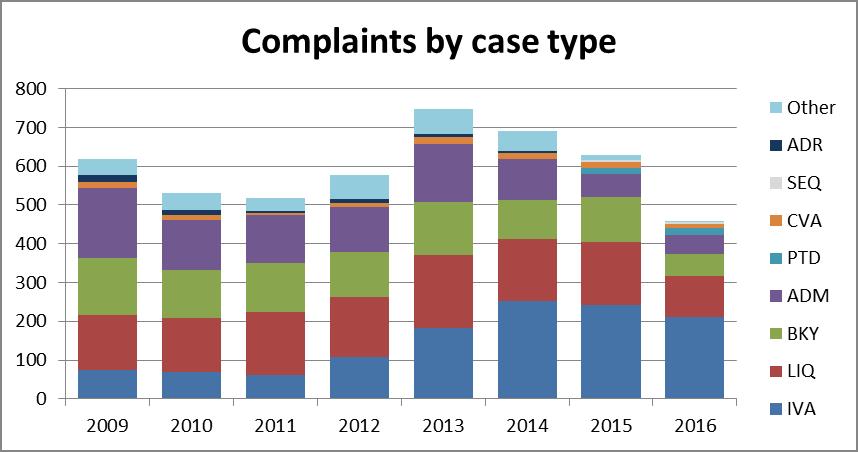
The following graph compares the number of IVA complaints with those about other matters:

(Note: the Gateway started in June 2014.  The way complaint numbers were published by case type then changed from those recorded by the RPBs to those referred to the RPBs from the Gateway.)

So for the first time, last year there were more IVA complaints than there were complaints about all other matters/case-types combined.  It’s no wonder therefore that the IPA has recorded many more complaints per IP than any other RPB and it’s not surprising that the IPA has sought to recruit more regulatory staff… and that they have warned IPA members that fees may be increasing this year!

I appreciate that the Insolvency Service did (finally!) wake up to some of the issues around regulating volume IVA providers last year and I accept that the IPA has made some public announcements about how they have been working towards changing their monitoring regime for the IPs in these firms.  However, as someone who has spent the last few years almost exclusively helping IPs in “traditional” insolvency practices, I do wonder if a disproportionate amount of time has been spent by the regulators (and government and the press) in criticising, legislating and threatening to legislate to remedy other apparent ills of the insolvency profession.


Is the solution a change in regulatory approach?

Interestingly, the Service’s just-released call for evidence on IP regulation (pg 15 of the doc at https://www.gov.uk/government/consultations/call-for-evidence-regulation-of-insolvency-practitioners-review-of-current-regulatory-landscape) focuses in on the different firm structure that exists in some IVA specialists where the IP is an employee.  This leads them to ask the question of whether firm-regulation, rather than individual IP-regulation, may be more appropriate in some sectors.  While I think that the Service definitely has a point, I do think that there are other fundamental differences in “volume IVA providers” – the hint is in the name – that also demand a fundamentally different regulatory approach.


In my next blog post, I’ll look more closely at complaint – and monitoring – sanctions.


2 Comments

The Insolvency Service’s To-Do List: Going Nowhere Fast?

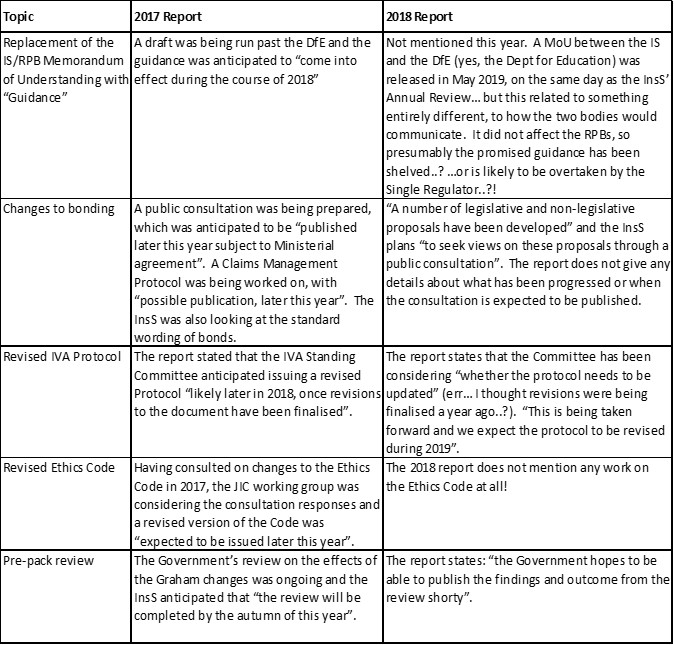
I’ll start my review of the Insolvency Service’s Annual Review of IP Regulation in reverse order this year.  Let’s first look at the progress made on the InsS’ 2017 to-do list.

Here’s a comparison of items listed in their 2017 Report with their 2018 Report, which has just been published (at https://www.gov.uk/government/publications/insolvency-practitioner-regulation-process-review-2018):

Of course, Ministers have had a few other things on their mind over the past year… but the landscape has not changed much since May 2018 when the 2017 report was published, so I would have hoped that the Insolvency Service would have anticipated realistic timescales back then.


So, if the above projects have not progressed as anticipated last year, what has the InsS achieved in 2018 and are they proposing any other outputs in the year ahead?

  • Taking on the role of a direct regulator?

It all sounds a bit secret squirrel, but the report’s overview emphasises the Service’s investigatory work.  It seems that their staff have identified and been referring “potential criminal offences by insolvency practitioners”, they “have been making effective use of information gathering powers to investigate areas of concern leading to a number of referrals to appropriate bodies” and they have “used our powers to undertake our own enquiries on a number of occasions”.  They expect to “report on what we have found when we are able to, given the progress of the investigation”.

  • The Single Regulator question

Of course, this is going to be the focus of a lot of the Service’s efforts.  I found the report alarming: it states both that they are considering “whether or not to consult on a single regulator” and that they are hoping to reach a position on “a recommendation on whether or not to exercise the power” to create a single regulator.  So… could they decide on the single regulator question without consultation?!

In any event, however, they are expecting “to publish shortly” a “formal call for evidence”, so at least we may have an opportunity to contribute something.

  • Last year’s report on RPB monitoring

I didn’t have a chance to blog on the subject, but I’m sure the Service’s September 2018 report on RPB monitoring did not pass you by.  The report was pretty scathing about much of the monitoring of volume IVA providers and included many recommendations, largely focusing on the extents to which they felt RPBs should be investigating, and taking to task, IPs who appear to be failing: to provide appropriate advice; to pay fees and expenses from estates that are fair and reasonable; and to manage the ethical threats arising from relationships with introducers and service-providers.

The Service’s 2018 Annual Report states that they are in the process of reviewing how the recommendations from the earlier review are being implemented by the RPBs and that this would inform their Single Regulator work – no threat there, then!

  • SIP revisions

So… no sign of a revised Ethics Code, but we do learn about the JIC’s work on revising SIPs.  In their in-box at the moment are:

    • SIP3.2, which is expected to be out for consultation “later this year”. Apparently, the revision work has come about “due to concerns about certain types of large CVAs where better and timelier information could be given to creditors”.  Interesting… but don’t we have the Act and Rules to tell us what IPs must send to creditors and by when?
    • SIP7 – a consultation on this is also expected “later this year”.
    • SIP9 – on the back of the concerns arising from the review of RPB monitoring of volume IVA providers and the “industry concerns over the charging of certain expenses and disbursements, primarily in the volume IVA sector” (so not just IVAs then..?), there has been ongoing work “to consider if a review of SIP9 is necessary”. The report also states that there has been work with the RPBs and R3 “to obtain data in order to assess the impact that possible changes to the way some charges ought to be applied would have on smaller firms”.  Debates over what are valid expenses/disbursements and what should be treated as an overhead have been rumbling for several years now and if the question is still “if” SIP9 should be changed, then it seems to me that an outcome could still be a long way from emerging.


So, the Service’s to-do list never gets any shorter, does it?  And it seems to me that the usual project-management rule applies to insolvency projects: estimate the timescale and then double it!

In my next blog, I’ll look at the complaints and monitoring stats… or I may get back to my 50 Things list…


Leave a comment

The stats of IP Regulation – Part 2: Monitoring


As promised, here are my thoughts on the RPBs’ 2017 monitoring activities, as reported by the Insolvency Service:

  • The InsS goes quiet on RPBs’ individual performances
  • Two RPBs appear to have drifted away from 3-yearly visits
  • The RPBs diverge in their use of different monitoring tools
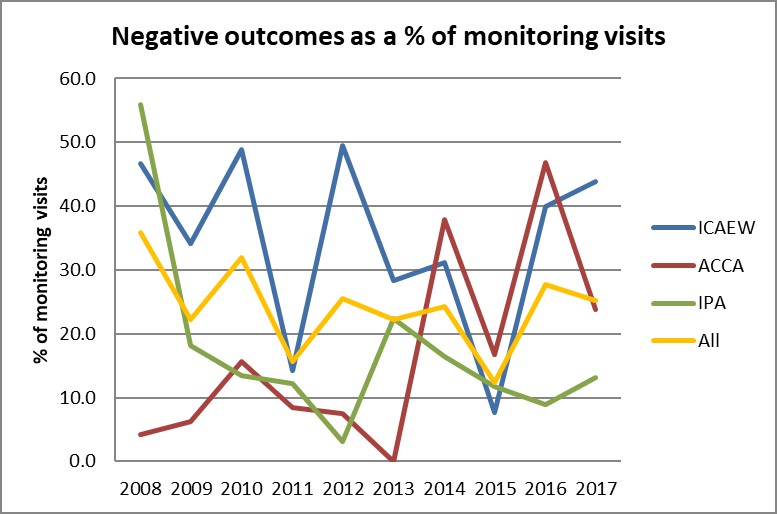
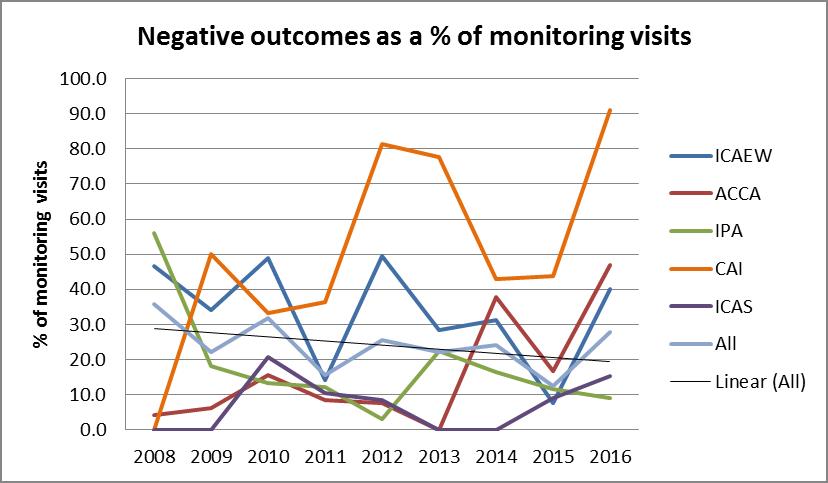
  • On average, ICAEW visits were over three times more likely to result in a negative outcome than IPA visits
  • On average, every fourth visit resulted in one negative outcome
  • But averages can be deceptive…

As a reminder, the Insolvency Service’s report on 2017 monitoring can be found at: https://tinyurl.com/ycndjuxz

The picture becomes cloudy

As can be seen on the Insolvency Service’s dedicated RPB-monitoring web-page – https://www.gov.uk/government/collections/monitoring-activity-reports-of-insolvency-practitioner-authorising-bodies – their efforts to review systematically each RPB’s regulatory activities seemed to grind to a halt a year ago.  The Service did report last year that their “future monitoring schedule” would be “determined by risk assessment and desktop monitoring” and they gave the impression that their focus would shift from on-site visits to “themed reviews”.  Although their annual report indicates that such reviews have not always been confined to the desk-top, their comments are much more generic with no explanation as to how specific RPBs are performing – a step backwards, I think.


Themed review on fees

An example of this opacity is the Service’s account of their themed review “into the activities, and effectiveness, of the regulatory regime in monitoring fees charged by IPs”.

After gathering and reviewing information from the RPBs, the InsS reports: “RPBs responses indicate that they have provided guidance to members on fee matters and that through their regulatory monitoring; fee-related misconduct has been identified and reported for further consideration”.

For this project, the InsS also gathered information from the Complaints Gateway and has reported: “Initial findings indicate that fee related matters are being reported to the IP Complaints Gateway and, where appropriate, being referred to the RPBs”.

Ohhhkay, so that describes the “activities” of the regulatory regime (tell us something we don’t know!), but how exactly does the Service expect to review their effectiveness?  The report states that their work is ongoing.

Don’t get me wrong, it’s not that I necessarily want the Service to dig deeper.  For example, if the Service’s view is that successful regulation of pre-packs is achieved by scrutinising SIP16 Statements for technical compliance with the minutiae of the disclosure checklist, I dread to think how they envisage tackling any abusive fee-charging.  It’s just that, if the Service thinks that they are really getting under the skin of issues, personally I hope they are doing far more behind the scenes… especially as the Service is surely beginning to gather threads on the question of whether the world would be a better place with a single regulator.

So let’s look at the stats…


How frequently are you receiving monitoring visits?

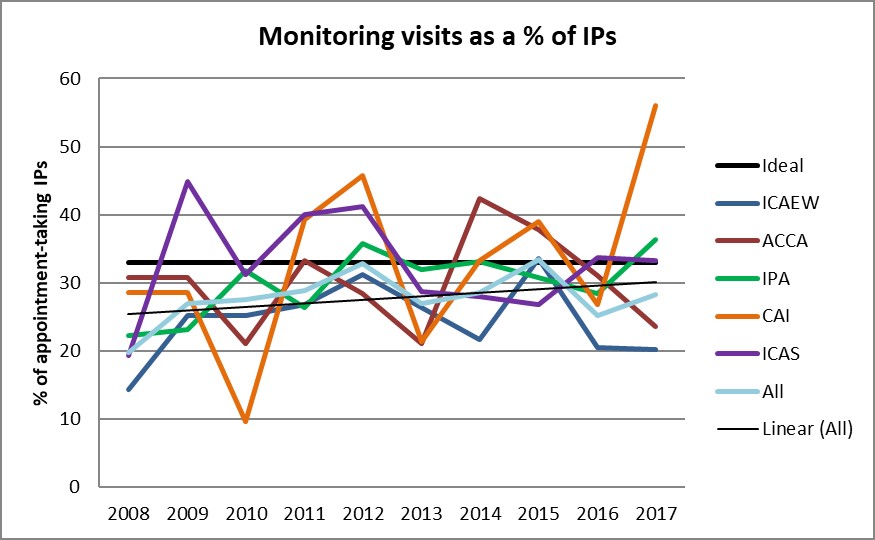
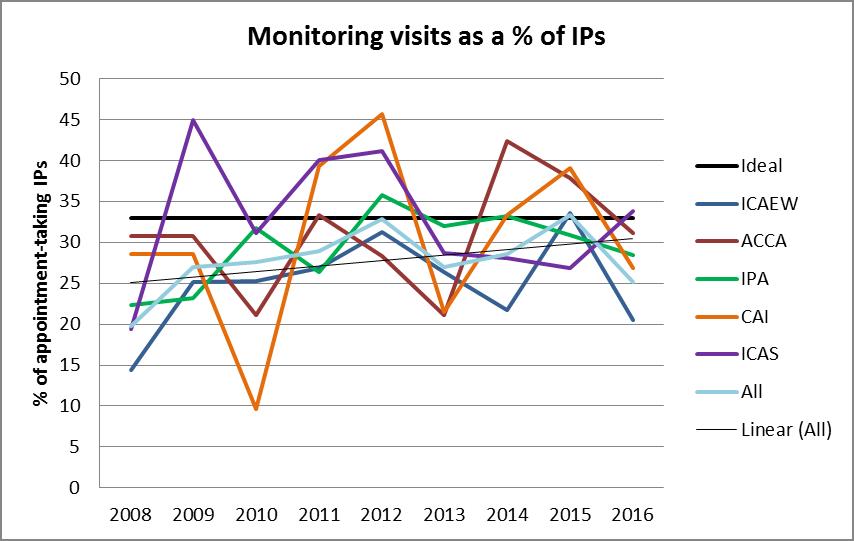
There is a general feeling that every IP will receive a monitoring visit every three years.  But is this the reality?

This shows quite a variation, doesn’t it?  For two years in a row, significantly less than one third of all IPs were visited in the year.  Does this mean the RPBs have been slipping from the Principles for Monitoring’s 3-year norm?

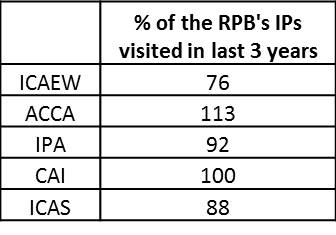
The spiky CAI line in particular demonstrates how an RPB’s visiting cycle may mean that the number of visits per year can fluctuate wildly, but how nevertheless the CAI’s routine 3-yearly peaks and troughs suggest that in general that RPB is following a 3-yearly schedule.  So what picture do we see, if we iron out the annual fluctuations?

This looks more reasonable, doesn’t it?  As we would expect, most RPBs are visiting not-far-off 100% of their IPs over three years… with the clear exceptions of CAI, which seems to be oddly enthusiastic, and the ICAEW, which seems to be consistently ploughing its own furrow.  This may be the result of the ICAEW’s style of monitoring large firms with many IPs, where each year some IPs are the subject of a visit, but this may not mean that all IPs receive a visit in three years.  Alternatively, could it mean they are following a risk-based monitoring programme..?

There are benefits to routine, regular and relatively frequent monitoring visits for everyone, almost irrespective of the firm’s risk profile: it reduces the risk that a serious error may be repeated unwittingly (or even deliberately).  However, this model isn’t an indicator of Better Regulation (see, for example, the Regulators’ Compliance Code at https://www.gov.uk/government/publications/regulators-compliance-code-for-insolvency-practitioners).  With the InsS revisiting their MoU (and presumably also the Principles for Monitoring) with the RPBs, I wonder if we will see a change.


Focussing on the Low-Achievers?

The alternative to the one-visit-every-three-years-irrespective-of-your-risk-profile model is to take a more risk-based approach, to spend one’s monitoring efforts on those that appear to be the highest risk.  This makes sense to me: if a firm/IP has proven that they are more than capable of self-regulation – they keep up with legislative changes, keep informed even of the non-legislative twists and turns, and don’t leave it solely to the RPBs to examine whether their systems and processes are working, but they take steps quickly to resolve issues on specific cases and across entire portfolios and systems – why should licence fees be spent on 3-yearly RPB monitoring visits, which pick up non-material non-compliances at best?  Should not more effort go towards monitoring those who seem consistently and materially to fail to meet required standards or to adapt to new ones?

But perhaps that’s what being done already.  Are many targeted visits being carried out?

It seems that for several years few targeted visits have been conducted, although perhaps the tide is turning in Scotland and Ireland.  The ACCA also performed a number, although now that the IPA team is carrying out monitoring visits on ACCA-licensed IPs, I’m not surprised to see the number drop.

It seems that targeted visits have never really been the ICAEW’s weapon of choice.  At first glance, I was a little surprised at this, considering that their monitoring schedule seems less 3-yearly rigid than the other RPBs.  Aren’t targeted visits a good way to monitor progress outside the routine visit schedule?  Evidently, the ICAEW is not using targeted visits to focus effort on low-achievers.  Perhaps they are tackling them in another way…


Wielding Different Sticks

I think this demonstrates that the ICAEW isn’t lightening up: they may be carrying out less frequent monitoring visits on some IPs, but their post-visit actions are by no means infrequent.  So perhaps this indicates that the ICAEW is focusing its efforts on those seriously missing the mark.

The ICAEW’s preference seems to be in requiring their IPs to carry out ICRs.  Jo’s and my experiences are that the ICAEW often requires those ICRs to be carried out by an external reviewer and they require a copy of the reviewer’s report to be sent to the ICAEW.  They also make more use than the other RPBs of requiring IPs to undertake/confirm that action will be taken.  I suspect that these are often required in combination with ICR requests so that the ICAEW can monitor how the IP is measuring up to their commitments.

And in case you’re wondering, external ICRs cost less than an IPA targeted visit (well, the Compliance Alliance’s do, anyway) and I like to think that we hold generally to the same standards, so external ICRs are better for everyone.

In contrast, the IPA appears to prefer referring IPs for disciplinary consideration or for further investigation (the IPA’s constitution means that technically no penalties can arise from monitoring visits unless they are first referred to the IPA’s Investigation Committee).  However, the IPA makes comparatively fewer post-visit demands of its IPs.  But isn’t that an unfair comparison, because of course the ICAEW carried out more monitoring visits in 2017?  What’s the picture per visit?


No better and no worse?

Hmm… I’m not sure this graph helps us much.  Inevitably, the negative outcomes from monitoring visits are spiky.  We’re not talking about vast numbers of RPB slaps here (that’s why I’ve excluded the smaller RPBs – sorry guys, nothing personal!) and the “All” line (which does include the other RPBs) does illustrate a smoother line overall.   But the graph does suggest that ICAEW-licensed IPs are over three times as likely to receive a negative outcome from a monitoring visit than IPA-licensed IPs. 

Before you all get worried about your impending or just-gone RPB visit, you should remember that a single monitoring visit can lead to more than one negative outcome.  For example, as I mentioned above, the RPB could instruct an ICR or targeted visit as well as requiring the IP to make certain undertakings.  One would hope that much less than 25% of all IPs visited last year had a clean outcome!

This doubling-up of outcomes may be behind the disparity between the RPBs: perhaps the ICAEW is using multiple tools to address a single IP’s problems more often than the other two RPBs… although why should this be?  Alternatively, perhaps the ICAEW’s record again suggests that the ICAEW is focusing their efforts on the most wayward IPs.


Choose Your Poison

I observed in my last blog (https://tinyurl.com/y8b4cgp7) that the complaints outcomes indicated that the IPA was far more likely to sanction its IPs over complaints than the ICAEW was.  I suggested that maybe this was because the IPA licenses more than its fair share of IVA specialists.  Nevertheless, I find it interesting that the monitoring outcomes indicate the opposite: that the ICAEW is far more likely to sanction on the back of a visit than the IPA is.

Personally, I prefer a regime that focuses more heavily on monitoring than on complaints.  Complaints are too capricious: to a large extent, it is pot luck whether someone (a) spots misconduct and (b) takes the effort to complain.  As I mentioned in the previous blog, the subjects of some complaints decisions are technical breaches… and which IP can say hand-on-heart that they’ve never committed similar?

Also by their nature, complaints are historic – sometimes very historic – but it might not matter if an IP has since changed their ways or whether the issue was a one-off: if the complaint is founded, the decision will be made; the IP’s later actions may just help to reduce the penalty.

In my view, the monitoring regime is far more forward-looking and much fairer.  Monitors look at fresh material, they consider whether the problem was a one-off incident or systemic and whether the IP has since made changes.  The monitoring process also generally doesn’t penalise IPs for past actions, but rather what’s important are the steps an IP takes to rectify issues and to reduce the risks of recurrence.  The process enables the RPBs to keep an eye on if, when and how an IP makes systems- or culture-based changes, interests that are usually absent from the complaints process.


Next blog: SIP16, pre-packs and other RPB pointers.


4 Comments

The stats of IP Regulation – Part 1: Complaints

My annual review of the Insolvency Service’s 2017 IP regulation report has thrown up the following:

  • The number of IPs drops again – the third year in a row
  • Good news: 2017 saw half as many complaints referred through the Gateway as 2015
  • This may be partly due to the Insolvency Service’s sifting process: almost half of all complaints put to the Gateway in 2017 were sifted out
  • Sadly, despite the overall reduction, there were more sifted-in complaints from creditors in 2017 than in the previous year
  • The RPBs seem to be generating more complaints sanctions: 10 years’ ago, 1 IP in 100 could receive a complaints sanction; now it is c.1 in 20

The Insolvency Service’s report can be found at: https://tinyurl.com/ycndjuxz


IPs leaving the profession

As the following graph shows, the number of appointment-taking IPs has fallen for the third year in a row:In ICAS’ 2017 monitoring report (https://www.icas.com/regulation/insolvency-monitoring-annual-reports), that RPB puts the decrease down to the number of IPs who have retired, which I suspect is probably the case across the board.  And we’re not seeing their number being replaced by new appointment-takers.  I can’t say I’m surprised at that either: regulatory burdens and personal risks continue to mushroom, formal insolvency cases (especially those with assets) appear more sparse and the media has nothing good to say about the profession.  Why would anyone starting out choose formal insolvency as their career choice?

Admittedly, it’s not an alarming fall… not yet… but one has to wonder how the Insolvency Service proposes to address this trend, given that one of their regulatory objectives introduced in 2015 was to encourage an independent and competitive profession.

But what is life like for current IPs?  Is there no good news?


Another dramatic fall in complaints

Much more striking is the fall in the numbers of complaints referred to the RPBs:No one – the Insolvency Service, RPBs or R3 – is shouting about this good news: the fact that the complaint number has halved since 2015, the first full year of the Complaints Gateway’s operation?  I would have thought that the InsS could have easily spun it into a story about the success of the Gateway or of their policing of insolvency regulation generally, no? 😉


Where are the rem and pre-pack complaints?

I wonder if the subject matter of the complaints is one reason why the InsS may not be keen to draw attention to complaints trends.

The following analyses the complaints put through the Gateway:If we were asked what areas of apparent misconduct we thought were the top of the InsS’s hit-list, I suspect most of us would answer: IP fees and pre-packs.  But, as you can see, these two topics have never featured large in complaints.

Despite the fees regime becoming more and more complex and involving the delivery of more information and rights to creditors to question or challenge fees, you can see that the complaints about fees have dropped: there were 19 in 2014 and only one last year.  And last year, there were no complaints about pre-packs.

This graph demonstrates what might be behind the drop in complaint numbers: there is a marked decrease in complaints about SIP3 and communication breakdowns.  I think that’s certainly good news to shout about.

So in what areas could we perhaps try harder to avoid attracting complaints?


Complaint danger zones?

The following analysis supports the perception that IVAs are attracting fewer complaints than in recent years, although IVAs are still number one.  In fact, it demonstrates that all insolvency proceedings are attracting fewer complaints.However, when looked at as a percentage of complaints received…… it would seem that complaints about ADMs and PTDs aren’t dropping quite as quickly as those for other processes.  Putting the two analyses together leads me to wonder whether ethics-related complaints involving ADMs now form a disproportionately large category of complaints, particularly in view of the relatively small number of ADMs compared with IVAs and LIQs.  Press coverage would also appear to support this area as a growing concern.


Creditors are lodging more complaints

The following graph gives us a little more insight into the origin of complaints:This shows that creditors are the only category of complainant that has seen an increase in the number of complaints lodged over the past year.  Could the profession do more to help creditors understand insolvency processes and especially ethics?

The Insolvency Service has reported for a few years now that the Insolvency Code of Ethics has been under review.  As we know, the JIC/RPBs launched a consultation on a draft Code last year – the consultation closure date has almost hit its anniversary!  The InsS 2017 review reported that a revised Insolvency Code of Ethics “is expected to be issued later this year”.  It seems to me that a fresh and clear revised Code could help us address the number of complaints lodged.


Not every complaint is a complaint

I highlighted last year that it seemed the InsS had been sifting out a greater number of complaints as not meeting the criteria for referring over to the relevant RPB.  This shows how that trend has developed:Wow!  So for the first time, the InsS rejected more complaints that it referred: almost half of all complaints were rejected (48%) and only 41% were referred.  Compare this to the first few months of the Gateway’s operation when only 25% were rejected and 72% were referred.  Nevertheless, setting aside the number of rejected complaints, it is good to see that even the trend for the number of complaints received is a nice downwards slope.  And in case you’re wondering, I suspect that the remaining 11% of complaints received are still being processed by the IS – a fair old number, but pleasingly a lot less than existed at the end of 2016.

Of course, the Gateway is still relatively young and it is good to read that the InsS is continually refining its sifting processes, as can be seen from the following graph:This indicates that a large part of the increase in rejected complaints is because more complainants have not responded to the Insolvency Service’s requests for further information.

For 2017, the Insolvency Service added a new category of rejections: complaints that were about the effect of an insolvency procedure.  Although there will always be some creditors and debtors who complain about the fairness of insolvency processes, perhaps an unintended benefit of the Complaints Gateway is that the InsS receives first-hand expressions of dissatisfaction about the design of the insolvency process… although let’s hope the InsS considers using such intelligence to amend legislation where sensible, rather than try to force IPs to fudge legislative flaws via Dear IPs and the like.

You might expect that, as the Insolvency Service rejects more complaints, so the percentage of sanctions arising from complaints that make it past the sifting process should increase.


Roughly one complaint out of every five results in a sanction

Well, you’d be right.The trendline here suggests that a complaint was twice as likely to end up in a sanction in 2017 as it was 10 years’ ago.

You might be wondering what is going on with ACCA-licensed IPs: how can over half of their complaints result in a sanction compared to an average elsewhere of around 10-20%?!

I agree that the figures are odd.  However, it should be remembered that complaints are not always closed in the year that they are opened.  And in this respect, the ACCA’s stats appear particularly odd.  For example, in last year’s InsS report, it was stated that the ACCA had only one 2013 complaint remaining open, but in this year’s report, apparently there are now thirteen 2013 open complaints against ACCA-licensed IPs!  The ACCA went through some enormous changes last year, as their complaints-handling and monitoring functions were taken over by the IPA with effect from 1 January 2017.  Could this structural change be behind the unusual stats?  Or perhaps the ACCA had been handling some particularly sticky complaints in 2014 and 2015, when their sanctions were low, and those investigations have now come to fruition.

The same effect of sanction clustering could be operating within the other RPBs in view of the spiky lines above.  Therefore, perhaps it would be wise to avoid drawing conclusions about apparent inconsistencies between RPBs’ complaints processes based on 2017’s figures alone.  However, averaging out the figures over the past three years, we can see that 23% of complaints against IPA-licensed IPs resulted in a sanction, whereas only 5% of complaints against ICAEW-licensed IPs did so.  I believe that the IPA licenses more than its fair share of IVA-specialists, so this might account for at least some of the difference.


Increased sanctions are not just a Gateway-sifting effect

But what about my suggestion above: that the increased number of sifted-out complaints has led to a larger proportion of complaints allowed through the Gateway leading to a sanction?

That’s not the whole story:This shows that the number of complaints sanctions per IP has also been on an upward trend: around 1 in 100 IPs received a sanction in 2008, whereas this figure was closer to 1 in 20 in 2017.

What is behind this trend?  I really don’t believe that it’s because more IPs now conduct themselves in ways meriting sanctions (or because there are a few IPs who behave badly more often).  And as we’ve seen, the number of complaints lodged doesn’t support a theory that more people complain now.

It must be because expectations have been raised, don’t you think?  Or perhaps because the increased prescription in rules and SIPs has led to more traps?

Hidden measuring-sticks?

For example, the InsS report describes one IP’s disciplinary order, stating that the IP had breached SIP16 “by failing to provide a statement as to whether the connected party had been made aware of their ability to approach the pre-pack pool and/or had approached the pre-pack pool and whether a viability statement had been requested from the connected party but not provided”.  Firstly, SIP16 doesn’t strictly require IPs to state whether connected parties have been made aware of the pool.  Secondly, SIP16 states that the SIP16 Statement should include “one of” two listed statements, only one being whether the pool had been approached.  Yes, I’ll accept that it seems the IP did not provide information on the existence of a viability statement, although I would have thought that, if a copy of a viability statement were not provided with the SIP16 Statement, then surely the likelihood is that the IP was not provided with one.  I appreciate I am splitting hairs here, but if a SIP is not crystal-clear on what is required of IPs, is it any wonder that slip-ups will be made?  And if a disciplinary consent order were generated every time an IP had omitted to meet every last letter of the SIPs and Rules, then I suspect no IP would be found entirely blameless.  Ok yes, there exists a mysterious fanaticism around SIP16 compliance and we would do well to check, check and check again that SIP16 Statements are complete (and hang the cost?).  However, I think this demonstrates how standards have changed: 10 years’ ago, would an IP have been fined £2,500 and have his name in lights for omitting one line from a report (hint: SIP16 began life in 2009)?


In my next blog, I’ll explore the RPB statistics on monitoring visits.


Leave a comment

The Regulators present a unified front on fees


In an unprecedented step, the IPA and the ICAEW have issued largely consistent articles on fees, SIP9 and reporting. I think some of the points are well worth repeating, not only because in the past few months, I’ve seen more IPs get into a fix over fees than anything else, the new rules having simply compounded the complexities, but also because the articles contain some important new messages.

In this post, I explore how you can make your fee proposals bullet-proof:

  • What pre-administration work is an allowable expense?
  • What pre-administration costs detail is often missing?
  • What pre-CVL work is allowable as an expense?
  • What Rules/SIP9 detail is commonly missing from fee proposals?
  • How do the monitors view Rules/SIP9 omissions?
  • What problems can arise when using percentage or mixed basis fees?

The articles can be found at:

The effort seems to have originated from a well-received presentation at the autumn’s R3 SPG Forum, given by the ICAEW’s Manager, Alison Morgan (nee Timperley) and the IPA’s Senior Monitoring Manager, Shelley Bullman.

As the ICAEW and the IPA monitor c.90% of all appointment-taking IPs, I think this is a fantastic demonstration of how the RPBs can get out to us useful guidance. Of course, such articles do not have the regulatory clout of SIPs or statute (see below). However, I believe it is an essential part of the RPBs’ role to reach out to members in this way in written form. Although roadshow presentations are valuable, they can only reach the ears of a proportion of those in need and the messages soon settle into a foggy memory (if you’re lucky!).

  • Do the articles represent the RPBs’ views?

The IPA article ends with a disclaimer that “IPA staff responses” cannot fetter the determinations of the IPA’s committees and the ICAEW article is clearly authored by Alison Morgan, rather than being something that can strictly be relied upon as representing the ICAEW’s views (for the sake of simplicity, I have referred throughout to the articles as written by “the monitors”).

That’s a shame, but I know only so well how extraordinarily troublesome it is to push anything through the impenetrable doors of an RPB – that’s why SIPs seem to emerge so often long after the horse has bolted… and I suspect why we are still waiting for an insolvency appendix to the new CCAB MLR guidance. However, at a time when the Insolvency Service’s mind is beginning to contemplate again the question of a single regulator, issuing prompt and authoritative guidance serves the RPBs’ purposes, not only ours.


Pre-Administration Costs

Over the past few years, I’ve seen an evolving approach from the RPBs. In the early days, the focus was on the process of getting pre-administration costs approved. The statutory requirement for pre-administration costs to be approved by a resolution separate from the Proposals has taken a while to sink in… and the fact that the two articles repeat this requirement suggests that it is still being overlooked on occasion.

Then, the focus turned to the fact that it was, not only pre-administration fees that required approval, but also other costs. I still see cases where IPs only seek approval of their own costs, apparently not recognising that, if the Administration estate is going to be paying, say, agents’ or solicitors’ costs incurred pre-administration, these also need to go through the approval process.

  • What pre-administration work is an allowable expense?

Now, it seems that the monitors’ focus has returned to the IP’s own fees. Their attention seems fixed on the definition of pre-administration costs being (R3.1):

“fees charged, and expenses incurred by the administrator, or another person qualified to act as an insolvency practitioner in relation to the company, before the company entered administration but with a view to it doing so.”

The IPA article states that this “would exclude any insolvency or other advice that may or may not lead directly to the administration appointment” and the ICAEW article states that it “would exclude any general insolvency or other advice”.

I do wonder at the fuzzy edges: if a secured creditor who is hovering over the administration red button asks an IP to speak with a director, doesn’t the IP’s meeting with the director fit the description? Or if an IP seeks the advice of an agent or solicitor about what might happen if an administration were pursued, wouldn’t this advice count? But nevertheless, the monitors do have a point. If a firm were originally instructed to conduct an IBR, this work would not appear to fall into the definition of pre-administration costs. Also, if an IP originally took steps to help a company into liquidation but then the QFCH decided to step in with an Administration, the pre-liquidation costs could not be paid from the Administration estate.

  • What pre-administration costs detail is often missing?

As mentioned above, the monitors remind us that pre-administration costs require a decision separate from any approval of the Proposals – there is no wriggle-room on this point and deemed consent will not work. The monitors also list other details required by statute that are sometimes missing, of which these are my own bugbears:

  • R3.35(10): a statement that the payment of any unpaid pre-administration costs as an expense of the Administration is subject to approval under R3.52 and is not part of the Proposals subject to approval under Para 53 of Schedule B1
  • R3.36(a): details of any agreement about pre-administration fees and/or expenses, including the parties to the agreement and the date of the agreement
  • R3.36(b): details of the work done
  • R3.36(c): an explanation of why the work was done before the company entered administration and how it had been intended to further the achievement of an Administration objective
  • R3.36(d) makes clear that details of paid pre-administration costs, as well as any that we don’t envisage paying from the Administration estate, should be provided
  • R3.36(e): the identities of anyone who has made a payment in respect of the pre-administration costs and which type(s) of costs they discharged
  • R3.36(g) although it will be a statement of the obvious if you have provided the above, you also need to detail the balance of unpaid costs (per category)


Pre-CVL Costs

Another example of an evolving approach relates to the scope of pre-CVL costs allowable for payment from the liquidation estate. Again, over recent years we have seen the RPB monitors get tougher on the fact that the rules (old and new) do not provide that the IP’s costs of advising the company can be charged to the liquidation estate. This has been repeated in the recent articles, but the IPA’s article chips away further still.

  • A new category of pre-CVL work that is not allowable as an expense?

R6.7 provides that the following may be paid from the company’s assets:

  • R6.7(1): “Any reasonable and necessary expenses of preparing the statement of affairs under Section 99” and
  • R6.7(2): “Any reasonable and necessary expenses of the decision procedure or deemed consent procedure to seek a decision from the creditors on the nomination of a liquidator under Rule 6.14”.

Consequently, the IPA article states that:

“Pre-appointment advice and costs for convening a general meeting of the company cannot be drawn from estate funds after the date of appointment, even if you have sought approval for them.”

So how do you protect yourself from tripping up on this?

If you’re seeking a fixed fee for the pre-CVL work, make sure that your paperwork reflects that the fee is to cover only the costs of the R6.7(1) and (2) work listed above. Of course, SIP9 also requires an explanation of why the fixed fee sought is expected to produce a fair and reasonable reflection of the R6.7(1)/(2) work undertaken. Does this mean that you should be setting the quantum lower than you would have done under the 1986 Rules, given that you should now exclude the costs of obtaining the members’ resolutions? Well, personally, I don’t see that the effort expended under the 2016 Rules is any less than it was before, even if you cut out the work in dealing with the members, but you will need to consider (and, at least in exceptional cases, document) how you assess that the quantum reflects the “reasonable and necessary” costs of dealing with the R6.7(1)/(2) work.

Alternatively, if you’re seeking pre-CVL fees on a time costs basis, make sure that you isolate the time spent in carrying out only the R6.7(1)/(2) work and that you don’t seek to bill anything else to the liquidation estate.

Although the articles don’t cover it, I think it’s also worth mentioning that, as liquidator, you need to take care when discharging any other party’s pre-CVL costs that they fall into the R6.7(1)/(2) work.


Proposing a Decision on Office Holders’ Fees

  • What Rules/SIP9 detail is commonly missing from fee proposals?

The articles list some relatively common shortcomings in fee proposals (whether involving time costs or otherwise):

  • lack of detail of anticipated work and why the work is necessary
  • no statement about whether the anticipated work will provide a financial benefit to creditors and, if so, what benefit
  • no indication of the likely return to creditors (SIP9 requires this “where it is practical to do so” – personally, I cannot see how it would be impractical if you’re providing an SoA/EOS and proposed fees/expenses)
  • generic listings of tasks to be undertaken that include items irrelevant to the case in question
  • last-minute delivery of information, resulting in the approving body having insufficient time to make an informed judgment

The IPA article states that “presenting the fee estimate to the meeting is not considered to be giving creditors as a body sufficient time to make a reasoned judgement”. Personally, I would go further and question whether giving the required information to only some of the creditors (i.e. only those attending a meeting) meets the requirement in R18.16(4) to “deliver [it] to the creditors”. At the R3 SPG Forum, one of the monitors also expressed the view that, if fee-related information is being delivered along with the Statement of Affairs at the one business day point for a S100 decision, this is “likely to be insufficient time”.

  • fee estimates not based on the information available or providing for alternative scenarios or bases

I wonder whether the monitors are referring primarily to the fairly common approaches to investigation work, where an IP might estimate the time costs where nothing of material concern is discovered and those that might arise where an action to be pursued is identified down the line. You might also be tempted to set out different scenarios when dealing with, say, a bankrupt’s property: will a straightforward deal be agreed or will you need to go the whole hog with an order for possession and sale?

Some IPs’ preference for seeking fee approval only once is understandable – it would save the costs of reverting to creditors and potentially of hassling them to extract a decision – but at the SPG Forum the monitors recommended a milestone approach to deal with such uncertainties: a fee estimate to deal with the initial assessment and later an “excess fee” request for anything over and above this once the position is clearer. This approach would often require a sensitive touch, as you would need to be careful how you presented your second request as regards the next steps you proposed to undertake to pursue a contentious recovery and the financial benefit you were hoping to achieve. But it better meets what is envisaged by SIP2 and would help to justify your decision either to pursue or to drop an action.

Alternatively, perhaps the monitors have in mind the fees proposed on the basis of only a Statement of Affairs containing a string of “uncertain”-valued assets. Depending on what other information you provide, it could be questioned whether creditors have sufficient information to make an informed judgment.

  • no disclosure of anticipated expenses

Under the Rules, this detail must be “deliver[ed] to the creditors” prior to the determination of the fee basis, whether time costs or otherwise, for all but MVLs and VAs… and SIP9 and SIPs3 require it in those other cases as well. It is important to remember also that this relates to all expenses, not simply Category 2 disbursements, and including those to be paid directly from the estate, e.g. to solicitors and agents.

  •  How do the monitors view Rules/SIP9 omissions?

At the R3 SPG Forum, one of the monitors stated that, if the Rules and SIP9 requirements are not strictly complied with, the RPB could ask the IP to revert to creditors with the omitted information in order to make sure that the creditors understood what they were approving and that this would be at the cost of the IP, not the estate. The IPA’s article states that “where a resolution for fees has been passed and insufficient information is provided we would recommend that the correct information is provided to creditors at the next available opportunity and ratification of the fee sought”. Logically, such a recommendation would depend on the materiality of the omission.

When considering the validity of any fee decision, personally I would put more weight on the Rules’ requirements, rather than SIP9 (nothing personal RPBs, but I believe the court would be more concerned with a breach of the Rules). For example, I would have serious concerns about the validity of a fees decision where no details of expenses are provided – minor technical breaches may not be fatal to a fees decision, but surely there comes a point where the breach kills the purported decision.


Fixed and Percentage Fees

  • How can you address the SIP9 “fair and reasonable” explanation?

It is evident that in some cases the SIP9 (paragraph 10) requirement for a “fair and reasonable” explanation for proposed fixed or % fees is not being met to the monitors’ expectations. The ICAEW article highlights the need to deal with this even for IVAs… which could be difficult, as I suspect that most IPs proposing an IVA would consider that the fee that would get past creditors is both unfair and unreasonable! MVL fixed fees also are usually modest sums in view of the work involved.

The articles don’t elaborate on what kind of explanation would pass the SIP9 test. Where the fee is modest, I would have thought that a simple explanation of the work proposed to be undertaken would demonstrate the reasonableness, but a sentence including words such as “I consider the proposed fee to be a fair and reasonable reflection of the work to be undertaken, because…” might help isolate the explanation from the surrounding gumpf. For IVAs, it might be appropriate to note how the proposed fee compares to the known expectations of what the major/common creditors believe to be fair and reasonable.

  • What is an acceptable percentage?

Soon after the new fees regime began, the RPB monitors started expressing concern about large percentage fees sought on simple assets, such as cash at bank. Their concerns have now crystallised into something that I think is sensible. Although a fee of 20% of cash at bank may seem alarming in view of the work involved in recovering those funds, very likely the fee is intended to cover other work, perhaps all other work involved in the case from cradle to grave. In addressing the fair and reasonable test, clearly it is necessary to explain what work will be covered by the proposed fee. Of course, if you were to seek 20% of a substantial bank balance simply to cover the work in recovering the cash, you can expect to be challenged!

Equally, it is important to be clear on what the proposed fee does not cover. For example, as mentioned above, the extent of investigation work and potential recoveries may be largely unknown when you seek fee approval. It may be wise to define to which assets a % fee relates and flag up to creditors the potential for other assets to come to light, which may involve other work excluded from the early-day proposed fee. The IPA article repeats the message that a fee cannot be proposed on unknown assets.


Mixed Fee Bases

It seems to me that it can be tricky enough to get correct the fee decision and billing of a single basis fee, without complicating things by looking for more than one basis! To my relief, personally I have seen few mixed fee bases being used.

  • How is mixing time costs with fixed/% viewed?

In particular, I think it is hazardous to seek a fee on time costs plus one other basis. Only where tasks are clearly defined – for example, a % on all work related to book debt collections and time costs on everything else – could I see this working reasonably successfully. The IPA article notes that:

  • when proposing fees, you need to state clearly to what work each basis relates; and
  • your time recording system must be “sufficiently robust to ensure the correct time is accurately recorded against the appropriate tasks”.
  • I would add a third: mistakes are almost inevitable, so I would recommend a review of the time costs incurred before billing – the narrative or staff members involved should help you spot mis-postings.


Of course, there are plenty of other Rules/SIP areas where mistakes are commonly made – for example, the two articles highlight some common issues with progress reports, which are well worth a read. However, few breaches of Rules or SIPs have the potential to be more damaging. Therefore, I welcome the RPB monitors’ efforts in highlighting the pitfalls around fees. Prevention is far better than cure.


Leave a comment

Annual review: IPs, complaints and visits down, but sanctions up

The Insolvency Service’s 2016 Review of IP Regulation always makes for interesting reading. This year, the headlines include:

  • The number of IPs falls again
  • Regulatory sanctions generally increase and for one RPB in particular
  • Complaints handled by the RPBs drop by 28%… although 17% of all complaints seem to be held in the Gateway
  • Apparent missing of the mark for 3-yearly visits
  • Current regulatory priorities include IVAs and fees, whereas routine monitoring appears less popular

The report can be found at https://goo.gl/Jkwz19.


IP number falls again

The Review reveals another drop in the number of appointment-taking IPs. In fact, there was the same number on 1 January 2017 as there was on the same day in 2009: 1,303.

Is it a surprise that the number of appointment-taking IPs has dropped again? The 2016 insolvency statistics show modest increases in the numbers of CVLs and IVAs compared with 2015 and of course there was a bumper crop of MVLs in early 2016. Why is it that fewer IPs seem to be responsible for more cases?

My hunch is that the complexity of cases in general is decreasing and I suspect that the additional hurdles put in place as regards fees have encouraged IPs to look at efficiencies, to create slicker processes, and to be more risk-averse, less inclined to go out on a limb with the result that some cases are despatched more swiftly and require less IP input.

I also suspect the IP number for next January will show another drop. The expense and effort to adapt to the 2016 Rules will make some think again, won’t it?

Does the presence of the regulators breathing down one’s neck erode IPs’ keenness to remain in the profession? How worried should IPs be about the risk of a regulatory sanction?


Regulatory actions on the increase

The RPBs seem to have shown varying degrees of enthusiasm when it comes to taking regulatory action.

To me, this hints at regulatory scrutiny of a different kind. Is it coincidental that the ACCA issued proportionately far more sanctions than any other RPB last year? Could the Insolvency Service’s repeated monitoring visits to the ACCA over 2015 and 2016 have had anything to do with this spike?

What are behind these sanctions? Are they generated from the RPBs’ monitoring visits or from complaints?


Monitoring v complaints sanctions return to normality

Last year, I observed that for the first time RPBs’ investigations into complaints had generated more sanctions than their monitoring visits. Regulatory actions in 2016 returned to a more typical pattern.

Does this reflect a shifting RPB behaviour or is it more a result of the number of complaints received and/or the number of monitoring visits undertaken?


Dramatic fall in complaints

Well, no wonder there were fewer disciplinary actions on the back of complaints: the RPBs received 28% fewer complaints in 2016 than they did in 2015.

Why is this? Is it because fewer complaints were made? Undoubtedly, IVAs have generated a flood of complaints in recent years not least because of the issues surrounding ownership of PPI claims, but those issues were still live in 2016, weren’t they?

Perhaps we can explore this by looking at the complaint profile by case type:

Yes, it looks like IVAs continued to be contentious last year, although perhaps the worst is over. It seems, however, that the most significant drop has been felt in complaints relating to bankruptcies and liquidations. The reduction in bankruptcy complaints is understandable, as the numbers of bankruptcies have dropped enormously over the past few years, but liquidation numbers have kept reasonably steady, so I am not sure what is going on there.

But are fewer people really complaining or is there something else behind these figures?


An effective Complaints Gateway sift?

When the Complaints Gateway was set up in 2014, it was acknowledged that the Insolvency Service would ensure that complaints met some simple criteria before they were referred to the RPBs. There must be an indication of a breach of legislation, SIP or the Code of Ethics and the allegations should be capable of being supported with evidence. Where this is not immediately apparent, the Service seeks additional information from the complainant.

The graphs above are based on the complaints referred to the RPBs, so what is the picture as regards complaints received before the sifting process occurs?

This shows that the Complaints Gateway sifted out more complaints last year: the percentage rejected rose from 25% in 2014, to 27% in 2015, to 29% in 2016.

The Insolvency Service’s review explains that in 2016 a new criterion was added: “Complainants are now required in the vast majority of cases to have raised the matter of concern with the insolvency practitioner in the first instance before the complaint will be considered by the Gateway”. This is a welcome development, but it did not affect the numbers much: it resulted in only 13 complaints being turned away for this reason.

But this rejected pile is not the whole story. The graph also demonstrates that a significant number of complaints – 144 (17%) – were neither rejected nor referred last year, which is a much larger proportion than previous years.   Presumably these complaints are being held pending further exchanges between the Service and the complainant. Personally, I am comforted by this demonstration of the Service’s diligence in managing the Gateway, but I hope that this does not hint at a system that is beginning to get snarled up.


How many complaints led to sanctions?

When I looked at the Insolvency Service’s review last year, I noted that the IPA’s sanctions record appeared out of kilter to the other RPBs. It is interesting to note that 2016 appears to have been a more “normal” year for the IPA, but instead the ACCA seems to have had an exceptional year. As mentioned above, I wonder if the Insolvency Service’s focus on the ACCA has had anything to do with this unusual activity (I appreciate that 2010 was another exceptional year… and I wonder if the fact that 2010 was the year that the Insolvency Service got heavy with its SIP16-reviewing exercise had anything to do with that particular flurry).

The obvious conclusion to draw from this graph might be that an ACCA-licensed IP has a 1 in 3 chance that any complaint will result in a sanction. However, perhaps these IPs can rest a little easier, given that the ACCA’s complaints-handling is now being dealt with by the IPA.

What about sanctions arising from monitoring visits? How do the RPBs compare on that front?


All but one RPB reported an increase in monitoring sanctions

These percentages look rather spectacular, don’t they? It gives the impression that on average almost one third of all monitoring visits result in some kind of negative outcome… and it appears that 90% of all the CAI’s monitoring visits gave rise to a negative outcome! Well, not quite. It is likely that some monitoring visits led to more than one black mark, say a plan for improvement and a targeted visit to review how those plans had been implemented.

Nevertheless, it is interesting to note that almost all RPBs recorded increases in the number of negative outcomes from monitoring visits over the previous year. I am not sure why the IPA seems to have bucked the trend. It will be interesting to see how the populations of ACCA and IPA-licensed IPs fare this year, as they are now being monitored and judged by the same teams and Committees.


How frequently are visits being undertaken?

The Principles for Monitoring, which forms part of a memorandum of understanding (“MoU”) between the Insolvency Service and the RPBs, state that the period between monitoring visits “is not expected to significantly exceed three years but may, where satisfactory risk assessment measures are employed, extend to a period not exceeding six years”. However, most if not all the RPBs publicise that their monitoring programmes are generally on a 3-yearly cycle.

The following graph shows that the RPBs are not quite meeting this timescale:

If we look at each RPB’s visits for the past 3 years as a percentage of their appointment-taking licence-holders, how far off the 100% mark were they..?

ICAEW’s missing of the mark is not surprising, given that they publicise that their IPs in the larger practices are on 6-year cycles. At the other end of the spectrum is the ACCA, which managed to visit all their IPs over the past 3 years and then some. However, as we know, the ACCA has relinquished its monitoring function to the IPA, so it seems unlikely that this will continue.


What is the future for monitoring visits?

The Insolvency Service’s 2015 review hinted that the days of the MoU may have been numbered. Their 2016 review strengthens this message:

“We propose to withdraw the MoU as soon as is reasonably feasible, subject to working through some final details”.

The review goes on to explain that the Service will be adding to their existing guidance (https://goo.gl/wDHElg). As it currently stands, prescriptive requirements such as the frequency of monitoring visits is conspicuously absent from this guidance. Instead, it is largely outcomes-based and reflects the Regulator’s Code to which the Insolvency Service itself is subject and that emphasises the targeting of monitoring resources where they should be most effective at addressing priority risks. The Service itself seems to be lightening up on its own monitoring visits: the review states that, having completed their round of full monitoring visits to the RPBs, they are now moving towards a number of risk based themed reviews. If this approach filters through to the RPBs’ monitoring visits, will we see a removal of the 3-yearly standard cycle?


Current priorities for the regulators

Does the 2016 review reveal any priorities for this year?

Not unsurprisingly, given one particularly high profile failure, IVAs feature heavily. The review refers to “general concerns around the volume IVA business model and developments in practice” and continues:

“The Insolvency Service is working with the profession to tackle some of these concerns; for example, through changes to guidance on monitoring and protections for client funds, and also a review of insurance arrangements. We are also engaging with stakeholder groups to better understand their concerns and how these may be tackled. We expect that this will be a key focus of our work for the coming year.”

Other projects mentioned in the review include:

  • Possible legislative changes to the bonding regime – consultation later this year;
  • Progression of the Insolvency Service’s recommendation that the RPBs introduce a compensation mechanism for complainants who have suffered inconvenience, loss or distress;
  • Publication of the Insolvency Service’s review into the RPBs’ monitoring and regulation processes, including consistency of outcomes, the extent of independence between the membership and regulatory functions, and the RPBs’ financial capabilities – report to be released within 12 months;
  • Progress on a review into the RPBs’ approach to the regulatory objective to encourage a profession which delivers services at a fair and reasonable cost, including how they are assessing compliance with the Oct-15 fee estimate regime – report to be released by the end of the year; and
  • A consultation on revisions to the Code of Ethics – expected in the spring.